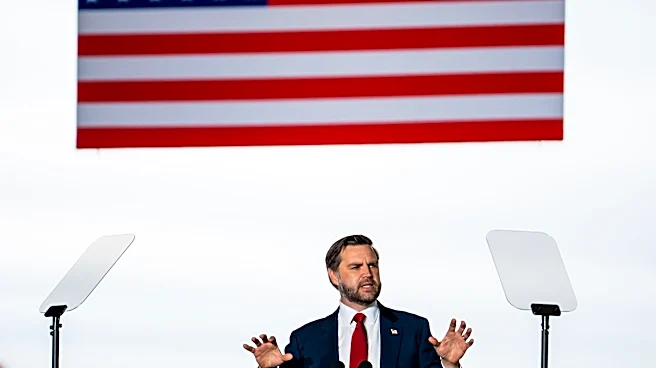





Election debacles require scapegoats, and some Republicans appear to have found the perfect one. Vice President JD Vance’s postmortem on the GOP’s midterm rout predictably laid the blame on the Trump administration policies he opposes.
Citing an unnamed pollster, he claimed that voters who have abandoned the party wanted to end the war on Iran, put America first and change the U.S. relationship with Israel
.Vance opposed the war and is one of the few Republican officeholders who are unenthusiastic about the alliance with Israel. That appears to stem, at least in part, from his close friendship with former Fox News host and podcaster Tucker Carlson, who claims Israel dragged the United States into the Iran war and has blamed the conflict on the Chabad
Hasidic movement.

More to the point, it feeds Vance’s mistaken belief that Carlson’s audience is an important GOP constituency, along with the followers of those who go further still. Those include Candace Owens, who has pushed claims that Israel had a hand in Charlie Kirk’s assassination, and Holocaust denier Nick Fuentes, leader of the Ggroyper movement, whom Carlson welcomed onto his show for a friendly interview.
The vice president made that clear in December at Turning Point USA’s AmericaFest. Days after conservative pundit Ben Shapiro called out Carlson from the same stage for hosting Fuentes, Vance refused to take sides.
He said he “didn’t bring a list of conservatives to denounce or to deplatform” and rejected “endless, self-defeating purity tests.”
He was calling for a Big Tent roomy enough for Carlson and those who share his views.
Trump pulls Vance from Iran negotiations, delivering deserved rebuke

On “60 Minutes,” President Donald Trump himself pointed to “a great dislike – incredibly – for Israel” as one reason for the GOP’s losses. That echoed at least part of Vance’s argument and left many of his supporters puzzled. But as is often the case with this president, the same interview offered plenty of support for the opposite view.
Trump defended the strikes on Iran’s nuclear program and insisted, “If I didn’t do that, there would be no Israel right now.”
Since then, Trump appears to have repudiated Vance. On Nov. 12, he pulled the vice president off Iran negotiations and ordered him to focus on alleged corruption in Democratic-run cities and states. That came after The Wall Street Journal reported that Vance had reached out to Mohsen Rezaei, one of the Tehran regime’s hard-liners, to restart talks. Trump also declared, “We don’t need a deal with Iran.”
That puts the president behind Secretary of State Marco Rubio, who argues that economic pressure is working so well, the United States doesn’t need to resume major combat. Rather than Vance’s appeasement or renewed war, the goal is to crush Iran’s economy and bring the regime to its knees.
It’s a rebuke to Vance, and Trump was right to deliver it.
Abandoning Israel is wrong – and bad politics

Breaking with Israel and its many American supporters – Jewish and non-Jewish – would be a mistake. That’s not just because it would feed the rising tide of antisemitism that has swept the globe since the Hamas-led Palestinian Arab terrorist attacks on Israeli communities on Oct. 7, 2023.
Last year was the deadliest for antisemitic attacks worldwide since 1994.
It’s also a political blunder.
No doubt the higher gas prices caused by the war with Iran hurt Republicans. But Vance’s conclusions don’t hold up. Leave aside that other factors loomed larger in the GOP defeat, among them the tariffs and the odor of corruption in government, which voters ranked as a bigger concern than high prices.
The war on Iran wasn’t popular. But the real problem wasn’t Trump’s determination to keep nuclear weapons out of Tehran’s hands, a goal most Americans still support. It was that this war, unlike the U.S. strikes alongside Israel in the 12-day war of June 2025, came to be seen as a failure.
By listening to Vance and others who seem to favor appeasing Iran, as Presidents Barack Obama and Joe Biden did, Trump settled for an inconclusive ceasefire that gave him the worst of both worlds. Like Obama’s disastrous 2015 nuclear deal, Vance’s efforts to broker an agreement with Tehran didn’t just fail. They were a fool’s errand, since Iran’s Islamist rulers see themselves as locked in a permanent war with the West.
But blaming all of this on Israel, the one ally ready to fight alongside the United States, is an equally foolish political gambit, and it has nothing to do with an “America First” foreign policy.
Trump has always been an Iran hawk because he understood that “America First” meant defeating America’s enemies as well as avoiding “forever” wars that did nothing for U.S. security. He’s also been the most pro-Israel president since the modern Jewish state’s founding, moving the U.S. Embassy to Jerusalem, because he rightly saw it as a unique strategic asset, not a liability. That makes his Election Day vow to end annual U.S. aid to Israel all the more baffling.
The GOP base still stands with Israel

Most Republican voters agree. Seven in 10 still sympathize more with Israelis than with Palestinians. Younger conservatives are another story: 57% of Republicans under 50 now view Israel unfavorably.
Like their Democratic counterparts, they have been influenced by the toxic doctrines about race that dominate the education system and popular culture, in which Israel and Jews are falsely labeled “White” oppressors. That worldview also helped skew liberal media coverage of Israel’s war against Hamas terrorists in Gaza and their Iranian sponsors, and it fed the subsequent decline in support for the Jewish state.
Carlson’s fans subscribe to a not-dissimilar worldview, built on antisemitic tropes, false conspiracy theories and noxious myths about Israel manipulating the United States against its own interests. It’s the latest example of horseshoe politics, in which the fringes of both parties find common ground. But unlike Democrats, whose anti-Israel wing won a string of high-profile primaries, Republicans have rejected at the ballot box those who believe these big lies.
By indulging such views, Vance is signaling where he thinks the Republican Party’s future lies. But he’s wrong to think he can win the presidency by mimicking the Democrats’ foreign policy, their Israel-bashing and the antisemitism that has been normalized on the left. That Israel-bashing is embodied by Sen.-elect Abdul El-Sayed, D-Michigan, who accuses Israel of genocide and has called it “bloodthirsty.”
That’s not just a matter of leaving Jews and Christian supporters of Israel politically homeless. Scapegoating an ally in ways that echo the left’s divisive doctrines will further demoralize most Republicans, who reject conspiracy thinking and want America to defeat its Islamist enemies. It will also weaken the GOP’s appeal to moderates who are unlikely to back a Democratic Party that could be in thrall to its left wing in 2028.
Notwithstanding their midterm triumph, the Democrats’ tilt toward the Democratic Socialists of America and their allies who hate Israel and the West could wreck their chances in the next presidential election. For Republicans to kowtow to their own fringe would be a moral disgrace. It would also sabotage their efforts to recover from the midterm defeat.
Jonathan S. Tobin is editor in chief of JNS.org. Follow him on X: @jonathans_tobin
This article originally appeared on USA TODAY: Blaming Israel isn't the answer to the GOP's problems | Opinion