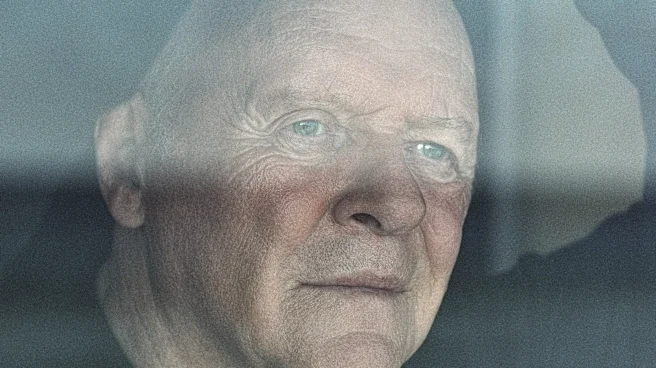



Anthony Hopkins has played villains and popes, presidentsanddictators, titans of literature and comic book kings.
But his most personal artistic endeavor is not of stage or screen, but sound.
At 88, Hopkins, he of knighted distinction and dozens of prestigious acting awards, is releasing his debut album.
Yes, this lion in winter is finally sharing with the world classical works he’s composed since his early 20s on “Life is a Dream,” out Aug. 21.
Acclaimed conductor Gustavo Dudamel – introduced to Hopkins by Bradley Cooper, who worked with Dudamel on the Oscar-nominated "Maestro" – and London's Philharmonia Orchestra performed the 12 compositions which include a three-part suite that features “Bracken Road,” inspired by his boyhood in Wales, a tranquil
piece written for his niece (“Tara”) and several inspired by his wife of 23 years, Stella Arroyave (“Farewell My Love” and “Stella Aria”).

Despite his acclaimed film career – and no worries, he’s quick to remind he has three movies coming in the next year – music, specifically the piano, was always Hopkins’ first and deepest love.
“The only language I could respond to was music. In school I was hopeless. I had no friends. I wouldn’t communicate with anyone,” he tells USA TODAY. “Music became my language.”
Calling from his home in Los Angeles, Hopkins ‒ insistent to call him Tony – is warm and erudite as he expounds on the orchestral works that spotlight the pervasive melancholy in his soul and why he views his “extraordinary” life as “one long goodbye.”
Question: You started playing piano as a child and composing as a teen. But how did you fit music into your life all these years with your prolific acting career?
Anthony Hopkins: I’ve always had a piano. I started when I was 6. I was such a dunce at school, but my father bought me an expensive baby grand in 1951. It cost £210, which was an awful lot of money at the time. I wanted to play complicated stuff, Chopin in A-flat. I went to a music teacher and she challenged me to perform them, so I would play piano five days a week.
Did you listen to any contemporary music growing up or was it always classical?
Post-war years, 1947, we used to go to the American movie theaters. The great MGM musicals flooded the British cinema market, so I was more or less listening to Sinatra, Louis Armstrong, jazz. And then I heard Harry James and his trumpet and I thought, “that’s what I want to do.”
The compositions “My Fatherland” and “Margam” are so personally rooted in your family and your humble beginnings. What did your parents teach you that still guides you today?
My father worked hard all his life. I remembered he saw my school report card and said, “You are hopeless.” And my mother said, “Leave him alone.” But because of my father’s criticism, I remember saying, “One day I’ll show you both.” Then I got a scholarship (to Cardiff College of Music and Drama in Wales) and my father said, “You’ll never make much money as an actor.” But my father also bought me encyclopedia and it had sections with musicians and composers. (My parents) had faith in me that I was going to do something.
So you have some happy memories.
All these songs and melodies are really about my childhood. I believe you can do anything if you believe you can. Just open the door and you never know. All the music on this recording, I don’t know how it quite got there.
You’ve said “The Plaza,” which is very sprightly, was inspired by your time spent in cinemas watching musicals and Westerns. Do you think your life might have turned out differently if you had never walked into a movie theater as a young man?
I honestly have no idea. It’s just the way it happened. I look back over the years and think, I couldn’t have made this possible. Something in us writes the story of our lives. I’m not a theologian, but something in the universe, the trees and the sky and the fly on the wall, they’re all part of it.
The universe does work in mysterious ways.
There is a cosmic consciousness that we are all one. We’re so busy condemning and there are so many horrors in the world. Why this hatred? We’re living in a society where everyone is up in arms all the time. I want to say, can you do better? Then shut up. What is wrong with us all? Why can’t we just have chat?
The piece “Farewell My Love” you wrote just last year for your wife, Stella. What does music allow you to sayabout love that words cannot?
I think music taps into the saddest part of ourselves. It sounds dramatic, but since we are born we begin to say goodbye to everything - the womb, childhood, adolescence. Then we become adults and everything is one long goodbye and there is a great sadness in that. The sound of the cello is the most heartbreaking sound and I use it to its maximum. I can’t really talk logically about music because it’s pure, unbridled instinct. I’ve had an extraordinary life and look at my childhood and think, how incredible I’m still here.

You’ve credited Stella with prodding you to do this album. How does she inspire you?
She found some old scripts of mine after we got married with some drawings on them and she said, you have to paint, so paint. Stop whining about it and just do it. She said, you’re a composer, just compose. We don’t get up in the morning and think, I have to get my heart going – it’s already there. So whatever it is – acting, painting, music – just do it.
“Samsara” is influenced by the Indian philosophy of the cycle of life, death and rebirth, and you say the music ends with “peaceful acceptance.” Is that how you view life now?
Yes, it is. It’s a strange thing. I wake up in the morning and look at the ceiling and say, “Is anyone in charge here?” My wife makes sure I eat healthily and I exercise. I feel OK. I move well, so why question it or bother to look for more? I have this great sense of peace. When I hear and write the music, it touches another dimension of myself. To live happy, die happy.
Is that a philosophy born out of aging?
For years I didn’t believe in myself and then I came across people who said, "Just be you, give yourself a break." Someone said, “You’re killing yourself,” and I said, “So what?” And realized that is a really silly thing to say. What a waste to throw your life away. I’m so lucky. I look back over the years and there’s a little voice in myself that says “now you can start living.” All the negatives in my life were there for a reason.

What was it like hearing Gustavo Dudamel and the Philharmonia Orchestra bring these pieces to life?
It was a breathtaking two days. I sat there like, "Did I write this?" And he said, "Yes, you did." All those musicians, every cellist, every flute player, the woodwinds. I thought good God, the discipline of technique and suddenly they’re all playing as one. They were wonderful people and Gustavo’s prodigies.
Was Gustavo always your choice to conduct?
I didn’t know him, but Bradley Cooper suggested him and contacted him somehow and a friend of ours also knew him. So we went to a session in London and it was pure joy. Such energy, no ego at all. Just a brilliant genius.
You have portrayed legends both real and fictional. But when people listen to these compositions, are they finally hearing the real you?
I think so. I hope so. There is a melancholy in it. I’m not morbid or depressed all the time, but that melancholy has always been in me. I’ve lived a fruitful life, but there’s always been a kind of heartache in me. Finally one day, we say hello, my love and goodbye, my life.
This article originally appeared on USA TODAY: Anthony Hopkins, 88, on his debut album and the surprising Bradley Cooper connection