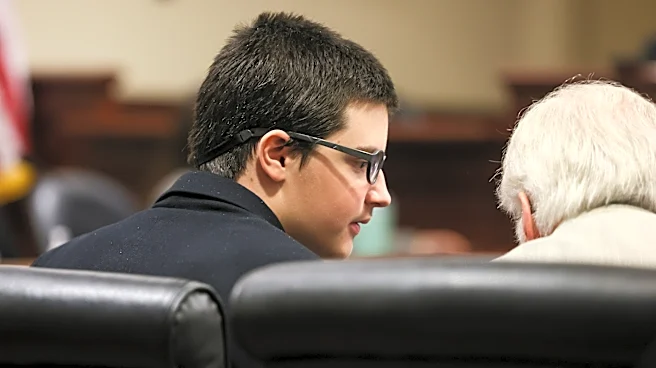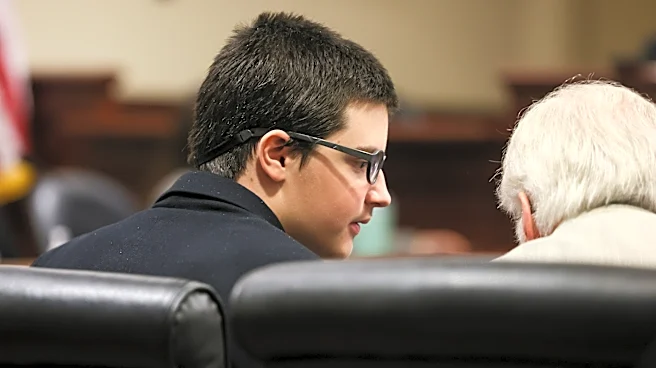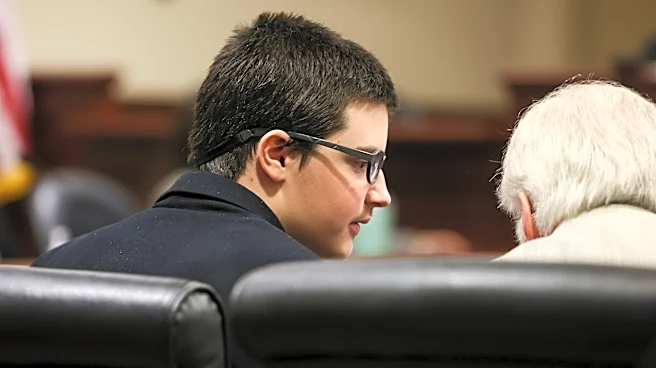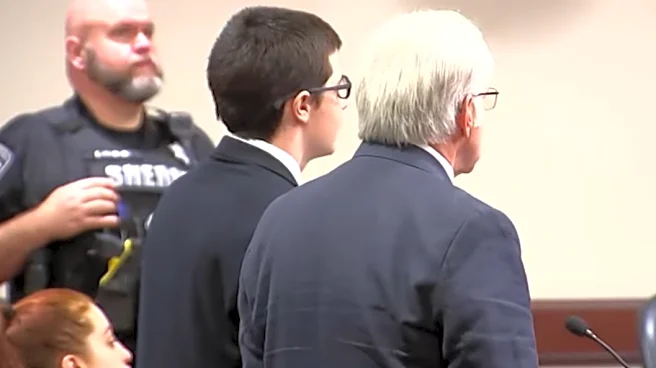








The teenager who committed a deadly mass shooting at a Georgia high school in 2024 and pleaded guilty to dozens of charges after the attack was sentenced to life in prison without the possibility of parole July 28.
Colt Gray, 16, was handed the sentence days after he pleaded guilty to 55 charges, including felony murder, aggravated assault and cruelty to children following the Sept. 4, 2024, shooting at Apalachee High School in which he killed two students and two teachers and injured nine others. Gray faced a maximum sentence of life without parole. There is no death penalty for juveniles.
Gray, who was 14 at the time of the shooting, was expected to face trial in Columbia County in October. But as the deadline for him to notify the court he wanted
to plead guilty approached, a "non-negotiated plea" − one in which the defense and prosecution have not agreed on a sentence − left Gray's sentence entirely up to Barrow County Superior Court Judge Nicholas Primm.
Barrow County District Attorney Brad Smith urged Primm to hand Gray the maximum sentence, saying he "opened fire on perfect strangers only so he could become famous," within an online community that was obsessed with mass shooters. Defense attorney Charlton Allen asked the judge for leniency saying Gray has admitted his actions and was "driven not by evil intent but by a desire to be accepted."
Primm challenged the defense's characterization, calling Gray's conduct "deliberate, contemplated evil" as he handed down his sentence.
"You wrote, 'I want to make history. I want people to remember the pain I caused,' and there you succeeded," Primm said.
Colt Gray mimicked other mass shooters, investigators say
Ashley Gillend, an investigator with Barrow County District Attorney’s office, walked through evidence obtained from Gray's devices and Discord account that she said demonstrated his obsession with and attempts to imitate other mass shooters in an attempt to achieve notoriety.
Gillend said Gray had more than 2,000 photos of the shooter who attacked Marjory Stoneman Douglas High School in 2018 on his phone and more than a dozen displayed in his room. She pointed out similarities between Gray's statements to police, journal entries and planning to those of other mass shooters.
"As a whole it didn't appear that there was any original thought from the defendant when planning the mass shooting," she said.
The prosecution also played audio clips of jail calls in which Gray encouraged his mother to look up and share information about him in the online community fixated on mass shooters that he was part of. Researcher Peter Smith testified that the group, known as the True Crime Community, was a novel form of extremism distinguished by its lack of unifying ideology. He said though the majority of participants are nonviolent, the group does have members who encourage or carry out acts of violence to gain notoriety.
Prosecutors also played clips of Gray's interviews with investigators following the shooting. Forensic psychologist Kevin Richards agreed that Gray lied to police about certain details of the attack to make the incident seem similar to other shootings, which a prosecutor described as leaving "easter eggs" for others in his online community to find.
Forensic psychologist testifies about Colt Gray's mental health
Gray's attorney questioned Richards about the teenager's mental health before and after the shooting. Richards said he interviewed Gray for about 15 hours, during which they first discussed his chaotic childhood, which was also described by Gray's grandmother and the head of the Georgia Division of Family and Children Services.
Richards said as the family dealt with financial issues and drug use, Gray grew increasingly isolated, spent most of his time online and eventually joined the community that was "obsessed" with school shooters. Richards said he reviewed more than 50,000 messages between Gray and two people in the online group and found Gray had sent ominous messages about something happening on Sept. 4. Richards read some of these messages aloud as prosecutors displayed them in court.
At the time of the shooting, Richards said Gray was struggling with anxiety, paranoia, depression and thoughts of self-harm. Under questioning by the prosecution, Richards acknowledged that Gray appeared to exaggerate his mental health symptoms at times, including claiming to experience hallucinations, in an apparent attempt to bolster a potential not guilty by reason of insanity defense at an eventual criminal trial.
After he was taken into custody, Richards said Gray never denied carrying out the shooting and said he “felt terrible about the victims." But Richards also acknowledged that Gray sent "hateful" messages about victims of previous mass shootings, including the 2018 attack in Parkland, Florida.
Barrow County Sheriff's Office Investigator Jason Smith returned to the stand briefly on July 27 and testified that investigators directed Gray to write apology letters to family members of his victims as part of their interrogation. Jason Smith said although Gray seemed "very excited to write the letters," he did not believe the apologies were genuine.
Smith said that Gray appeared extremely emotional during his initial interview with law enforcement and cried at some points, but Smith said he believed his behavior was "largely performative."
"There's a lot Colt said that wasn't true and there's a lot Colt said that was true," he said of the interview.
School shooting sentencing sparks emotional testimony
Mason Schermerhorn and Christian Angulo, both 14, and teachers Richard Aspinwall, 39, and Cristina Irimie, 53, were killed in the Sept. 4, 2024, rampage, which sent shock waves through Winder, Georgia, a small town northeast of Atlanta. Several loved ones of the victims tearfully addressed the court during a nearly eight-hour hearing on July 24, expressing anger and despair, calling Gray a coward and asking the judge to sentence him to the maximum sentence he faced under the law.
"The cruel actions of Colt Gray cost precious lives … (affected) countless victims," Apalachee Principal Jessica Rehberg told the judge. "The ripple effect will be felt for generations … For that he deserves the harshest consequences."
During the hearing, the prosecution played audio of an interview in which Gray told a detective he heard voices on the day of the shooting telling him to open fire on people in the school. Smith testified that Gray had planned the attack for some time and found the weapon used in the shooting in his father's bedroom.
Gray's sentencing comes before his father's sentencing hearing is set to begin. In March, Colin Gray was found guilty of murder and other charges for providing his son with the rifle used in the mass shooting.
During the landmark trial, Colin Gray testified in his own defense that he had no idea his son was capable of carrying out a mass shooting. "I struggle with it every day," he said during the emotional testimony.
Contributing: Natalie Neysa Alund, USA TODAY
This article originally appeared on USA TODAY: Teen sentenced to life for deadly Georgia high school shooting