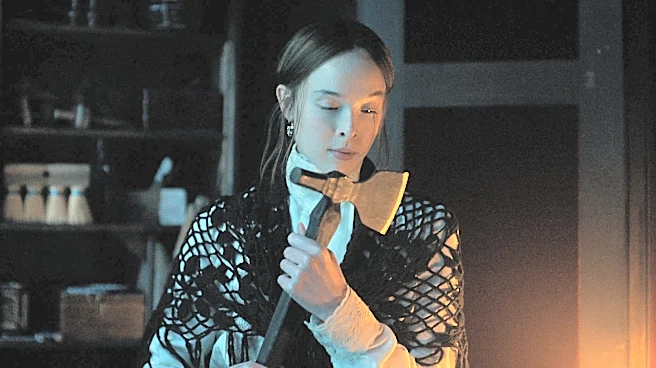









Fall is near, which means we’ve come to expect an explosion of pumpkin-flavored everything, the turning of the leaves and a new installment of Netflix’s “Monster” anthology series.
Creators Ryan Murphy and Ian Brennan have previously turned their eyes to the killings of Jeffrey Dahmer, Erik and Lyle Menendez and Ed Gein. The latest chapter, "Monster: The Lizzie Borden Story" (now streaming on Netflix), focuses on Borden and two deaths that shocked a nation: the butchering of her wealthy father, Andrew Borden, and her stepmother, Abby Borden. The pair were slain in their Fall River, Massachusetts home (about 17 miles southeast of Providence, Rhode Island) on Aug. 4, 1892. Days later Lizzie Borden – portrayed in "Monster" by Annette Bening and Warren
Beatty’s talented daughter Ella Beatty − was arrested.
Since projects inspired by true events need to be dramatized for TV, we wanted to answer the questions viewers might have about Borden.
What was Lizzie Borden accused of doing?
Contrary to the popular nursery rhyme, Andrew was struck with a hatchet 11 times on that fateful August morning, while Abby was hit 19 times.
According to Fisherman & Farmer, a newspaper out of Edenton, North Carolina that followed the trial, Andrew had fallen asleep that day in the sitting room. Abby “continued dressing, if she was not already dead,” the outlet printed in its June 16, 1893 edition.
The paper also detailed Borden’s account, in which she claimed to have stroked her father’s head on her way to a barn on the property, where she remained for half an hour. Supposedly Borden’s screams upon finding her bloodied father brought housemaid Bridget "Maggie" Sullivan downstairs. Dr. Seabury Bowen was requested, and when it was suggested that Abby be informed of the incident, her lifeless body was found.

Did Lizzie Borden kill her parents?
Borden, 32 at the time, was arrested on Aug. 11, 1892 and held in custody until the start of her trial on June 5, 1893, in New Bedford, Massachusetts. An all-male jury acquitted Borden of the slayings on June 20, 1893, based on a lack of evidence likely influenced by their own unconscious biases. (Women did not serve on a jury in the state of Massachusetts until 1950.)
Smithsonian Magazine reports that Borden “presented herself as a helpless maiden… holding a bouquet of flowers in one hand and a fan in the other.”
Fisherman & Farmer documented that during the trial, “Borden fainted after [District Attorney William H. Moody] had declared that it would be proved that she burned a dress three days after the murder of her father and stepmother and had produced in court the hatchet with which it is supposed the crimes were committed. She remained unconscious for several minutes.”
Dr. Bowen said in an interview that in the years he’d known Borden, he found her to be “a person of undisputed virtue”. He deemed her “absolutely innocent,” explaining, “I do not believe a hardened man of the world, much less a gentle and refined woman, in her sober senses, devoid of sudden passion, could strike such a blow with such a weapon as was used on Mr. Borden and linger to survey the bloody deed… I believe no human being in sane mind could perpetrate such a terrible work and then duplicate it on the floor above, taking a defenseless old woman as a victim.”
Did Lizzie Borden have a relationship with the maid?
For years, there have been rumors that Borden had a secret affair with their housemaid, Bridget "Maggie" Sullivan, and the two plotted to kill Borden's parents. The theory was even explored in Evan Hunter’s 1984 novel “Lizzie” and the 2018 film “Lizzie” starring Chloe Sevigny. The new Netflix series also suggests that the two were involved romantically. However, there's been no evidence confirming this theory.
What happened to Lizzie Borden after her trial?
The decades following Borden’s trial proved difficult, according to accounts. When reporting on her June 1, 1927 death at 66 years old from pneumonia, a Springfield Massachusetts newspaper wrote of the “hell” she must’ve endured.
“Lizzie Borden, innocent, could not have been glad she was alive these past 35 years,” “The Springfield Weekly Republican” stated. “She was a tragic figure to the end. She not only shunned society; society shunned her. Her elder sister [Emma Borden], who had stoutly supported her during the trial, separated from her. Miss Borden thereafter lived as a recluse, without friends and without seeking them.”
This article originally appeared on USA TODAY: The real Lizzie Borden story – What Netflix's 'Monster' got right about the murders