








Another case of measles has been confirmed in Georgia as the Department of Public Health says a resident of the Atlanta metro area has tested positive for the virus.
The case was confirmed in an unvaccinated person, though the age of the individual was not released.
"At this time, there is no known travel history or exposure to someone infected with measles," DPH said in a statement. "DPH is working to identify anyone who may have had contact with the individual while the individual was infectious."
The case will bring the total number of measles infections in Georgia in 2026 to seven. There were 10 total measle cases in the state in 2025, and 5 total cases in 2024, according to data from the Centers for Disease Control and Prevention.
What are symptoms of measles?
Measles is
"very contagious," according to Georgia DPH, and spreads through the air from coughs and sneezes. It can stay in the air or on hard surfaces for as long as two hours after an infected person has left a room or area.
Symptoms will start to appear between seven and 14 days after someone has been exposed to the virus, and includes fever, cough, runny nose and watery eyes. A rash of red spots also appears across your body, typically starting around your head.
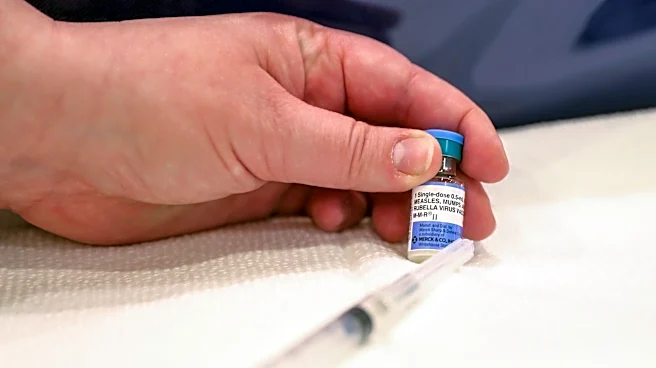
There is a vaccine for measles, as part of the MMR vaccine. The vaccine is used to fight against measles, mumps and rubella. The vaccine is typically recommended for a first dose in children 12 to 15 months old, and then again for a second dose in children between the ages of four and six. If a child is traveling internationally, it may be administered younger than 12 months.
"The vaccine is safe and effective, and parents with questions about the vaccine or the vaccination schedule can consult their physician," DPH said. "More than 95% of the people who receive a single dose of MMR will develop immunity to all three viruses. A second dose boosts immunity, typically enhancing protection to 98%. Individuals who are vaccinated with the MMR vaccine also help protect others who are too young or medically unable to be vaccinated."
If you believe you or your child may be experiencing measles symptoms, contact a health care provider right away.
Measle cases still on the rise
National cases of measles have been on the rise since 2022, with a spike in cases at the beginning of this year, according to the CDC.
Some states have experienced outbreaks, including Utah with 526 cases, Arizona with 109 cases, Pennsylvania with 280 cases, South Carolina with 670 cases and Virginia with 176 cases, as of Aug. 13.
Cases jumped significantly from 2024 to 2025.
Nationally, there were 285 measle cases in 2024. The next year, there were 2,289 cases, according to the CDC.
So far, there have already been 2,566 cases across the country in 2026, making it on track to be the highest number of measles cases in the United States since the turn of the century.
The spike in cases has come at the same time that kindergarteners are coming to school unvaccinated.
From 2020 to 2025, the number of vaccinated kindergarteners dropped by nearly 3%, accounting for 286,000 children in the United States.
In Georgia, only 86.8% of the population was vaccinated for the 2024-2025 school year, according to CDC estimates, but the state did not report vaccination coverage to the national database.
Irene Wright covers politics in Georgia as the Atlanta Connect reporter with USA Today’s Deep South Connect team. Find her on X @IreneEWright or email her at ismith@usatodayco.com.
This article originally appeared on USA TODAY: Measles case confirmed in unvaccinated Atlanta resident. What to know