


Spoiler alert! We're discussing important plot points in "The Mosquito Bowl" (streaming now on Netflix), so beware if you want to go in completely cold.
“The Mosquito Bowl” mines real-life history to craft a tale set on two different battlefields.
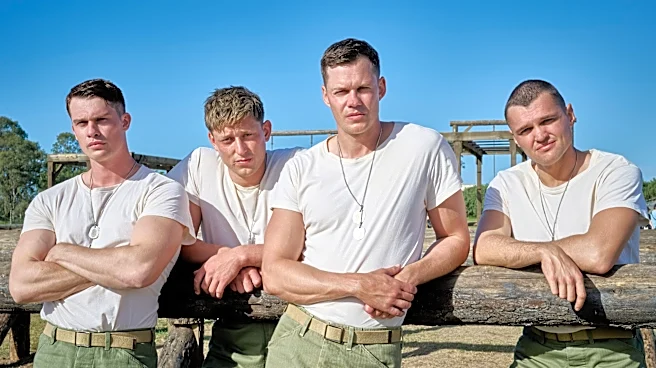
Based on the 2022 Buzz Bissinger book, the World War II drama centers on four college football standouts who join the Marines in the aftermath of Pearl Harbor. After boot camp, Brown quarterback John McLaughry (Nicholas Galitzine), Purdue running back Tony Butkovich (Ray Nicholson), and Wisconsin defensive players Dave Schreiner (Tom Francis) and Bob Bauman (Bill Skarsgård) are sent to the Pacific Theater to fight Japanese forces. They are among the young men who play in a morale-boosting 1944 Christmas
Eve game on the mosquito-infested island of Guadalcanal, just months before the deadly Battle of Okinawa.

Bissinger’s book “could have worked if he had picked soccer players, young doctors, poets, anyone that goes into war,” director and cowriter Peter Berg says. “The football was an added bonus to me, because I appreciate it and understand it, but this is much more than a football film.”
Berg acknowledges that the movie version condenses timelines and changes some things around in a historical context. For Bissinger, a "Mosquito Bowl" executive producer whose 1990 “Friday Night Lights” book was also adapted by Berg, that fictionalization was needed. He spent five years writing his book, “so to encapsulate that in a two-hour movie with so much else going on, I was blown away. And I don't like giving out compliments.”
Bissinger and Berg break down fact vs. fiction in “The Mosquito Bowl”:
Was Tony Butkovich really drafted into the NFL by the Cleveland Rams?

The beginning of the film shows how all four football players wind up going into the Marines after their playing careers, and “Touchdown Tony” Butkovich is widely known as the best of the best. He’s drafted by the Rams but goes off to war instead of playing pro ball.
In real life, all four of the main characters were drafted. Butkovich went No. 11 overall in 1944 to the Rams, while in the 1943 NFL draft, Schreiner was picked No. 11 by the Detroit Lions and Bauman was chosen in the 24th round by the Chicago Bears. McLaughry was drafted by the New York Giants in the third round in 1940 and played one season as a pro before joining the Marines.
Berg now wishes he'd put a note at the end of the movie to point out McLaughry's short NFL career. “I happen to be a big Giants fan, that’s my team,” Berg reveals. “John McLaughry was a very good football player. He was not at the level of Tony Butkovich.”
Did Tony Butkovich and Dave Schreiner have an intense rivalry?

“The Mosquito Bowl” starts with an epic game where Butkovich’s undefeated Boilermakers take on Schreiner and Bauman’s Badgers. Butkovich notches a climactic touchdown, breaking the Big Ten scoring record and winning the game. It leaves a bad taste in Schreiner’s mouth, and as they go off to war, the outgoing Butkovich doesn’t let the more serious Schreiner forget it. Despite early personality conflicts, the guys ultimately become friends and comrades in arms.
In this instance, Berg added some extra drama to each man’s character arc: Schreiner’s last season at Wisconsin was in ’42, but Butkovich didn’t make history until a year later during his one and only season at Purdue. “If I'm Dave Schreiner and you're Tony Butkovich and you come into my stadium, and aim to set a national touchdown record against my team, on my field, in my stadium, with my family watching, and you succeed in that, I find it hard to imagine how there couldn't be some rivalry,” the director says.
Was there actually a Mosquito Bowl played during World War II?

In the movie, the members of the Marine 4th and 29th regiments are stationed at Guadalcanal when a dustup between Schreiner and a couple of disrespectful soldiers leads to a brawl. He and Bauman are sent to their commanding officer, but instead of being punished, they’re tasked with putting together a football game on Christmas Eve. Former players play against each other in one last moment of glory with the pigskin, and a rough-and-tumble game ends with a tie and many happy faces.
To detail this “serendipitous” scrimmage (which did occur on Dec. 24, 1944) for his “Mosquito Bowl” book, Bissinger spoke to survivors who had been in Okinawa and wrote books about their experiences. (Bissinger's own father served in the 4th Regiment.) “I wanted to get as close as I could get to the real thing,” he says. “That game was about joy. And that really came through as a viewer. If you have a sense of what's going to happen, you love how they play, you love their spirit, but inside, it's going to be sad what happens afterward.”
Did college football standouts die at the Battle of Okinawa?

The movie climaxes on June 1, 1945, at the Battle of Okinawa, where the Marines engage in a firefight with the Japanese. Butkovich, Schreiner and Bauman die while McLaughry survives. That’s mostly what happened in real life as well, though in a condensed manner. Fifteen of the 65 Mosquito Bowl players perished in Okinawa, a battle that lasted from April 1 to June 22, 1945. Butkovich was killed in April, while Bauman and Schreiner died within weeks of one another in June. McLaughry wound up coaching college football after the war, including at his alma mater, and lived until age 90.
“War is brutal and there's no way around it,” Bissinger says. “And frankly, in the hands of some other filmmakers, they would have said, ‘Oh, you know, too many people died then. Let's have them live, let's have them live happily ever after.’ And there was no compromise on that, thank God.”
Contributing: Heather Bushman, Indianapolis Star
This article originally appeared on USA TODAY: Did 'The Mosquito Bowl' really happen? We fact check the Netflix film