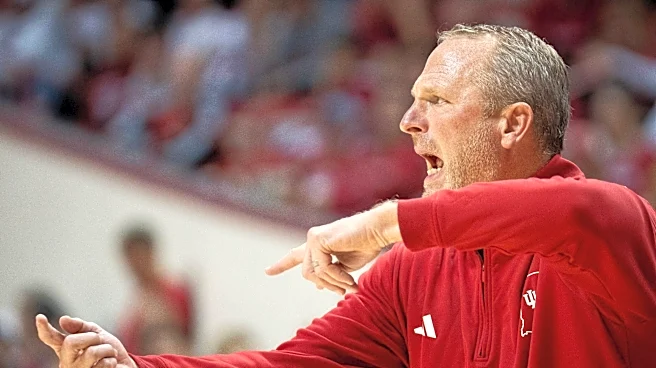

It took Darian DeVries one disappointing season to raise doubts at Indiana.
It may have taken 72 hours to start erasing them.
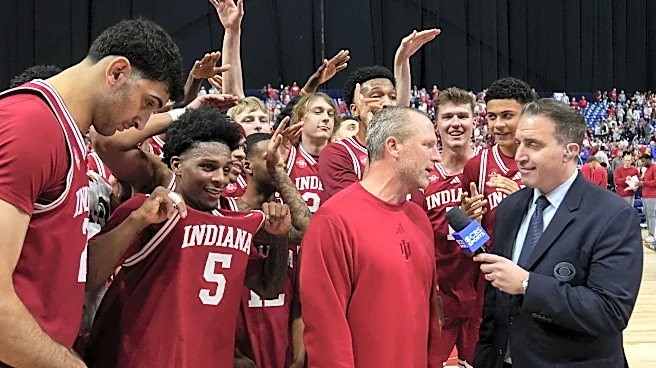
Few teams in men’s college basketball had a better week than Indiana, which improved to 6-0 with two victories against SEC opponents and offered early signs its second-year coach has the program headed in the right direction.
First came an 81-76 victory over then-No. 23 Arkansas under the bright lights of Madison Square Garden on Nov. 16. The Razorbacks were the highest-ranked team Indiana had beaten away from home in four years.
Three days later came an even more meaningful
statement: a 90-76 triumph over rival Kentucky before 23,078 fans at Lucas Oil Stadium.
For the first time since 2002-03, Indiana is unbeaten with three victories over high-major opponents through six games. By Monday, the Hoosiers will almost certainly be ranked in the top 25 of the USA TODAY Sports Coaches Poll.
The hot start isn't just a product of what Indiana has done over the season’s first three weeks. It reflects what DeVries and his staff did away from the court during the previous eight months.
After being hired away from West Virginia to replace Mike Woodson in 2025, DeVries endured a disappointing first season in Bloomington. Indiana went 18-14, its fewest wins in a full season in eight years, and collapsed down the stretch, losing six of its final seven games. Five of those losses came by double figures.
That team had one of the country’s most explosive scorers in Lamar Wilkerson, but glaring holes elsewhere that Big Ten opponents exploited. Tucker DeVries shot well below his career averages and at times appeared out of shape. Point guard Conor Enright played hard but had obvious limitations. Indiana attempted 3-pointers at a higher rate than all but 13 Division I teams, yet ranked just 138th nationally in 3-point percentage.
Most glaringly, Indiana was small.
Of the six players who averaged at least 20 minutes per game, only one stood taller than 6-7. Physically, it looked more like the kind of roster DeVries might have fielded at Drake than one built to withstand the Big Ten.
This offseason, DeVries didn’t merely recognize the problem. He attacked it.
DeVries and Ryan Carr, Indiana’s first-year executive director of basketball, added much-needed backcourt scoring. Markus Burton arrived after averaging 19.1 points per game over three seasons at Notre Dame. Bryce Lindsey had been one of the top scorers on a 24-win Villanova team. And Indiana took a worthwhile flier on Darren Harris, a former top-40 recruit buried in Duke’s crowded backcourt.
The payoff has been immediate.
Harris leads Indiana at 14.5 points per game. Burton is averaging a team-best five assists and has made nine of 16 3-pointers. Lindsey is second in scoring at 13.8 points per game, scored a team-high 20 off the bench against Kentucky and buried a 32-footer with 25 seconds left to break a 76-76 tie against Arkansas.
But more scoring wouldn't have mattered nearly as much if Indiana remained too small to compete with the country's best teams. DeVries addressed that, too.
Aidan Sherrill, a versatile seven-footer who averaged 11.1 points last season at Alabama, was perhaps the biggest prize of Indiana’s top-10 transfer class. He’s averaging 11.8 points, 5.7 rebounds and 1.2 steals while shooting 50% from the field and 47.1% from 3.
And nothing signaled Indiana’s emphasis on size quite like 7-2 Turkish big man Samet Yigitoglu, a SMU transfer averaging 10.7 points and a team-high 6.5 rebounds.
The difference has been dramatic.
Through six games, Indiana ranks 16th nationally in offensive rebounding percentage, grabbing 41.8% of its misses. Last season, the Hoosiers grabbed just 26.9% of available offensive boards, ranking 298th among 365 Division I teams.
Against Kentucky and Arkansas, Indiana held a combined 29-17 edge on the offensive glass and scored 39 second-chance points. Sherrill was especially imposing against the Wildcats, finishing with 16 points, seven rebounds, including three offensive, and two blocks as Indiana bullied Mark Pope’s team inside.
There is reason for restraint. Indiana started hot last season, too, winning its first seven games before going 11-14 the rest of the way. But only one of those seven victories, against No. 83 Marquette, came against a KenPom top-100 opponent.
This feels different.
Victories over Arkansas and Kentucky have shown this Indiana team at least has the potential to take the much-needed step forward DeVries needs in Year 2, and to show why he can succeed where so many of his immediate predecessors in Bloomington could not.
For a proud program in a basketball-mad state, one with five national championships but no Elite Eight appearance since 2002, that’s a welcome development.
The Hoosiers aren’t back. There are months, and probably years, ahead to determine that.
But for the first time in a while, they look like they might be on their way.
This article originally appeared on USA TODAY: Indiana basketball’s perfect start feels different. Here’s why you should believe it