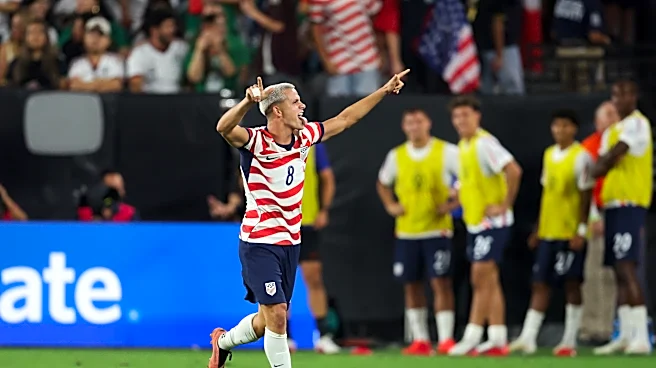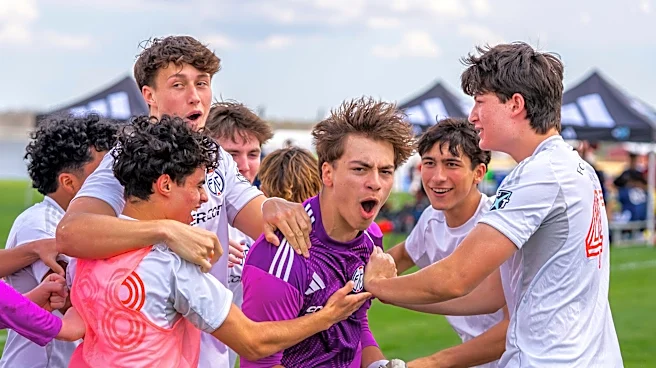








USA TODAY Sports spoke with the U.S. Soccer Federation and Major League Soccer about the state of the American youth game and the pipeline to the top following last summer’s World Cup. Since its Round of 16 finish, the USMNT has gone 4-0 in fall friendlies and plays next in the Concacaf Nations League two-legged November quarterfinal series against Haiti. The USA has been boosted by an influx of youth .
We explore how to create opportunities for every young soccer player so they can find their personal path.
Part 1: Three ways to improve a kid’s youth soccer experience from the beginning
They are familiar journeys. Some would say they’re idyllic.
You grow up playing soccer locally, in one case in Ohio, perhaps within kicking distance from your front
door.
You matriculate into the club level, joining a team when you are ready and then rise to a high level of the sport. You wind up engaged in it for life.
"I made sure that I retained a deep connection to soccer in myriad ways," says Dan Helfrich, chief operating officer of the U.S. Soccer Federation. "One of the things that I feel deeply passionate about is that all forms of the game in all contexts can provide value. When I say all forms of the game, I mean small-sided and futsal and beach and 11 v. 11. And when I say all context, I mean soccer focused on those in a particular community."
After he played Division 1 soccer at Georgetown and pursued a career in business, Helfrich got involved with Street Soccer USA, which uses the sport to uplift lives of people down on their luck. He coached a team of men in the Homeless World Cup, which he said was "one of the more fulfilling experiences in my life."
He joined U.S. Soccer in January and is a father of four who has experienced the parenting part of the landscape from youth through college.
The roots of Ali Curtis, a father of a high school player himself, were mostly in Michigan, around a collection of immigrant families.
“They came from countries where soccer was really the main or the only sport that was played,” says Curtis, who reached Major League Soccer as a player and, after a stopover at J.P. Morgan, returned to MLS to work in team front offices and as president of MLS NEXT Pro. “And so, their parents passed the love of the game to their kids.”

The picture of kids' soccer today is muddled by a high-priced system that dominates most youth sports and, as Helfrich describes it, a “spider web of a club and academy landscape for competitive players.”
It’s the American model that led into last summer’s World Cup, which saw the U.S. men’s team reach the round of 16 before falling to Belgium. Helfrich and Curtis insist we can do better, not only at the World Cup, but in improving access to kids at the grassroots level, giving them experiences that develop their passion and a chance to dream about what might be next for them within the game.
“How do you create a more aligned, integrated system (where) players and their families can enjoy competitive, meaningful games without traveling extraordinary distances for practice and for matches,” Helfrich told USA TODAY, “that the cost of participating in both time for parents, and in cost for travel, become prohibitive for many people? Those are the questions we are seeking to ask ourselves. We believe we can design a new system where those things are far more accessible and far more affordable than they are today.”
Limit the 'travel': Youth soccer players can start, and continue, to play close to home as they advance
Helfrich boils down his objectives with U.S. Soccer to three goals. His first two: Put the country in position to win major tournaments on the world stage, including the World Cup; and “create a sense of belonging and ownership for the sport’s future” in all of its participants, including families, fans, players, referees and coaches.
His No. 3, and North Star, gets to the heart of why so many people say youth sports is broken: Make soccer the No. 1 sport played in every community in America.
The goals are intricately connected. When something is a grass roots issue in a country, it can eventually become a national team issue. When asked how close we are to finding the best kids for the national stage, and not just the ones who can afford to pay to get into the pipeline, Helfrich points to the local level.
“We are excited about the experience and background and stories of our youth national teams and senior national teams of both the men's and women's side,” he says. “When you understand the stories of the individuals, you see a lot of different backgrounds and stories and we think that's a great thing.
“However, we have a ways to go to create the access and the affordability required for even more of the highest potential players to start the sport, continue in the sport, and then reach their full potential, and that drives us every day.”
He points to the vast majority of players on the latest senior men’s national roster who are products of domestic academies. Adri Mehmeti and Julian Hall, who scored in each of his first three USMNT appearances, are from New York City and Red Bull New York Academy.
Fellow teenagers Cavan Sullivan and Neil Pierre (Philadelphia Union); Justin Ellis (Orlando City SC); and Peyton Miller (New England Revolution) hail from the state or vicinity of their academies. It’s how their particular MLS academy system is designed to work.
But how do other kids rise on the soccer ladder? While MLS academies are fully funded, local clubs throughout the entire youth sports environment charge thousands of dollars per year.
“I think cost is a material issue that affects retention in the sport,” Helfrich says. “It's addressable via rethinking of structures that add costs of both time, commuting and traveling, which often involves multi-hour car and plane rides and multi-$100 hotel rooms. That is far more standard in the operation and life of a competitive youth soccer player than we believe it needs to be.”
Sports start at the local level for kids – at the park down the street or maybe the field complex a few miles away – but can quickly drift farther away with the lure of teams at young ages that often promise better competition, for a price. But how often have you played a so-called “travel” team from your town or vicinity at a location two or three hours away?
U.S. Soccer is focused on building soccer programming in schools – whether it be in P.E., after-school programming or school-based teams - and in local parks and recreation departments. They are places, Helfrich says, where soccer isn’t available consistently enough.
But Helfrich says it's thriving in Los Angeles – a result, at least in part, of low-cost programming choices by the city’s Parks and Recreation Department.
“The funnel should be way wider if you're introducing the game in places where kids already are in the age 4 to 7 or 8 time frame,” Helfrich says. “Then, the question of access and affordability becomes for a subset of players that want to continue in more of a grassroots recreational journey: how are there enough places to play? And for those who have decided that they have the interest in progressing down a more competitive path, how do you create the conditions for more and better coaching for more and better programming in a wide array of communities?”
Ensure kids have a personalized experience - and a sense of purpose - to carry them through their sport
MLS NEXT, a competitive structure that begins at the under-13 level, has Homegrown and Academy Divisions. Each are invited to a national championship but are structured, according to Luis Robles, MLS NEXT's general manager of sporting operations, based on geography.
In Tier 2, the Academy Division, Robles says MLS is focused on keeping drives to games no more than two hours, but mostly about 45 minutes to an hour away.
“Luis and the team have done a really good job over the last couple years trying to evolve our competition to make it more efficient,” says Curtis of MLS NEXT Pro, which bridges the league’s youth programming to MLS first teams. “One of our goals in MLS NEXT is it needs to work for the player, the coach, the club, the family. It's very player-development centric, but at the same time, it still has to be accessible and work for all the people that are involved.”
You don’t need to go great distances to find your child’s passion for a sport. We have gotten caught up in the notion of a “travel” team as a status symbol for our kids. But we get better with reps, not miles.
The less time they spend traveling, the more they can spend playing and practicing on a field closer to home. Those beginning stages also are where we develop our love of the game that carries us through when it gets harder.
Curtis also played baseball and basketball while growing up. But when he began to challenge himself locally and regionally in soccer clubs, just far enough away to see how he stacked up with other kids (and see how far he still had to go), all he wanted to do was play soccer.
Everyone’s journey, though, is a little bit different.
“As it relates to my own kids, I want them to be happy, and I want them to have an experience that they'll look back on and be proud of,” he says. “I'm still friends with some of the players that I played with since I was 12 years old, and so I want that for my son.”
Curtis’ 16-year-old son competes in Tier 2 of MLS NEXT, or the Academy Division, which allows boys to play high school soccer, which his son wants to experience.
“I go through a lot of the same decision points as other parents,” Curtis says. “Where is he gonna play and how does that impact our family in terms of how far training is from our house and how does that affect his schooling? At the end of the day, you want your kid to be within a team where he can make friends and that he's got a coach that can support him in all ways – not just as a soccer player, but also emotionally.
“I believe that kids should be kids and do what they love. And I think that when you do what you enjoy, then you excel at it in all ways, not just on the court or on the field, but emotionally and psychologically and intellectually.”
Understand that every player has a different development path
Helfrich has two pieces of advice for young and aspiring soccer players and their parents.
“Realize the journey is individual and don't be in a hurry to take the path that someone else has told you is the only one to achieve your potential,” he says.
He emphasized an issue parents often don’t fully grasp: If their son or daughter is the fastest and strongest kid on the field in youth soccer, and even up to early teenage years, it doesn’t mean they will continue that way.
“It's really important that the pathways (for advancement) are open,” Helfrich says, “and parents understand that their kids' journey is likely to be highly varied from others that they've seen, and they need not be in a rush to get into X environment or on X team because that's the only way to be seen. It's our job as U.S. Soccer to make it clear that our eyes are gonna be very wide and they're going to remain wide for much longer.”
To help counteract players who develop faster than others, MLS NEXT has instituted Quality of Play rankings to evaluate players on defensive and off-the ball-actions and other measurables besides goal-scoring and brute strength.
“At the end of the day, we all want to win a World Cup,” Curtis says, “and so to the extent that we can identify more players, we can have development programs that can service all, that our players come from all different backgrounds and we’re in all in all different communities, I think that we will only be served better.”
The July 19 World Cup Final, played at MetLife Stadium in East Rutherford, New Jersey, was the most-watched English-language broadcast of any sports program outside of NFL games since 2016. That happened when 40 million viewers tuned in to watch Game 7 of the World Series.
It showcased the potential of the sport.
“We have our eyes on the 2028 Olympics and the 2030 World Cup and we think we have a core of players, including young players, that are gonna be important parts of that path, but it's also important to say that as U.S. Soccer, we have our eyes on the changes and evolution of the system that will result in a better pool of players for a World Cup in 2050,” Helfrich says. “It's our job to devote as much energy to planning for the conditions that create the team in 2050 to be prepared to win a World Cup as it is to optimize the road to 2030.”
But is it an environment where late bloomers don’t get left out of national team consideration? Or even one where a kid can develop a passion in recreational soccer, continue to play rec soccer longer than most peers, yet still find a place in the more competitive club pipeline?
Helfrich was asked if he believed there was still a place for this type of kid.
“We have to believe it because we know that physiologically, kids develop at really different rates,” he says.
Part II coming next week: How does the path to the USMNT work, and how can we widen it?
Steve Borelli, aka Coach Steve, has been an editor and writer with USA TODAY since 1999. He played baseball in high school, rowed in college and spent 10 years coaching his two sons’ baseball and basketball teams. He and his wife, Colleen, are now sports parents to a college and high school baseball player. For his past columns, click here
Got a question for Coach Steve you want answered in a column? Email him at sborelli@usatoday.com
This article originally appeared on USA TODAY: What's the 'right' path for a youth soccer player? Why parents shouldn't rush the journey