






A reader, Edward Robertson of Texas, responded to a story we wrote recently about a $130 national fee for electric car drivers that Congress is considering imposing as soon as December. We took a deeper dive to attempt to answer his questions. If you have questions about anything you read in our coverage, email me at klaing@usatodayco.com and I'll do my best to answer. You can also subscribe to our Cars newsletter here.
Robertson raised two points as he asked us to explore the topic of the proposed national EV fee further. First, he said "states are already imposing their own fixed fees on EVs," noting that he already pays a $200 registration fee for his EV in Texas. Secondly, he added, the proposal calls for "flat fees rather than being use-based
fees like the gas tax."
"That means that I have to pay them even if I do not drive the car at all," Roberston wrote. "They should be based on my annual odometer reading at registration (based on my annual inspection documentation) to calculate a gas tax equivalent using a reference mpg figure - say 30 mpg.
"These EV fees are arbitrary, excessive, and unequal," he added. "And to add insult to injury, I already pay taxes on the electricity that is used to 'fuel’ my EV. Furthermore, by driving an EV I am also reducing the amount of pollution emitted. I demand equal treatment."
Why is Congress considering adding an EV fee?
Congress is considering adding an EV fee because lawmakers have struggling to come up with news ways to pay for road construction as receipts from the federal gas tax that has historically funded them dwindle.
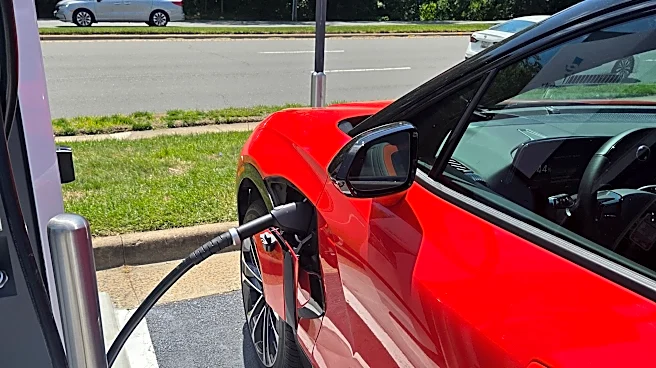
The federal government currently collects 18.4 cents per gallon on every U.S. gasoline purchase to help pay for road and transit construction projects, and most states also tack on their own fees. EV drivers don’t pay that tax because their vehicles don’t use gasoline.
Money collected from gas-car drivers through federal fuel taxes goes into the U.S. Department of Transportation’s Highway Trust Fund and is then distributed to states to help pay for road and transit construction projects. As cars have become more fuel-efficient and more drivers have opted for EVs and hybrids, less money per mile driven has been collected, despite increased use of roads. Lawmakers have looked for ways to close that growing gap in federal gas tax revenue.
The federal gas tax hasn't increased since 1993, and it brings in about $40 billion a year at its current level, according to the Tax Policy Center. President Donald Trump and some lawmakers in Congress have recently proposed suspending the federal gas tax as the average price of gas hovers around $4 per gallon, according to the AAA Auto Club.
The federal government typically spends about $60 billion on transportation projects, and infrastructure advocates say that amount is just enough to maintain the nation's roads and transit systems. Most states also levy their own gas taxes to fund local road projects.
Supporters of the proposed fee say it's time for EV drivers to contribute to the fund that helps pay for the upkeep of the roads they use. Rep. Sam Graves, a Republican from Missouri who chairs the U.S. House Transportation Committee, said in a statement that the EV fee "ensures that electric vehicle owners begin paying their fair share for the use of our roads."
Why is Congress not considering a mileage-based fee for road construction?
Mileage fees have been floated by infrastructure supporters as a potential replacement for the gas tax before.
Vehicle miles traveled (VMT) programs tax drivers based on miles they drive on U.S. roads instead of how much gasoline they purchase. Mileage-based road tax proposals have long been controversial in U.S. transportation funding debates because critics question how the government would monitor drivers' traveling habits without infringing on their privacy.
A number of states, such as Oregon, Pennsylvania, Utah, Hawaii, Virginia, and Colorado, have adopted mileage fee programs, but thus far Congress has been unwilling to do so. As gas tax receipts have dwindled, Congress has resorted to transferring money into the Highway Trust Fund to make up for the shortfall rather than raise the fuel levy or adopt a controversial mileage menu.
Supporters of the current proposal note that the EV tax proposal would involve no tracking or reporting from drivers about their travels. EV owners would simply pay the $130 annual fee upon registering their vehicles each year.
What do EV drivers potentially have to pay in state and federal fees?
The national gas tax money only pays for federally funded road construction projects, which are usually related to the upkeep of the interstate highway system.
States have their own roads, which they need to raise money for to maintain and improve. Even for gas car drivers, states usually tack on their own taxes on top of the 18 cents per gallon the federal government charges. The average state gas tax that gets tacked on at the pump is 33.8 cents per gallon, according to US Gas Gauge.
Robertson argued that a mileage-based fee approach would be more fair.
"To be clear, I am fine with paying my fair share of taxes to support road infrastructure development and maintenance, but these fees are arbitrary and unfair," he wrote, nothing that in three years of owning an EV, he has traveled less than 6,000 miles, "but I have paid $600 extra for the Texas EV registration fee."
"Either that, or eliminate the gas tax and charge all passenger vehicles the same flat fees at the state and federal levels," Roberston said of the proposed mileage fee. "As long as I am being treated equally and fairly, then I can deal with that."
A lot of EV supporters agree with him that a national fee targeting plug-in model drivers would be unfair.
Electric vehicle owners save an average of about $8,811 in ownership and maintenance costs over 200,000 miles compared with owners of best-selling gas-powered vehicles in the same class, according to Consumer Reports.
A driver who opts for a new or used EV could save $2,200 annually on gas, according to the U.S. Department of Energy. Hybrid drivers can save $1,500 on gas each year, according to the agency.
EV supporters have argued that additional annual fees increase the cost of owning an electric vehicle.
When state lawmakers in South Carolina were considering a new user fee for EV owners of 4.5 cents per kilowatt-hour on electricity consumed at publicly accessible charging stations, the Electrification Coalition, which lobbies for EV-friendly policies, said in a February 2026 statement that the state's proposal "imposes significant additional costs on EV drivers."
Keith Laing is an automotive reporter on the National Trending Desk at USA TODAY. Contact Keith at klaing@usatodayco.com.
This article originally appeared on USA TODAY: A reader asked why Congress wants to add EV fees. We looked into it.