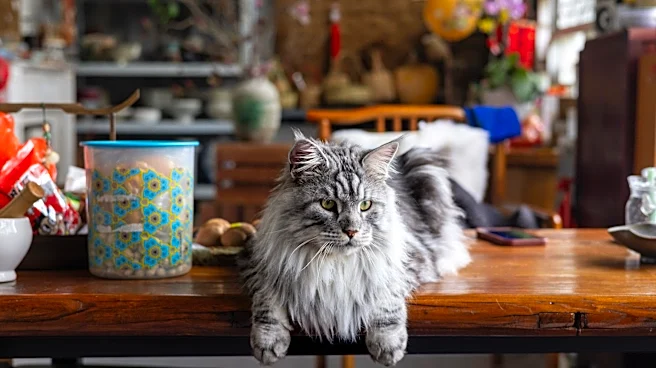








A Maine coon can look a little like a creature designed for a storybook winter: Towering ears with wispy tufts, massive paws, a shaggy coat and a tail that seems built to wrap around its body like a scarf.
But the breed’s appeal goes beyond its unusually large size and distinct appearance. Maine coons have become popular for their playful, sociable reputation, distinctive chirps and trills and their deep roots in New England history.
That being said, they’re not necessarily the low-maintenance “gentle giants” social media makes them out to be. Their size, coat and potential health concerns mean future owners should understand what living with a Maine coon actually involves.
One of the biggest cat breeds
Maine coons are widely considered one of the largest domestic cat breeds.
The International Cat Association (TICA) said the weight of a mature male averages between 13 to 18 pounds, while a female can range between 9 and 13 pounds. The Cat Fanciers’ Association (CFA) listed a slightly lower average ranges— about 12 to 15 pounds for males and 9 to 12 pounds for females — while highlighting that some males can weigh more than 20 pounds.

Breed standards describe these substantial cats as having a muscular, rectangular body with a broad chest, large paws and a long, flowing tail. The cats’ large ears, often capped with lynx-like tufts, and their broad, squared muzzle are notable features of their unique look.
Maine coons also take their time growing up. The CFA website said the breed often does not reach full development until age 3 or 4, while TICA said full maturity may take three to five years.
That long growth period is worth remembering for perspective owners drawn in by photos of enormous adult cats. A Maine coon kitten will not stay kitten-sized for long, but it may take years to reach its full build.
Built for a New England winter
The breed originated in Maine, as the name suggests, where it has been the official state cat since 1985. TICA described the Maine coon as the only native longhaired American breed among pedigreed cats.
Its physical features reflect that cold-climate heritage. Maine coons have a heavy, semi-longhaired coat that is shorter around the shoulders and longer around the ruff, underbelly and hindquarters, according to TICA. Their big paws may have bits of fur growing between their toes, and their tails are long and bushy.
The familiar brown tabby may be the look many people picture first, but Maine coons come in numerous colors and patterns, including solid colors, parti-colors and shaded or smoke varieties, according to CFA breed materials.
Despite a common origin myth, Maine coons are not descended from raccoons. TICA called that idea "biologically impossible," and the CFA echoed that sentiment, saying theories involving raccoons or bobcats aren't based in reality. Breed histories generally point instead to local cats interbreeding with longhaired cats brought to the region by sailors or settlers.
Not every Maine coon is alike
The Maine coon’s personality is another major part of its appeal.
The CFA described the cats as sociable, loyal and intelligent, while TICA called them gentle, friendly and playful. Some may learn tricks, play fetch or accept leash training.
They are also often associated with special sounds. Rather than relying on a mere meow, Maine coons are known for chirps, trills and purrs; however, the CFA noted that they are not necessarily a very vocal breed.
As with any breed, those descriptions are tendencies, not guarantees. An individual Maine coon’s temperament depends on genetics, socialization, life experience and its home environment. A cat can be affectionate without being a lap cat, playful without wanting to walk on a leash, or social while still preferring a quiet household, breeders said.
Grooming and health matter
A Maine coon’s lush coat requires diligent upkeep.
TICA said grooming needs vary with the coat’s texture: a silkier coat may need less maintenance, while a thicker coat can require daily combing to prevent tangles. The CFA recommended brushing or combing your Maine coon's coat at least a couple of times a week.
Future owners should also account for the practical realities of a larger cat, including appropriately sized carriers, litter boxes and scratching posts. Routine veterinary care and maintaining a healthy weight are important for all cats, but even more so for a large-bodied breed.
Maine coons can be predisposed to inherited health conditions. The CFA identified hypertrophic cardiomyopathy (HCM), a disease of the heart muscle, and hip dysplasia among conditions breeders may screen for.
TICA said responsible breeding practices may include genetic testing as well as periodic echocardiograms. Genetic testing can be useful, but TICA cautioned that it does not identify every mutation associated with HCM.
For someone considering a Maine coon, it’s important to ask detailed questions and prepare thoroughly before taking one home. A responsible breeder or rescue should be ready to discuss a cat’s health history, veterinary care, temperament and the breed’s needs — not just its size or its photogenic ear tufts.
For the right household, a Maine coon can offer an impressive presence, a playful spirit and a little chirp that makes home feel less quiet.
This article originally appeared on USA TODAY: Maine Coon cats: What to know about the big, fluffy breed