





AI-generated posters are everywhere and graphic designers are fed up.
As people use artificial intelligence software like ChatGPT to create fresh headshots for LinkedIn or playful caricatures to share on Facebook, small businesses are turning to the technology to churn out social media posts, event flyers and sandwich board signage. But graphic designers who make a living off this type of work say these AI-generated visual assets taking over social media and shop windows are slop.
"I think we're neglecting the fact that human care is something you can see and people value," Jesse Tyler, partner at branding studio All True, told USA TODAY. "If you want to promote your event or do something in Sharpie on white printer paper, to me, that's better
than letting a computer generate something generic that you put no thought into."
For many, AI-generated posters are easy to identify because they feature the same design elements. The posters are often overcrowded with text and iconography, making it difficult to distinguish the most important information, Nick McGraw, owner of marketing agency McGrawesome Design, told USA TODAY. AI-generated posters tend to lack hierarchy, he said, the arrangement of elements in a design to guide viewers from most to least important information.
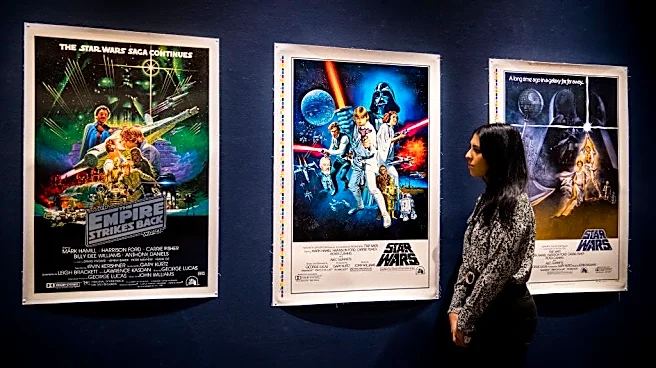
McGraw provided the original 1977 "Star Wars: Episode IV − A New Hope" movie poster as a good example of design hierarchy.

"Darth Vader and the Death Star are the biggest, most looming elements of that poster. So you're seeing that and you're going, 'Okay, he's going to be a main character,'" McGraw said. "Then you see Luke in the foreground and there's contrast around the lightsaber and you're like, 'Okay, he's going to be meaningful too.' And then there's secondary characters around them. That's called hierarchy."
Fonts are also a "glaring" giveaway of an AI-generated poster, Mika Reyes, founder of social media API Adeli, told USA TODAY. She said most AI-generated posters use the same font families, sizes and weights, and one of these posters may have three to five different fonts featured on them.
As more AI-generated posters pop up in communities, graphic designers are taking a stand on why small businesses should think twice before using the technology.
Why are small businesses turning to AI-generated posters?
USA TODAY reached out to several small businesses, including restaurants, car washes and cosmetologists, that shared AI-generated posters on social media. Though none of the businesses responded, graphic designers echoed one another about why business owners may be turning to AI-generated posters. The short answer? Time and money.
Working with a marketing agency or independent graphic designer can be costly. All True in Springfield, Missouri offers a variety of services, from name and logo creation to website design and tailored brand strategy for increased audience reach. Most clients spend between $10,000 to $15,000 for branding project with the studio, Tyler said. But smaller projects can start in the low thousands and bigger ones can be over six figures.

McGraw told USA TODAY on average, Ontario-based McGrawesome Design clients spend $6,000 to $10,000 Canadian dollars (about $4,200 to $7,000 USD) for a custom-built website. His lowest web design package − an AI-generated website prompted by McGraw that can be ready in 48 hours − starts at $1,000 (about $700 USD), he said.
Joe Perpetua, owner of Connecticut-based marketing agency Hyperview Creative, offers social media management, website design, tailored email marketing, branding strategies, content creation and SEO development. Perpetua told USA TODAY that a one-off design project, like a logo, flyer or menu, may cost a client $100 to $200.
Tyler of All True, McGraw and Perpetua all told USA TODAY that when they spot an AI-generated poster in the wild, they categorize the associated business as lazy or misleading.
"When I see a poster for a restaurant that has a picture of food that's AI generated, I don't want to eat at that restaurant because I know I'm not going to get what's on that picture because a computer just came up with it," Tyler said. "It tells me that the owner may not have attention to detail or may not care that much. It looks like carelessness to me to use AI for a lot of these things."
But McGraw said he also has sympathy for business owners turning to AI.
"When I see it at first I go, 'Ugh, another one' ... but I give them a break because I'm like, 'You know how hard it is to run a business? Do you know how many things you can hemorrhage money on?' McGraw said. "It's hard to be a business owner these days. If they use AI to be sort of a rescue operation for them, they see it as a breath of fresh air. They're looking at it and going, 'Wow, this saves me money, this saves me time.'"
USA TODAY reached out to OpenAI for comment about the rising trend of AI-generated posters.
What makes an AI poster different than an ad for a McDonald's Big Mac?
AI-generated restaurant posters may display AI-generated food, which can be misleading, but food advertising has long been labeled as deceptive. Imagery of a McDonald's Big Mac, depicting a juicy beef patty on a plush sesame seed bun, is never actually what customers receive in their brown paper bags. The most notorious commercial photography hack for replicating syrup in advertisements is actually using motor oil.
The difference between AI-generated imagery of food and marketing tactics used by corporations like McDonald's is the human touch, Tyler said.

"When McDonald's does a photoshoot to promote a new product, there is a shocking, and maybe even grotesque, amount of man hours required to achieve that," he said. "It is a room full of people who are experts and are paid well, meticulously manicuring a hamburger bun to look perfect and then it goes to an edit bay and they spend hours and hours working through every sesame seed on a bun. It's dishonest in ways, but it is human craft and care."
Ultimately, Tyler said, small businesses shouldn't try to mimic the marketing materials of corporations.
"The level of polish these big companies do, they look like that because they can afford it, because they invest in that in a different way. If you're a small business, you can be honest about your limitations and do things in a simpler way that works for you. That's a business I want to support," Tyler added.
What can business owners do rather than turn to AI?
Tyler said he is more charmed by a small business that takes a do-it-yourself approach to marketing, even if it's a rough-around-the edges hand-drawn poster, because it shows human care.
If available, McGraw recommends business owners turn to a local print shop. Often, McGraw said, a print shop has an in-house graphic designer who is capable of creating unique visuals at a lower price and quicker turnaround.
And for business owners who are going to stick with AI and may have experience with the technology, Reyes recommends writing stronger prompts for more refined results. The reason why so many AI-generated posters look the same, Reyes said in a recent TikTok video, is because the prompts users are inputting are too vague.

In a blog post on her website, Reyes provides several different prompt examples for creating marketing materials, including an mid-century-styled event poster. Here's a closer look at the prompt:
"Create a poster for [what it's for]. STYLE: modern editorial with mid-century travel poster influence, limited palette of [color 1], [color 2], and [color 3], flat illustration, one strong focal image, clear headline-kicker-footer hierarchy, generous margins, offset print texture, no photorealism, no glow. Portrait 4:5. Leave the top third clear for a headline I will add later."
In the brackets, users should fill out the details relevant to their event, including the type of event and what colors they would like the poster to include.
Countless AI enthusiasts like Reyes and dedicated website provide prompt examples (with output results) for free.
Greta Cross is a national trending reporter at USA TODAY. Story idea? Email her at gcross@usatoday.com.
This article originally appeared on USA TODAY: Graphic designers want you to stop with the AI posters