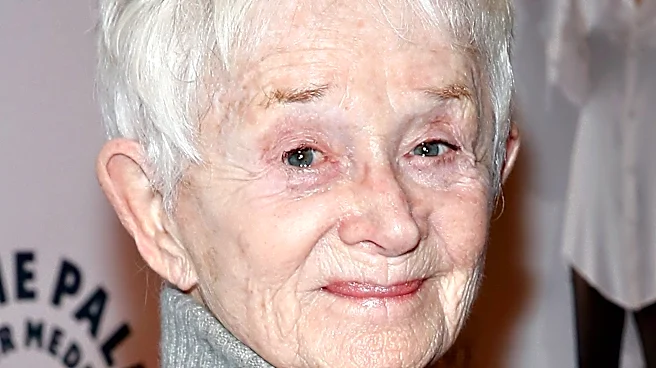










Oscar-nominated actress Barbara Barrie chose medical aid in dying after she was diagnosed with terminal cancer, according to The New York Times. She died on Oct. 28, at 95 years old.
The actress "was a proponent and advocate" of the New York State Medical Aid in Dying law, her agent Gary Gersh said. New York's medical aid in dying law became effective in August 2026.
Eleven other states and Washington, DC have similar laws allowing medical aid in dying. While advocates of the practice say medical aid in dying is an option for terminally ill patients to end their lives with dignity, many are also against these laws, sometimes for religious reasons.

Illinois is one of the latest states to adopt a medical aid in dying policy, though a handful of physicians,
religious leaders and a Lutheran skilled nursing facility challenged the new law in August with a lawsuit alleging physicians against medical aid in dying would have to choose between "violating their faith" or "abiding their faith and violating state law" under the new legislation, according to court records. The Catholic Medical Association recently joined the plaintiffs in support of retracting the new law.
"We cannot agree to the State’s demand that we help patients end their own lives, in direct violation of our rights of conscience," Catholic Medical Association President David Hilger said in a September press release. "We are called to accompany rather than abandon patients in their times of greatest need."
The law in Illinois, known as "Deb's Law," took effect in September while the lawsuit remains pending.

USA TODAY previously spoke with Dan Diaz, who was married to arguably the most well-known medical aid in dying advocate, Brittany Maynard. Maynard was only 29 when she was diagnosed with terminal brain cancer. She documented her last months for the world to see, and ended her life with medical aid in dying on Nov. 1, 2014.
"She died in the same way that she lived her life, with grace, compassion and love," Diaz told USA TODAY in June 2025.
Advocates like Diaz say there are many misconceptions about medical aid in dying, often also colloquially called "doctor assisted suicide," a term some of those closest to the community avoid and discourage using. Barrie's death has brought the topic back into the news, sparking both debates and curiosity. Here's what people often get wrong about medical aid in dying, according to experts.
What is medical aid in dying? It's legal in these states
Medical aid in dying allows patients with six months or less to live the option to obtain a medicine that can help them die peacefully at a time of their choosing. It's not considered euthanasia – which is when someone administers a lethal drug – because the patient takes the medicine themselves. Medical aid in dying is legal in the following 13 states and in Washington, DC, according to Death With Dignity, a national advocacy group:
- California
- Colorado
- Delaware
- Hawaii
- Illinois
- Maine
- Montana
- New Jersey
- New Mexico
- New York
- Oregon
- Vermont
- Washington
Most of these laws are very similar, though some states like Vermont and Oregon do not have residency restrictions.
Advocates stress the importance of not using the term "assisted suicide" both because of the stigma associated with that term, and for accuracy reasons.
Jessica Empeño, executive director at The CSU Shiley Haynes Institute for Palliative Care and former national director for clinical engagement at Compassion & Choices, a nonprofit advocacy group that supports medical aid in dying, previously told USA TODAY that "physician-assisted suicide" isn't accurate because the patient is in control. A physician doesn't even have to be in the room when a patient takes the medicine.
She added that the term "suicide" indicates that a person wants to die. Patients who choose medical aid in dying don't want to die, she said, "but they are dying." It's a long and involved process to apply for and get the medication in the United States, and only patients with a prognosis of six months or less to live qualify.
Why some people choose medical aid in dying
Even though they don't want to die, for some patients, medical aid in dying offers a way to take back control after receiving a devastating diagnosis. After all, a terminal illness rarely just impacts the person who is sick.
"A lot of patients really express this desire to shield family members from the agony of watching them die, and potentially having them witness a really traumatic or a really burdensome death," Anita Hannig, an anthropologist and author of the book "The Day I Die: The Untold Story of Assisted Dying in America," previously told USA TODAY.
Bernice Rodriguez, a grandmother in California, has stage 4 breast cancer that's spread to her lungs and bones. She spoke to USA TODAY in April about choosing medical aid in dying. She said she might not even use the medicine in the end. But it's nice to know she has the option.
"I had family members pass recently and they went through all the chemo and losing their hair, being chronically ill for, you know, six months and then dying anyway," she said. "And so, yeah, that wasn't even on the table for me."
Madeline Mitchell's role covering women and the caregiving economy at USA TODAY is supported by a partnership with Pivotal and Journalism Funding Partners. Funders do not provide editorial input.
Reach Madeline at memitchell@usatoday.com and @maddiemitch_ on X.
This article originally appeared on USA TODAY: Barbara Barrie's headline-making death and what people get wrong about medical aid in dying