


"Analog" seems to be the word of the summer.
Young people are using flip phones, carrying clunky cameras and filling up journals by hand. Hobbies like embroidery, needlepoint and crocheting are finding new audiences through TikTok hashtags like #wipwednesday, (work in progress Wednesday), and snail mail and pen pal clubs with letters are booming. This summer has brought a wave of phone-free parties, picnics and block parties encouraging life off screens.
So it’s only natural that Gen Z’s latest fashion statement is following suit.
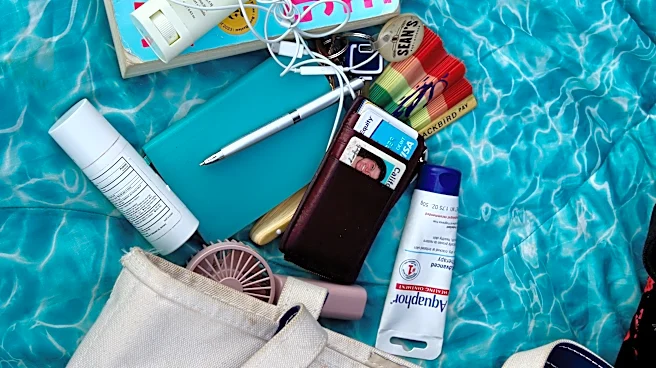
"Analog bags," tote bags filled with portable offline items like leather-bound journals, paperback books and mini watercolor palettes, are taking over TikTok and Instagram.
"It's kind of like a 'Mary Poppins' bag that
I can just dig in," says Caitlyn Kasler, a 25-year-old in Atlanta. "It's a great trend. Honestly, it's one of the better things to come out of social media."
Content creator Sierra Campbell coined the term in a TikTok last year about tips to lower screen time, and it's been spreading on social media since.
Even though the point of the trend is to get offline, "what’s in my analog bag" videos with bouncy animated text, soft typing sound effects and curated sticker overlays have racked up tens of thousands of views.
Sudoku puzzles, coloring books and puzzles
Kasler started an analog bag as part of her New Year’s resolution to spend more time away from social media and work on her mental health.
Her bag includes a pink travel Mahjong set, a puzzle, a Filofax organizer and a Louise Carmen − a leather-bound notebook with a cult following online.
"I've been really trying to take steps back because it's so easy to get consumed in TikTok [and] doom scrolling," Kasler says. "Putting all these things together that help me unplug and focus on real life hobbies."
Her bag currently has a cookbook — she recently got into sourdough baking — and she always carries a Sudoku book and murder mystery puzzle book inside.
The bag is as much about aesthetics as hobbies. Trending videos show patterned bags adorned with beaded charms and plushies, like Sonny Angels and Labubu dolls popping out of the sides.
The L.L. Bean Boat and Tote has emerged as the bag of choice, with people embroidering everything from their initials to phrases like "self care" on the cotton canvas totes. The company says sales are up more than 50% this year, and the best-selling month for the product occurred this spring. The company launched limited-edition "Analog" and "Off the Grid" monogrammed Boat and Totes.

Julia Lacayo’s friends gifted her a "So Julia" embroidered tote for her 28th birthday, in reference to singer Charli XCX's lyrics.
The 29-year-old, who is based in New York, brings a journal for jotting down ideas, sunglasses, headphones, sunscreen, lip gloss and a book. She just finished Paul Murray’s "The Bee Sting."
"I’ll try to go to a park. I'll try to take myself to a bar, even just to read, because if I'm trying to read up in my house, I'm so much more tempted to grab my phone," Lacayo says.
Gen Z’s analog summer
The conversation about young people’s screen addiction has become more mainstream in a post-COVID-19 world, brought on by books like Jonathan Haidt’s "The Anxious Generation," schoolwide phone bans and the U.S. surgeon general’s office warnings about loneliness and screen time.
At the same time, Gen Z is increasingly nostalgic. They’re struggling with decreasing social infrastructures and are disillusioned with the state of their finances, a growing political divide and a job market overshadowed by artificial intelligence.
Clay Routledge, a psychologist who studies nostalgia, says people long for a time when socializing felt more organic, and they are thinking about how to bring the technology of that era into their lives.
"There's something about mining the past, for what seems on the surface like objects, but it's really more about a vibe or an energy from that time," Routledge says.
Young people are increasingly embracing flip phones and landlines in place of their smartphones — traffic on the website Dumbphone Finder jumped 12-fold from 2022 to 2025, according to the site’s founder, Jose Briones.
Walkman sales are up 111% and instant film cameras 157%, according to Afterpay’s Spring/Summer 2026 Trends Report. Pinterest Predicts’ 2026 report found searches for "snail mail gifts" are up 110% on the platform. Eventbrite in June declared it "The Offline Summer."
"Young people are saying, 'Hey, we're frustrated with all the negativity, all the pessimism, feeling like just addicted or too dependent on these technologies, and we're doing something about it,'" Routledge says.
Why analog bags are more than a trend
Kasler acknowledges it’s "kind of ironic" to post about an analog bag online. But she also says it’s become a way for her and her friends to connect about hobbies.
"We'll text each other, 'Oh my gosh, look at this new puzzle book' or 'Oh, I just started reading this book, you should put it in your analog bag,'" Kasler says.
Peyton Mader, 26, isn’t on social media and uses a Nokia 2780 flip phone. She didn’t know she was doing something trendy until others brought up the name of the movement, but she’s glad offline activities are having a mainstream moment.
She brings her analog bag, which includes the physical calendar she used to replace Google calendar and a notebook for daily observations, "pretty much everywhere."
She likes to add something "whimsical" each time. On a July evening during a phone-free gathering in New York’s Fort Greene Park, she pulls out Henrie, a needle-felted opossum.
"It's fun to see so many people just kind of independently find their way to something like that," Mader says.
Routledge says nostalgia can function as an internal psychological resource that helps us move forward with "optimism" and "more sense of meaning." For Gen Z, that inspiration from the past is translating into more control in their lives, and a social component where people connect through shared hobbies.
"It's not either no technology or technology," Routledge says. "It’s the story of young people wanting to use their agency to figure out a healthier relationship with technology."
Rachel Hale’s role covering Youth Mental Health at USA TODAY is supported by a partnership with Pivotal Ventures and Journalism Funding Partners. Funders do not provide editorial input. Reach her rhale@usatoday.com and @rachelleighhale on X.
This article originally appeared on USA TODAY: Gen Z is having an 'analog summer' and they’re obsessed with this item