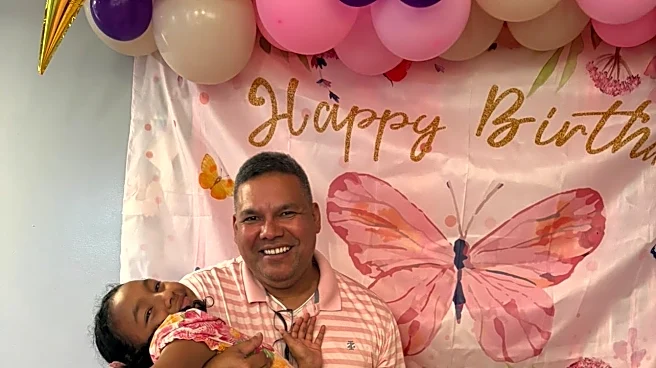

José Palma can measure the uncertainty hanging over his family in the things they have stopped buying.
Palma and his wife have put off building a shed behind their Houston home. They abandoned plans for
a swimming pool where their two youngest children could escape the Texas heat. They are holding onto an aging car, eating out only on special occasions and considering pulling their son from the soccer team where he has played for years.
The cutbacks are not because the 49-year-old father has lost his job. They are because he does not know how much longer he will be allowed to keep it.
For 25 years, Temporary Protected Status, or TPS, has allowed Palma, who is also the coordinator for the National TPS Alliance advocacy group, to live and work legally in the United States. But that protection for El Salvador could expire in the coming weeks, leaving him and tens of thousands of others unsure whether they can continue paying their mortgages, supporting their children or investing in the country where many have set down roots for nearly three decades.
“They’ve asked me, ‘Are you planning to return?’ But return where?” said Palma, who arrived without authorization at the southern border as a 22-year-old in 1998, pushed north by the lingering effects of El Salvador’s civil war and the scarcity of opportunities that followed. He added: “Mi vida es aquí en los Estados Unidos,” meaning his life is here in the United States.

Across the country, other Salvadorans are making their own calculations as the deadline approaches. Some are exploring whether they could start over elsewhere. Others are rushing to consult immigration attorneys and sign guardianship agreements that determine who would care for their children if they are detained or deported.
In a Aug. 12 update, U.S. Citizenship and Immigration Services notified Salvadorans that their work authorization and protection from deportation are set to expire Sept. 9. But the law requires the secretary of the Department of Homeland Security to decide whether to extend or terminate TPS at least 60 days before a designation expires. If no determination is made, the protections automatically extend for six months.
For the termination to take effect Sept. 9, the administration would have had to publish a notice in the Federal Register in July. It did not — leaving roughly 170,000 Salvadorans waiting for official word.
The White House referred USA TODAY to the Department of Homeland Security, which declined to comment.
DHS has typically announced such automatic extensions close to when they were scheduled to expire. Earlier this year, DHS did not announce that Lebanon’s TPS designation had automatically rolled over until the day after its previous expiration date. The Federal Register notice followed a day later.
Still, Salvadoran TPS holders are reluctant to count on a reprieve.
In July, 80 Democratic members of Congress urged DHS Secretary Markwayne Mullin to extend TPS rather than send Salvadorans back to “a country beset by documented state-sponsored human rights abuses which does not have the means or capacity to support a diaspora of tens of thousands of people.” This month, more than 270 faith leaders and organizations issueda similar appeal.
Yet, the Trump administration has terminated protections for 13 of the 17 countries that held TPS designations when the president returned to office in 2025, most recently ending them for Haitians, Syrians and Ethiopians. A June U.S. Supreme Court decision sharply limited courts’ ability to review the administration’s TPS determinations, weakening one of the principal avenues recipients had used to fight terminations.
“It feels like we’re just waiting for the Grim Reaper to knock on our door,” said César Linares, 45, a Salvadoran TPS holder and construction worker in Washington, DC.
A little trembling in the heart
The life Palma is now trying to protect was built before dawn, after work and inside night school classrooms.
He wanted to become a lawyer. To get there, he began learning English through community programs and enrolled in college, fitting classes around the demands of raising his children, supporting relatives in El Salvador and working two or three jobs at a time.
For years, his workday began around 3 a.m., when he climbed into a truck to deliver milk across the Boston area. He finished his route in the afternoon, stopped at home and then headed to class, often staying until 9 at night. By the time he went to bed, another shift was only a few hours away.
It took him nine years to complete an associate degree in paralegal studies at North Shore Community College. He later enrolled at the University of Massachusetts to focus on labor studies, moving one step closer to law school.

But as the future of TPS again came under threat amid Trump's 2024 presidential campaign, Palma put his education on hold and devoted more time to organizing other recipients.
Palma said he had always understood that the protection was temporary. Every 18 months, when El Salvador’s designation came up for review, he felt “una tembladita en el corazón” — a little trembling in the heart — as he waited to learn whether he could keep working and whether the life he had built could continue.
What he lacked was a straightforward way out of that cycle.
Palma’s wife, a permanent resident, petitioned for him. Yet his green card application has been pending for more than five years, he said, because his entry through the southern border requires him to clear additional legal hurdles.
“We have always known it was temporary,” Palma said. But if recipients qualified for another status, he added, “we would have applied a long time ago. Who wants to live without knowing what will happen to their future?”
That tension has existed since the program’s inception.
Congress created TPS with bipartisan support as part of the Immigration Act of 1990, signed into law by Republican President George H.W. Bush. The program shields eligible, vetted immigrants from deportation when armed conflict, natural disaster or other extraordinary conditions make returning to their countries unsafe.
El Salvador became the first country to receive the protection as its brutal civil war neared its end, though that initial designation expired in 1992. The country received TPS again in 2001, under President George W. Bush, after two devastating earthquakes killed more than 1,000 people.
That designation has remained in place for 25 years — long enough for recipients to raise families, build businesses and become embedded in their communities, but without providing a path for permanent residency or citizenship.
That limitation was deliberate, said Ariel Ruiz Soto, a senior policy analyst at the Migration Policy Institute, a nonpartisan think tank. When lawmakers created the program, he said, they designed the protection as a pause rather than a pathway to prevent TPS from becoming “an incentive for people to come into the United States illegally and then stay here, ask for TPS, and then transition to something else.”
“Only Congress can make that law or change that TPS law,” Ruiz Soto said.
But Congress has repeatedly failed to reach a compromise on immigration reform, he added, leaving people like Palma dependent on a temporary status that presidential administrations have extended for decades — and can also move to take away.
Critics of the program say past presidents misused TPS by allowing it to drag on long after the emergencies passed.
The decisions have also become increasingly political under both Republican and Democratic administrations, Ruiz Soto said.
“It’s no longer about the policy,” he said. “It’s about the president and the party.”
In El Salvador’s case, however, the politics extend beyond the country’s partisan divide and into one of President Donald Trump’s strongest relationships in Latin America.
An ally complicates the decision
Last year, a multimillion-dollar agreement between the Trump and Salvadoran President Nayib Bukele sent hundreds of migrants from U.S. detention to El Salvador’s notorious Terrorism Confinement Center, known as CECOT — a move that cemented Bukele’s role as one of Trump’s closest allies in the region and made El Salvador a willing partner in the president’s immigration agenda.
Bukele, who once described himself as the “world’s coolest dictator,” has built his international profile around his crackdown on gangs and the dramatic decline in violence that followed. Homicides fell to historic lows, but tens of thousands of people were imprisoned, often without due process, amid allegations of torture, arbitrary detention and other human rights abuses.
That alliance has become an unpredictable variable in the future of TPS, Ruiz Soto said.
“It's a lot easier to terminate TPS for a country which the administration in power has little or no relationship with – say Venezuela or Haiti– than it is to terminate TPS for a country that is a close ally,” he said. “The political dynamics are very sensitive and go beyond policy.”
The decision could pull Bukele in opposite directions, Ruiz Soto said. Supporting an end to TPS would mean accepting the possible return of thousands of Salvadorans after years of promoting the country as safe and prosperous. But asking Trump for an extension could require acknowledging that El Salvador may not be prepared to receive them.
Neither government has said whether the two administrations have discussed El Salvador’s TPS designation. The press office of El Salvador’s presidency and the country’s Ministry of Foreign Affairs did not respond to requests for comment.
Their silence leaves Salvadorans looking to two recent cases — and two very different outcomes. In May, after DHS said it could not complete its review of conditions in Lebanon on time, the country’s designation was automatically extended for six months.
Honduras went the other way. When its designation expired last year without a decision, recipients and advocates believed the law had automatically extended their protections for six months. Two days later, DHS announced that TPS would instead end in 60 days for Hondurans — many of whom had been protected since 1999.
Honduran TPS holders sued, arguing that the decision had been predetermined and giving them only 60 days before their protections ended broke with decades of DHS practice. A federal judge later struck down the termination, but an appeals court put that decision on hold, leaving Hondurans without TPS as the legal fight continues.
“This is why we're operating under the guise that things are only official when they become official,” Palma said. “Until we get an announcement from the government, there's no telling what will happen.”
'A sea of tears'

In recent months, so many parishioners have come crying to the Rev. Vidal Rivas that he has begun to think of St. Matthew’s Episcopal Church as “a sea of tears.”
They ask the senior priest what he thinks will happen to TPS and what they should do if it ends. They tell him about the homes they are still paying off, the businesses they have built and the children and grandchildren who have never lived anywhere else.
Many times, he doesn’t know what to say.
For more than 25 years, he has traveled to Capitol Hill with immigrant advocacy groups, lobbying members of Congress for protections for families like those in his predominantly Salvadoran congregation in Hyattsville, Maryland. Now, with the potential Sept. 9 deadline approaching, he said he can offer little beyond consolation.
“Have courage. Have faith. Fight. Wait,” Rivas tells them. “But nothing more.”
Some families are no longer merely waiting. They are filling out documents that specify who should care for their children if they are detained or deported. Rivas has been named a standby guardian for 31 kids, including several whose parents have TPS.
On a recent Sunday Mass, he urged TPS-holders to begin making their arrangements.
Even if the administration ends TPS, Ruiz Soto said, the impact would not be as immediate or orderly as 170,000 Salvadorans boarding flights the next morning.
“It’s not an on-and-off switch,” he said.
Some recipients may find another way to remain legally. Others are likely to stay without authorization, taking informal jobs that pay less and leave them more vulnerable to exploitation. Detentions and deportations would occur gradually, making the full economic and social effects difficult to measure for months or years, Ruiz Soto said.
The loss of work authorization, however, could begin much sooner. Without another legal status, recipients could lose the jobs they have held for years and the health insurance attached to them. Depending on the state, they might also be unable to renew their driver’s licenses, affecting everything from the morning commute to school pickups and medical appointments.
The strain would also be felt in El Salvador, where remittances represented 27.5% of the country’s economy in 2025, per World Bank data. Of the nearly $10 billion Salvadorans abroad sent home that year, $9.22 billion – or 92.4% – came from the U.S., according to El Salvador’s Central Reserve Bank.
El Salvador has worked with the International Organization for Migration and other United Nations agencies to help returning migrants find jobs, start businesses and obtain mental health support. The government has adopted a national reintegration plan for 2025 through 2029 and, in July, announced financial assistance for 2,500 returnees. But El Salvador received 16,051 deported citizens in 2025, according to its General Directorate of Migration, while its reintegration programs have operated on a much smaller scale than the number of people who could lose TPS.

The impact around the nation's capital
In the Washington, DC, area, the disruption would spread through one of the country’s largest Salvadoran communities – a region dotted with pupuserías and shaped by Salvadoran stonemasons and construction crews that have spent decades building and restoring its homes, offices and historic landmarks.
For Maricela, who requested partial anonymity because she fears repercussions from the Trump administration, the uncertainty has seeped into two milestones her family expected to celebrate.
The 40-year-old single mother came to the United States at 19 after gangs killed her cousin and threatened her family, she said. Her two children were born here.
Her 17-year-old son, a high school senior, was supposed to spend this fall applying to colleges. Now, he's refusing to do so.
“I can’t leave you and my sister alone, if you have to go back,” Maricela recalled him telling her.
She has urged him not to surrender his future because hers is uncertain. But she sees no easy choice between taking her children to a country where she fears opportunities would narrow or leaving them here without their mother.
Her daughter will turn 15 on Sept. 10, the day after the upcoming TPS deadline is scheduled to expire. Maricela had planned a large quinceañera, but has since canceled the party in an attempt to save money.
Instead, the three of them will eat pizza at home – one day into whatever comes next.
This article originally appeared on USA TODAY: As TPS cliff nears, Salvadorans in the US put lives on hold