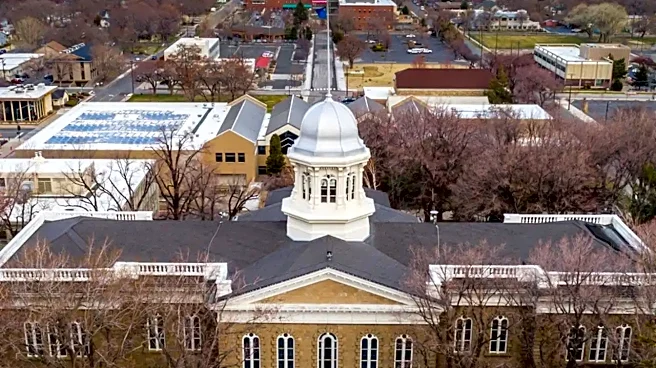

The Legislature Draws the Lines
First, it’s important to understand the basic process. In Nevada, the State Legislature is responsible for drawing and passing new maps for the state’s four congressional districts. They draft the legislation,
hold hearings, and vote on a final plan, just like any other bill. This makes Nevada a legislature-dominant state in the redistricting process. The party that controls the Assembly and the State Senate has the authority to create maps that, in theory, reflect population changes from the latest U.S. Census. In practice, this often means the majority party has the first and best opportunity to draw districts that could favor their candidates for the next decade. But their power isn't absolute; the process doesn't end with a legislative vote.
The Governor's Ultimate Weapon: The Veto
The single most powerful tool a Nevada governor has in the redistricting fight is the power to veto the maps. Because the district boundaries are passed as a standard bill, they must go to the governor's desk for a signature to become law. If the governor believes the maps are unfairly drawn—a practice known as gerrymandering—or if they disadvantage their own party, they can reject the entire plan. This sends the legislature back to the drawing board. A veto immediately halts the process and forces a negotiation. History shows this is not a theoretical power. In the 2011 redistricting cycle, Republican Governor Brian Sandoval twice vetoed maps sent to him by the Democratic-controlled legislature, creating a stalemate.
Forcing the Issue with a Special Session
What happens if the regular legislative session ends without an approved map? The governor has the authority to call the legislature back for a special session focused specifically on redistricting. This tool keeps the pressure on lawmakers to find a compromise. A governor can use the threat of a special session—or the decision not to call one—as leverage. For instance, if negotiations are close, a governor might call a session to get a deal across the finish line. Conversely, as happened in 2011, a governor can refuse to call a special session after a veto, effectively declaring an impasse and kicking the decision to another branch of government. This move signals that no legislative solution is possible.
The Art of Negotiation and the Bully Pulpit
Beyond formal powers, a governor wields significant informal influence. Using the “bully pulpit,” a governor can take their case directly to the public, using media appearances and public statements to rally support for their position and criticize the legislature’s proposal. Behind the scenes, the governor and their staff are key players in negotiations. This is especially true in a divided government, where the governor is from a different party than the legislative majority. In that scenario, a compromise is essential to avoid a stalemate. When the governor and legislative majority are from the same party, as was the case in 2021 with Governor Steve Sisolak and the Democratic legislature, the governor’s role is often to unify the party and sign off on a map that solidifies their collective power.
The Last Resort: When the Courts Take Over
If the legislature and the governor cannot agree on a set of maps and a political deadlock ensues, the entire process falls to the judicial system. This is the ultimate consequence of a sustained stalemate. Following Governor Sandoval's vetoes in 2011, a state court appointed neutral experts, known as “special masters,” to draw the district lines. This outcome is a double-edged sword. While it takes the map-drawing power away from partisan legislators, it also removes it from the governor’s influence. However, a governor might strategically use a veto with the knowledge that a court-drawn map may be more neutral or favorable than the one passed by an opposing party’s legislature. In this way, even the failure to sign a bill is a form of power that shapes the final outcome.