
Ever wonder how your voice gets heard in Washington D.C.? It starts with a map. In Mississippi, the lines of its congressional districts define political power. So how many are there, and did the recent
once-a-decade shakeup change anything?
The Short Answer: Four Districts
Let's get the simple part out of the way first. Mississippi has four congressional districts. This number didn't change after the 2020 U.S. Census, meaning the state's overall representation in the U.S. House of Representatives has held steady. For decades, Mississippi has fluctuated between five and eight seats, but it has maintained four since the apportionment following the 2000 Census. These four districts carve up the state, with each one sending a single representative to Congress to advocate for the interests of their constituents.
The Story of the Lines: Post-2020 Redistricting
While the number of districts stayed the same, their shapes did not. After every census, states are required to redraw their congressional and state legislative district lines to account for population shifts. This process, called redistricting, ensures that each district has a roughly equal number of people, upholding the principle of "one person, one vote." Following the 2020 Census, the Mississippi state legislature, led by a Republican majority, undertook this task. In January 2022, Governor Tate Reeves signed the new congressional map into law. This was the first time in decades the legislature successfully passed a map without a court drawing it for them due to political gridlock.
What Actually Changed on the Map?
The 2022 redistricting plan preserved the general political landscape of three Republican-leaning districts and one Democratic-leaning district. The most significant adjustments were made to balance populations. The 2nd Congressional District, which is the state's only majority-Black and Democratic-held district, was geographically large but had lost population. To bring its numbers up, mapmakers had to expand its borders. They did this by moving four majority-white precincts from the 3rd District and parts of Adams, Franklin, and Wilkinson counties from the 4th District into the 2nd District. This maintained the district’s population balance while ensuring it remained a majority-Black district, a key requirement under the Voting Rights Act.
The Political Fight: A Battle Over Representation
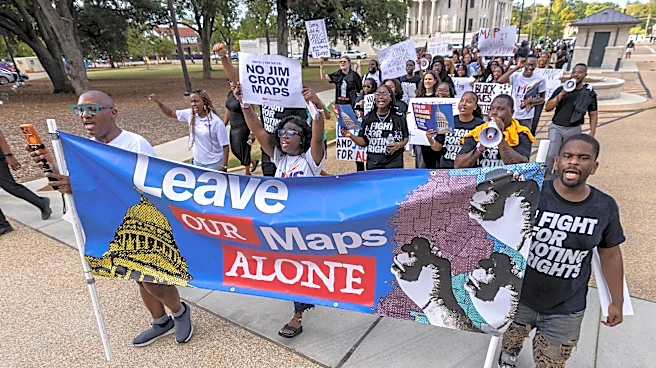
Redistricting is rarely without controversy, and Mississippi's process was no exception. While the congressional map passed, it drew criticism. Democrats and voting rights advocates argued that the new lines unnecessarily split some communities and could have been drawn to better reflect the state's Black population, which is the largest percentage of any state in the nation. Lawsuits were filed, primarily focused on the state legislative maps, which were also redrawn in 2022. In July 2024, a federal court ruled that the state legislative maps, not the congressional ones, did indeed dilute the voting strength of Black Mississippians and ordered them to be redrawn. The legal challenges to the congressional map, however, concluded, leaving the 2022 plan in place for federal elections.
Who Represents Mississippi Today?
The four districts are currently represented by three Republicans and one Democrat. The 1st District is represented by Trent Kelly (R), the 2nd District by Bennie Thompson (D), the 3rd District by Michael Guest (R), and the 4th District by Mike Ezell (R). Congressman Thompson is the delegation's longest-serving member, having held his seat since 1993, making him the dean of the Mississippi delegation. These are the four individuals tasked with representing the diverse interests of a state whose internal boundaries are a constant source of political debate and legal scrutiny.