







What is the story about?

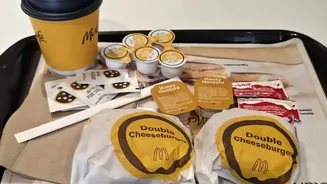
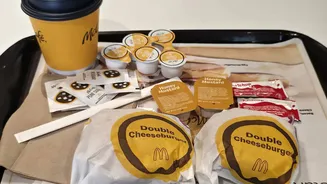
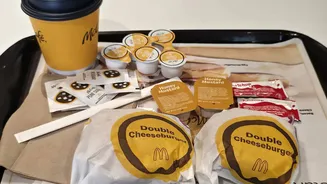
After two years of adjustments to its value menu, McDonald’s has adopted a new strategy: simplicity. The fast-food giant's McValue menu will feature 10
items, each priced under $3, beginning April 21.
The breakfast selections will include hash browns and Sausage McMuffins, while options available throughout the day will feature a small order of fries or a McDouble burger. While some items currently cost less than $3 in various parts of the U.S., others do not. The standardized menu aims to replace the existing McValue menu, which allowed customers to select from a limited range of $1 items only when purchasing a regular-priced item.This move towards a simpler value menu aligns with similar strategies adopted by competitors. In January, Taco Bell introduced a Luxe Value Menu, offering 10 items priced at $3 or less. Additionally, Panera Bread launched its first value menu in February, featuring 10 items at $4.99 each. Wendy's revamped its Biggie Deals value menu in January, which now includes $4 Biggie Bites, a $6 Biggie Bag, and an $8 Biggie Bundle. KFC has also recently added $5 bowls to its U.S. menu.
Value menus are intended to provide customers with more affordable options, even as fast-food chains introduce higher-priced items like McDonald’s Big Arch burger or Burger King’s limited-time Peppercorn BLT Whopper. Fast-food chains have focused on value for several years to regain customers who were dissatisfied with rising food prices. Historically, the cost of dining out increases by about 3.5% annually; however, prices surged by 7% in 2023, followed by 4% in 2024 and 3.8% in 2025, according to government statistics.
Roger Beahm, an emeritus professor of marketing at Wake Forest University, stated, 'In all retail, including quick-serve restaurants, ‘value’ has become a promotional expectation.' In June 2024, McDonald’s introduced a $5 Meal Deal, with plans to add a $4 Breakfast Meal Deal on April 21. The company first launched the McValue menu in January 2025, following the introduction of Extra Value Meals in the previous fall, which promise a 15% discount on bundled meals compared to individual purchases.
Alyssa Buetikofer, McDonald’s USA's chief marketing and customer experience officer, remarked, 'Value matters more than ever to our customers, and we take that responsibility seriously.' She noted that the company has improved customer perceptions of value and affordability since 2024. However, McDonald’s decided to revamp its McValue menu after receiving feedback from customers who desired greater flexibility and better value in the morning, with half of the items on the under-$3 menu being breakfast options.
Scott Rodrick, a franchisee in California, praised the new approach, expressing optimism that the ordering process would be more efficient with fewer questions regarding the deals. He commented, 'The value proposition is super clear — no deep explanation or mental gymnastics needed to understand where value is on my menu board.' Rodrick indicated that the changes have garnered widespread support from franchisees, with approximately 95% of McDonald’s U.S. stores owned and operated by franchisees who determine their own pricing.
According to Revenue Management Solutions, a restaurant consulting firm, the balance between investing in value through promotions while increasing prices on premium items seems to be effective. Customer traffic at U.S. fast-food restaurants increased by less than 1% in February compared to the same month the previous year, following a 2% decline during the last three months of 2025 and in January.
However, the company cautioned that rising gas prices due to the ongoing Iran conflict may have impacted fast-food traffic in March, potentially putting pressure on chains to enhance value offerings. Beahm warned that the term 'value' risks becoming overused, suggesting that the novelty of deals diminishes over time and customers may forget previous prices for certain products. 'If everything is always positioned as a value, then can anything really be a value?' he questioned.
He further suggested that introducing new products could effectively attract customers, while improving service or offering unexpected perks, such as charitable donations with each purchase, may also be beneficial. Jennifer Fritch, an assistant professor of marketing at Arcadia University, concurred, noting that the fast-food industry is highly competitive, and solely focusing on price reduces food to a commodity. Younger consumers, in particular, seek emotional experiences, personalization, and ingredient transparency, and are willing to pay more for these aspects. 'If it’s just cheap food, that’s not a winning long-term strategy,' Fritch stated. 'The list of demands and expectations is higher than ever, and relying solely on cost to drive sales is inadequate.'