







What is the story about?

DUBAI, United Arab Emirates (AP) — U.S. President Donald Trump announced Thursday that he had called off planned military strikes on Iran, citing a breakthrough
in negotiations aimed at ending the ongoing conflict. This decision came shortly after Trump had threatened to escalate the situation by taking control of Iran's oil industry. In recent weeks, Trump has repeatedly claimed that the involved parties were close to reaching an agreement, yet no significant outcomes had been realized. Officials in Iran did not immediately respond to Trump's comments, nor did the mediators engaged in the negotiations.
During an Oval Office event on Thursday afternoon, Trump stated, “We just made a great settlement of the war with Iran.” He provided few details but expressed optimism that an agreement to extend the ceasefire would be finalized “over the next few days.”By extending the ceasefire terms, U.S. leaders gain additional time to negotiate Iran’s nuclear program, which Trump and Israeli Prime Minister Benjamin Netanyahu have cited as a key reason for initiating the war.
This announcement followed two days of escalating attacks between the U.S. and Iran, which brought the region closer to a full-scale war. Earlier on Thursday, Trump had threatened to escalate further, declaring on social media that the U.S. would strike Iran “VERY HARD TONIGHT” and would take “total control” of its oil and gas sectors.
A few hours later, Trump shared that significant points in the negotiations had been elevated to the highest levels of Iranian leadership and approved. He also indicated that “discussions and final points have been, in both concept and great detail,” approved by the United States, Israel, and other regional allies.
One of the primary challenges in the negotiations remains Iran's nuclear program, which the U.S. and Israel fear could lead to the development of an atomic weapon. Iran, however, insists that its nuclear activities are intended for peaceful purposes. Additionally, Iran's control over the Strait of Hormuz, a vital shipping route for oil and natural gas, poses another significant concern.
Trump's quick transition from threats to negotiating peace highlights his unpredictable strategy in dealing with the conflict. He had suggested earlier in the week that a resolution could be reached within days.
This week witnessed a series of exchanges of fire, beginning with hostilities between Iran and Israel, followed by U.S. strikes targeting areas where U.S. troops are stationed. The U.S. military action was initiated after Trump blamed Iran for the downing of an American attack helicopter near the Strait of Hormuz, from which both pilots were successfully rescued.
Iran’s Foreign Ministry stated that the U.S. strikes had effectively rendered the ceasefire “meaningless,” although it did not declare an abandonment of it.
In response to Trump’s threats of further military action, Iran’s parliamentary speaker, Mohammad Bagher Qalibaf, warned on social media that “wrong strategies and impulsive decisions” could destabilize energy markets and lead to an “endless quagmire.”
This is not the first instance of Trump issuing threats before pivoting back to negotiations. In April, he warned Iran that “a whole civilization will die tonight” if it did not agree to his demands, only to later extend a ceasefire.
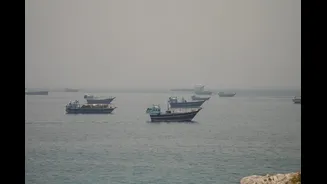
Iran's ongoing disruption of shipping through the Strait of Hormuz has significantly impacted global energy supplies, driving up fuel prices and increasing the cost of essential goods far beyond the region.
On Thursday, Trump had threatened to seize Kharg Island, a critical hub for Iran's oil industry through which 90% of its exports flow. However, he later expressed uncertainty about the feasibility of such an action, stating in an interview with Fox News, “I don’t know that America has the stomach for it, to be honest.”
“I don’t want to have boots on the ground,” Trump added, “But if I wanted to, we could put a small group of soldiers and take over the place.”
U.S. Treasury Secretary Scott Bessent stated on social media that the U.S. would draw funds from frozen Iranian accounts to cover damages incurred by American allies and any tolls imposed by Iran on ships transiting the Strait of Hormuz.
The two sides continue to remain at odds over Iran's nuclear ambitions, with Tehran maintaining that its efforts are peaceful, while the U.S. and Israel worry that its enriched uranium stockpile could lead to weaponization.
Iran has also insisted that any agreement to conclude the war must address the conflict in Lebanon involving its ally Hezbollah and Israel. However, Israeli Prime Minister Netanyahu appears determined to pursue the elimination of the militant group.
A 25-year-old student from northern Iran expressed growing concerns among Iranians regarding the potential for “chaos” amid the ongoing war with the U.S. and Israel, coupled with escalating domestic crises.
The student, residing in Babol, revealed that many Iranians struggle to afford basic necessities due to mass unemployment and soaring food prices. He requested anonymity due to security concerns.
“Everything is going wrong and there is no hope among the people,” the student remarked.
He noted that his primary worry is for Iran to “maintain territorial integrity and deterrence” in the face of attacks from the U.S. and Israel.
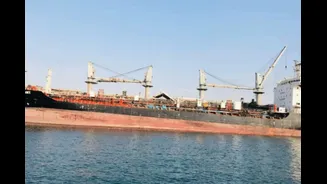
In a related development, the U.S. military's Central Command reported that it struck a Guinea-Bissau-flagged tanker attempting to evade the American blockade on Iranian ports. The tanker, identified as M/T Jalveer, was transporting Iranian oil when it was disabled after failing to comply with U.S. orders.
This marks the ninth merchant vessel that U.S. military forces have disabled to enforce the blockade. On Tuesday, three Indian sailors were killed when American forces targeted the Palau-flagged M/T Settebello, as confirmed by India’s minister overseeing ports and shipping.
U.S. Central Command asserted that American forces issued warnings prior to firing on the ship, which was accused of trying to circumvent the blockade. The leader of the International Maritime Organization, a U.N. agency, condemned the attack.