








What is the story about?
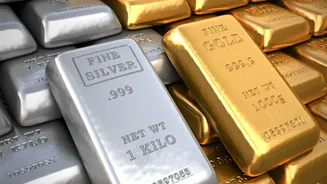
Gold and silver are expected to remain structurally supported in 2026 as macro uncertainty, policy shifts and supply-side constraints continue to favour precious metals, according to Motilal Oswal Financial Services’ Commodities Review 2025 & Preview 2026.
Why precious metals retain strength
The report highlights that global markets are entering 2026 amid persistent policy uncertainty, currency volatility and uneven economic growth. In such an environment, investors increasingly favour assets with intrinsic value and limited supply response.
Gold, in particular, continues to draw support from sustained central-bank accumulation, which has become a long-term feature rather than a cyclical trend.
This steady demand provides a durable price floor and limits downside risk during periods of market correction.
Silver’s strength, the report notes, stems from a fundamentally different driver set. The metal benefits from prolonged supply deficits and rising structural demand, particularly from sectors linked to energy transition and infrastructure development. These demand trends are less sensitive to short-term economic cycles, lending durability to silver’s price outlook.
How demand dynamics are evolving?
According to the report, gold demand is no longer driven primarily by retail or speculative interest. Instead, institutional participation—through central banks and exchange-traded funds—has reshaped market behaviour. This shift has reduced gold’s reliance on risk-off events and strengthened its role as a strategic allocation across market cycles.
Silver’s demand profile continues to broaden. Industrial usage has reached historically high levels, supported by solar energy deployment, electrification and emerging technologies. With limited scope for rapid supply expansion, the report expects physical tightness to persist, reinforcing silver’s sensitivity to incremental demand growth.
How currency and financial flows add support?
Motilal Oswal Financial Services notes that currency movements remain a critical amplifier for domestic precious metal prices. Periods of dollar weakness and depreciation in emerging-market currencies enhance local returns and sustain investor interest. At the same time, rising financial participation—evident in growing ETF holdings—adds depth and liquidity to the market, improving price discovery without undermining structural support.
What this implies for 2026?
The report characterises 2026 as a phase of consolidation rather than reversal for precious metals. While short-term volatility may arise from policy adjustments or geopolitical developments, underlying demand-supply dynamics remain favourable. Gold is expected to maintain its strategic relevance as a reserve and portfolio asset, while silver continues to benefit from its dual identity as both a precious and industrial metal.
Overall, Motilal Oswal Financial Services says that precious metals are transitioning from performance-driven trades to structurally supported assets, positioning gold and silver as long-term portfolio stabilisers in a fragmented global macro environment.
Why precious metals retain strength
The report highlights that global markets are entering 2026 amid persistent policy uncertainty, currency volatility and uneven economic growth. In such an environment, investors increasingly favour assets with intrinsic value and limited supply response.
Gold, in particular, continues to draw support from sustained central-bank accumulation, which has become a long-term feature rather than a cyclical trend.
This steady demand provides a durable price floor and limits downside risk during periods of market correction.
Silver’s strength, the report notes, stems from a fundamentally different driver set. The metal benefits from prolonged supply deficits and rising structural demand, particularly from sectors linked to energy transition and infrastructure development. These demand trends are less sensitive to short-term economic cycles, lending durability to silver’s price outlook.
How demand dynamics are evolving?
According to the report, gold demand is no longer driven primarily by retail or speculative interest. Instead, institutional participation—through central banks and exchange-traded funds—has reshaped market behaviour. This shift has reduced gold’s reliance on risk-off events and strengthened its role as a strategic allocation across market cycles.
Silver’s demand profile continues to broaden. Industrial usage has reached historically high levels, supported by solar energy deployment, electrification and emerging technologies. With limited scope for rapid supply expansion, the report expects physical tightness to persist, reinforcing silver’s sensitivity to incremental demand growth.
How currency and financial flows add support?
Motilal Oswal Financial Services notes that currency movements remain a critical amplifier for domestic precious metal prices. Periods of dollar weakness and depreciation in emerging-market currencies enhance local returns and sustain investor interest. At the same time, rising financial participation—evident in growing ETF holdings—adds depth and liquidity to the market, improving price discovery without undermining structural support.
What this implies for 2026?
The report characterises 2026 as a phase of consolidation rather than reversal for precious metals. While short-term volatility may arise from policy adjustments or geopolitical developments, underlying demand-supply dynamics remain favourable. Gold is expected to maintain its strategic relevance as a reserve and portfolio asset, while silver continues to benefit from its dual identity as both a precious and industrial metal.
Overall, Motilal Oswal Financial Services says that precious metals are transitioning from performance-driven trades to structurally supported assets, positioning gold and silver as long-term portfolio stabilisers in a fragmented global macro environment.