

By Lucy Papachristou
TBILISI, April 15 (Reuters) - When anti-government protests began in Georgia in late 2024, Luka Mishveladze started sleeping on the floor at his university building to be closer to student rallies.
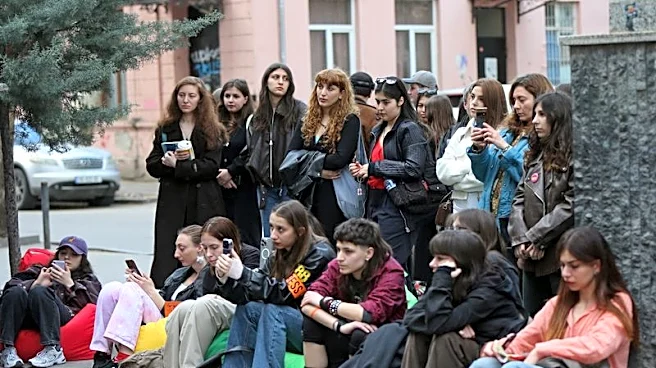
Some 18 months later, the 20-year-old student is now a protest organiser, demonstrating outside the same building in the capital Tbilisi against government reforms of higher education that look set to force his university's closure.
"It was hard for me to realise that this was happening
in reality, that I am losing my university, the place I am used to calling home," Mishveladze told Reuters.
Opponents of the government see the overhaul adopted in February as part of a broader anti-Western shift under the governing Georgian Dream party that began in earnest after Russia's invasion of Ukraine in 2022.
Once seen in the West as a burgeoning democracy, on the fast track to joining the European Union and escaping Russia's orbit, Georgia is increasingly turning its back on the West and deepening ties with Moscow.
'ONE FACULTY, ONE CITY'
Georgian Dream says the higher education reforms, affecting funding and the geographical redistribution of faculties, are intended to better reflect the demands of the labour market and promote regional universities.
It says it wants to reduce what it calls an excessive concentration of higher education institutions in Tbilisi and stop the "irrational" use of resources.
Detractors say the reforms are further evidence that the government is turning the country of 3.7 million away from the West, more than three decades after Georgia gained independence from the Soviet Union.
Under the reforms, guided by the principle of "one faculty, one city", only one university in a given city will be allowed to offer certain degree programmes.
The government will decide which academic disciplines can be taught at each of the 19 public universities - attended by over half of Georgia's university students - and redistribute admission quotas.
Tbilisi's Ilia State University (ISU), where Mishveladze and about 17,300 others study, will be hit particularly hard. One of the country's top-ranked research institutions, it is widely seen in Georgia as outspoken and liberal, and has strong ties with European partner institutions.
ISU says over 90% of its programmes will be cut and that it will have to wind down over three years. This autumn, ISU will be able to admit only 335 new undergraduates, down from the 3,770 admitted last year.
"No other sector in Georgia has been so integrated into the European space than higher education. So they're killing it," said Ketevan Darakhvelidze, the chancellor of ISU. "The more isolated Georgia will be, the better for the government."
Seven other universities received cuts to their admission quotas although only ISU says it faces closure.
Shalva Tabatadze, who runs an education policy research centre, said state funding had often been used in Georgia to support universities "which have political affiliations", describing this as "problematic".
A March report by a mission from the Organization for Security and Co-operation in Europe, a security and rights body, found "marked democratic backsliding" in Georgia and briefly mentioned the higher education reforms. It cited concerns in Georgia that the redistribution of faculties was intended to disperse large numbers of student protesters.
The government did not respond to Reuters' requests for comment for this article. Education Minister Givi Mikanadze, a member of a state committee that drew up the reforms, did not respond to Reuters' interview requests.
Georgian Dream, in power since 2012, says its policies are not authoritarian and that it is trying to keep peace in Georgia, which lost a short war to Russia in 2008. It accuses opposition parties of seeking to foment violent coups.
'SHUT DOWN EVERY FREE-THINKING INSTITUTION'
Resistance to the reforms among students and university staff has injected new fervour into the nightly anti-government rallies that began in late 2024, when the government announced it was suspending talks on joining the EU.
The relatively small rallies do not pose a big threat to the government but have attracted support at universities across Georgia.
"They are going to shut down every free-thinking institution capable of critical reasoning," said ISU sociology professor Nino Rcheulishvili.
Since it was founded in 2006, ISU has forged links with 145 European institutions to offer double-degree programmes.
"All those programmes are at risk," said Nino Doborjginidze, ISU's rector, adding that the university could lose access to most foreign grants under recent legislative changes.
In a small victory for the protesters, the government scrapped a planned merger of two Tbilisi universities in February, but some young people still see little future in Georgia.
Davit Mshvenieradze, 20, is among students who say they may leave, but he wants Georgian Dream ousted first.
"If they are here (in power), I want to stay here and protest against them," he said.
(Editing by Timothy Heritage)