

By Lucinda Elliott
VENTANILLA, Peru, May 19 (Reuters) - Heading to her fourth straight Peruvian presidential runoff, Keiko Fujimori is betting that voter fears over spiraling crime will revive support for a brand of leadership closely associated with her father, who dominated the country's politics in the 1990s.
In previous elections, Keiko had distanced herself from the late Alberto Fujimori, who was jailed for human rights abuses and remains one of Peru's most divisive political figures.
But the 50-year-old
conservative has increasingly recast her campaign to embrace his legacy, pledging uncompromising security measures, tough anti-terrorism laws, and an expanded role for the military.
Before casting her first-round ballot on April 12, Fujimori visited her father's grave. She has likened today's criminal gangs to the left-wing Maoist insurgents he defeated during his two terms in office from 1990 to 2000, and she has vowed to use Peru's intelligence services and special forces to fight a "frontal war" on crime and extortion.
"There is a deep collective memory of Fujimorismo," said Luis Galarreta, Keiko Fujimori's running mate and one of her closest allies, in an interview with Reuters. "What was done in the 1990s — the rescue of Peru — still matters."
Alberto Fujimori is credited by his supporters for stabilizing the economy and defeating Shining Path guerrillas during the 1990s, but his critics say he was authoritarian and he was convicted in 2009 of ordering a massacre. He served 16 years in prison before his death in 2024.
EXTORTION A DAILY PROBLEM
Security concerns have dominated this year's election in Peru, mirroring a broader trend across Latin America, where rising violence linked to organized crime has increased the appeal of hardline candidates, including El Salvador's Nayib Bukele and Chile's Jose Antonio Kast.
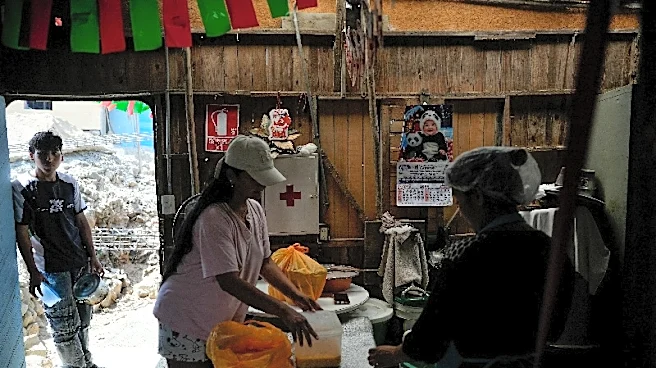
In Ventanilla, a sprawling northern suburb of Lima near the port of Callao, residents who Reuters spoke to described rampant robberies and frequent extortion.
Residents of a low-income housing settlement in Ventanilla formalized during Alberto Fujimori's presidency said criminal groups extract daily payments from even the smallest businesses.
"Extortion is being carried out against everyone," said Rosa Rengifo Zegarra, 39. "There's a man with a ceviche (fish dish) place, they ask him for 10 soles ($3) a day," she said.
Nationally, extortion cases reported to the police rose by roughly 20% last year, official data show, while homicides in the Lima region more than doubled from a rate of 9 per 100,000 people in 2021 to 23.1 per 100,000 in 2025.
"You can no longer even think about having a business that operates," said Pilar Cardenas Lopez, 49, who runs a community food kitchen. "Once they see that you have something, that's it."
Crime in Peru has surged due to a combination of expanding organized crime and weakening state institutions, said Martin Cassinelli of the Atlantic Council. Transnational gangs such as Tren de Aragua have gained ground, while the rapid growth of illegal gold mining has been a major driver of criminal activity.
The state's ability to respond has been undermined by years of political instability and corruption, as well as laws that have weakened prosecutors' ability to investigate and prosecute organized crime, Cassinelli added.
Ventanilla residents described daylight shootings, disappearances and phone-snatching in interviews with Reuters.
"On that corner, at the store, they killed someone," said Teresa Cardenas, 48, signaling beyond the food kitchen entrance. "In the other block, a young man also disappeared," she said.
Successive governments have turned to periodic states of emergency and crackdowns to confront the rising crime, but these have failed to address the underlying causes, analysts say.
For families, insecurity now shapes daily decisions. Zegarra said her 17-year-old daughter often returns home late after dance practice.
"You worry," she said. "One thing is that they snatch the phone — another is that they take her."
ROOTED IN FUJIMORI'S NAME
The settlement in Ventanilla bears the presidential candidate's name – Keiko Sofia Fujimori. In the 1990s, families without housing were resettled on barren sand hills north of Lima and this area was named for Alberto Fujimori's daughter, who he nominated as his first lady after a falling-out with his first wife.
"There was no electricity, no water — just sand," Cardenas said, remembering her arrival in 1995. She lives in a section called Keiko 1.
Older residents recalled visits by Alberto Fujimori and social programs under his government. But they said his daughter had never set foot in the area that carries her name.
"I've been here 27 years, and she has not come personally — not at all," said Cardenas Lopez.
Keiko Fujimori nonetheless retains supporters in the area, driven in part, some locals said, by promises of financial assistance, including cash bonuses, if she is elected. In the April first round she secured around 22% of the vote in Ventanilla, the highest share of any candidate in the district.
DOUBLE-EDGED SWORD
With the first-round count finally done after weeks of delays and allegations of fraud, Fujimori secured about 17% of the national vote in a fragmented field, advancing to a second round against leftist congressman Roberto Sanchez.
An April 26 Ipsos opinion poll put Fujimori and Sanchez in a tie for the June 7 runoff on 38% each.
As she accelerates her campaign ahead of the second round, leaning too far into the Fujimori legacy could be risky for Keiko, analysts said.
"Anti-Fujimorismo is the reason Keiko Fujimori has fallen just short of the presidency three times," said historian and political analyst Daniel Parodi. "That rejection may be weakening, but by how much?"
Eileen Gavin, of consultancy Verisk Maplecroft, described Fujimori's focus on security as a "double-edged sword."
Some voters may be receptive to her tough-on-crime message, Gavin said. "But many also expect commitments to the rule of law and democratic institutional rebuilding to be part of any solution." Commitments to those areas have been "sorely lacking in Fujimorismo," she added.
Alfaro Rojas Carla, a 48-year old mother of five in Ventanilla, looked back on the time of the elder Fujimori era as one of greater security, when she received financial support for her first child.
"There are many who say (Keiko Fujimori) is like her father, which is why they vote for her," said Rojas Carla.
"We hope she'll work in the same way her father did."
(Reporting by Lucinda Elliott; additional reporting by Marco Aquino and Angela Ponce in Lima. Editing by Cassandra Garrison and Rosalba O'Brien)