


(Refiles to add dropped apostrophe in headline)
By Samia Nakhoul
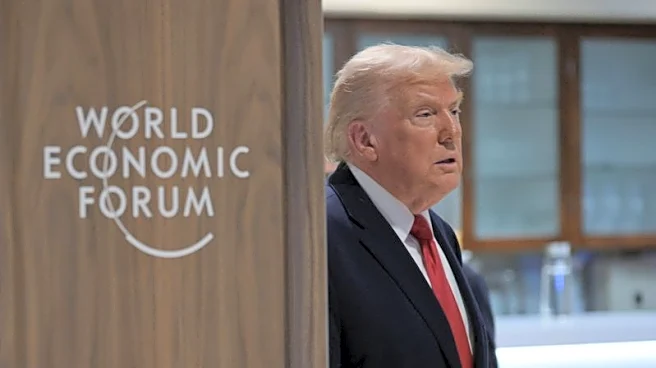
DAVOS, Switzerland, Jan 21 (Reuters) - Donald Trump's Board of Peace, seen by some as a rival to the United Nations, has caught officials at some of the countries invited off guard, with several saying they felt compelled to sign up rather than risk the U.S. president's wrath.
Reuters canvassed 16 world leaders, including politicians and delegates from Arab nations, Latin American countries and Europe at the World Economic Forum annual
meeting in Davos, Switzerland, with the response fairly consistent.
Officials from several regions said privately that joining Trump's proposed board felt less like a choice and more an inevitability, as governments weighed the risks of staying out against the uncertainty of signing on.
One Western delegate pointed to flashpoints involving Trump -- tariffs, Iran, Venezuela, Gaza and Greenland -- as examples of how difficult it can be to resist U.S. demands.
"Who can say no to Trump?" one Arab official said.
A senior White House official said about 35 world leaders have committed so far to the board, which was unveiled last week when the White House sent invitations to about 60 governments, including Britain, Russia and China.
The board, which would be chaired by Trump, would aim to be "a more nimble and effective international peace-building body", a draft charter seen by Reuters showed.
Trump is expected to sign up members as soon as Thursday during a ceremony at the Swiss mountain resort meeting.
Originally conceived as a post‑war Gaza plan to administer and rebuild the devastated enclave, the Board's mandate has widened, with Trump saying it may work on global crises, a role traditionally performed by the United Nations.
He told a news conference on Tuesday that he likes the UN, but it has "never lived up to its potential".
Trump has also put a $1 billion price tag for countries to secure a seat at the table, according to the board's charter.
COUNTRIES DEBATE WHETHER TO JOIN
Some European leaders said they were uneasy about elements of the board's draft charter, particularly provisions that appear to concentrate decision-making power with Trump.
One European diplomat said although EU member states would consult one another, any final decision would ultimately be taken individually, based on each country's national interests.
He said Trump's initiative was still riddled with unanswered questions, including the location of its headquarters and what legal status it would hold.
Describing the process as "a nightmare" mired in bureaucracy, the diplomat said the charter's tightly drawn rules for removing the Board of Peace chairman appeared designed to position Trump in the role for life.
The chair can resign only voluntarily or be ousted unanimously by the executive board on grounds of incapacity.
Several European states have declined to sign up.
France said President Emmanuel Macron intends to turn down the invitation. Foreign Minister Jean-Noel Barrot said the board's charter was incompatible with France’s international commitments, particularly its membership of the UN.
Norway and Sweden also declined, while Italy and Germany said they were still assessing. EU officials said discussions are ongoing among member states, with no decision yet announced.
Britain has adopted a more cautious approach.
Prime Minister Keir Starmer said Britain was discussing the proposal with allies, but stopped short of endorsing it.
BOARD REFLECTS TRUMP’S GLOBAL AMBITIONS
Foreign policy watchers said the initiative was an attempt by the U.S. president to cement his influence.
"In Trump's mind, he's the boss -- whether it's Gaza, Venezuela or anywhere else," said Paul Salem at the Middle East Institute, adding: "This Board of Peace may be his way of managing an American sphere of influence."
He said the ambiguity around the board's mandate was consistent with Trump's approach to power, namely keeping details fluid and intentions opaque to maximise leverage.
"It's not just his style; it's his strategy. He doesn't want people to know in advance what he intends to do as a superpower," Salem said.
Trump allies, including some Latin American and Arab countries, argue the initiative fits within his broader strategy of projecting U.S. strength and leveraging American power to shape outcomes abroad.
Turkey, which has joined along with Saudi Arabia, said it regards the board as a valuable development despite any potential "shortcomings".
"If it provides Gaza with a gram of benefit, if it will save the life of one person in Africa, our president (Tayyip Erdogan) looks at this very positively," Foreign Minister Hakan Fidan told Turkish media.
Critics say it has left governments wary of punishment.
Trump hit back at Macron for refusing to join and threatened punitive trade measures, saying: "I'll put a 200% tariff on his wines and champagnes, and he'll join -- but he (Macron) doesn't have to join."
(Additional reporting by Alexander Cornwell in Jerusalem and Steve Holland in Davos, Editing by David Gauthier Villars, Paritosh Bansal and Alexander Smith)