




By Andrew Osborn
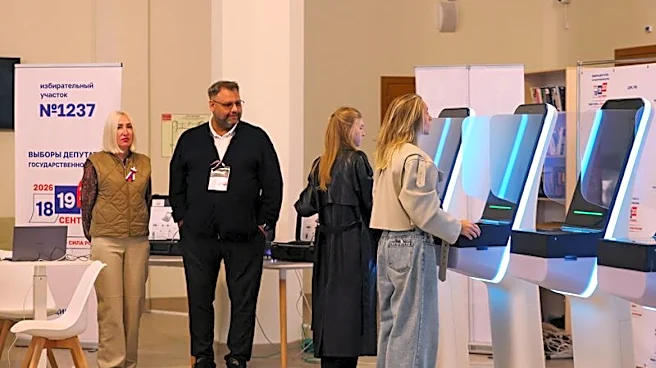
MOSCOW, Sept 18 (Reuters) - Russians began voting on Friday in a three-day parliamentary election which President Vladimir Putin has said will show that millions of people back his army fighting in Ukraine, even though most anti-war candidates were not allowed to run.
The State Duma election, the first since Russia launched its full-scale war in Ukraine in February 2022, is widely expected to see the ruling pro-Putin United Russia party retain its dominance in Russia's tightly controlled
political system.
The result is likely to be held up by the Kremlin as evidence of widespread public support for Putin's policies and, in particular, for his prosecution of Europe's deadliest conflict since World War Two, now in its fifth year.
"Your choice, and your will, will once again demonstrate that millions of people stand behind our soldiers, that we are a united people bound together by shared values, historical memory, and love for our homeland, and that no one will succeed in dividing or intimidating us," Putin said in a televised address before the vote.
An advert on state TV urging people to vote showed Russian military commanders down the ages before cutting to soldiers holding up the national flag after winning a battle in Ukraine with the slogan: "Their voice is the voice of victory. Your vote is the strength of Russia!"
In another move to boost morale and support for fighting on until victory, bone fragments from the sword hand of a medieval Russian prince who won a famous victory over the Mongols were sent to the front in Ukraine in the run-up to the vote.
Voting in Moscow, Anatoliy Simonenko, 76, said he was sanguine about what might happen after the election amid speculation — repeatedly denied by the authorities — that a new wave of mobilisation may be announced.
"There are some very grim predictions, and others that are more optimistic. I expect the outcome will likely fall somewhere in the middle. War is war. It entails expenses, defence spending, and cuts to various social benefits. Well, it’s necessary; there’s no getting around it," he told Reuters.
Another voter, who declined to give his name, said he believed the results were easy to rig and raised doubts about an electronic voting system being used in some parts of the country. The electoral commission has rejected such suggestions as false.
ANTI-WAR PARTY SQUEEZED
Most anti-war candidates were excluded from the ballot before voting across Russia's 11 time zones got underway, after the Supreme Court ruled last month that the liberal Yabloko party — which wants a ceasefire in Ukraine — had breached electoral rules, something it denied.
Some candidates from Yabloko — which has traditionally only got single-digit support in opinion polls — are still running in individual constituencies that account for half the 450 seats in the lower house of parliament.
In the run-up to the vote, Lev Shlosberg, a senior figure in the Yabloko party, was jailed for 11 years for comments about the war. Its deputy leader, Maxim Kruglov, was jailed for seven years on similar charges in June.
Discrediting the army or spreading what authorities regard as fake news are punishable with long jail terms.
Some opinion polls show public support for peace talks has risen to over 60% and the Kremlin has repeatedly said that it is ready to resume such talks.
However, it has also made clear — as its troops push to take control of the rest of the Donetsk region in eastern Ukraine — that any settlement must leave it in full control of all of that territory and that it only wants a long-term deal, not a ceasefire.
Voting is taking place at a time when opinion polls show some Russians have become more anxious about how the conflict affects them.
The economy is also under strain and the authorities are expected to use the vote to gauge the depth of society's war weariness as fuel shortages caused by Ukrainian drone strikes on oil refineries roil some parts of the country and businesses grapple with drone attacks on their warehouses, high interest rates, a labour crunch and Western sanctions.
The Kremlin says national unity is vital because of what it says are increasingly dangerous efforts by Ukraine's intelligence services and other enemies to stir unrest inside Russia.
Initial and partial results are expected to begin trickling out at 1800 GMT on Sunday and near complete results to be available on Monday.
(Reporting by ReutersWriting by Andrew Osborn Editing by Jon Boyle)