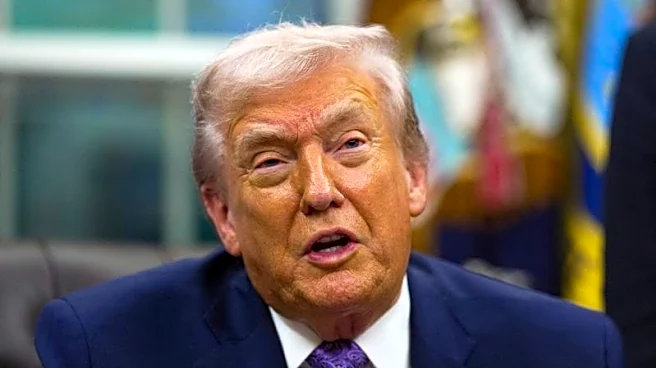




WASHINGTON, Jan 8 (Reuters) - U.S. President Donald Trump said on Thursday that he is ordering his representatives to buy $200 billion in mortgage bonds to bring down housing costs, though he provided no specifics.
"Because I chose not to sell Fannie Mae and Freddie Mac in my First Term ... it is now worth many times that amount — AN ABSOLUTE FORTUNE — and has $200 BILLION DOLLARS IN CASH," Trump wrote in a post on Truth Social.
"I am instructing my Representatives to BUY $200 BILLION DOLLARS IN MORTGAGE
BONDS. This will drive Mortgage Rates DOWN, monthly payments DOWN, and make the cost of owning a home more affordable," Trump wrote.
Federal Housing Finance Agency Director Bill Pulte said on X that Fannie Mae and Freddie Mac will execute the purchase.
It was not immediately clear what funds Trump was referring to when he said the two government-owned mortgage finance companies had $200 billion in cash. The combined cash and cash equivalents listed on the two firms' balance sheets in their third-quarter earnings reports to the Securities and Exchange Commission was less than $17 billion as of September 30.
The White House did not immediately respond to requests for more information on Trump's statement.
Affordability of everything from groceries to homes has become a hot political issue even as Trump has occasionally dismissed affordability concerns and blamed inflation on his Democratic predecessor.
His public approval has mostly sagged since his inauguration as Americans worry about the economy.
Trump’s call to purchase $200 billion in mortgage bonds could provide stimulus to the economy akin to what the Federal Reserve did when it also bought those same types of bonds during the pandemic and its aftermath, as part of an effort called quantitative easing.
But in the Fed's case, it used money it created as the U.S. central bank to fund the purchases. No other entity would have the same ability, which could mean tapping resources that might go to another use.
Trump has pressed the Fed to cut interest rates aggressively and his policy, if implemented, would likely provide some of the lift he’s been seeking.
(Reporting by Kanishka Singh and Bhargav Acharya, Ann Saphir, Michael S. Derby, Trevor Hunnicutt; Editing by Ryan Patrick Jones and Lisa Shumaker)