





By Howard Schneider
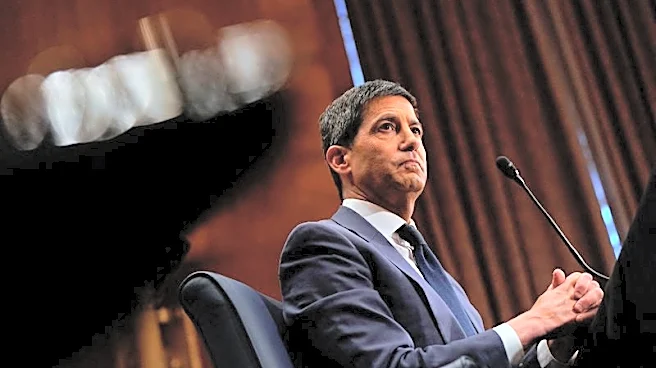
WASHINGTON, May 13 (Reuters) - Kevin Warsh will face a key moment in his first weeks as U.S. Federal Reserve leader when interest rate projections released at June's meeting could reveal to President Donald Trump and the world whether Warsh is as dovish about rates as Trump might hope or disappears into more mainstream Fed thinking.
That's if he submits a projection and interest rate "dot" at all.
Warsh could opt out, an escape valve he could use to conceal his views about interest
rates at least for his first months as the central bank's top policymaker, hand-selected by a president who has made clear he expects borrowing costs to fall.
"That would be a strategic question for him," said former St. Louis Fed President James Bullard, now dean of the Mitch Daniels School of Business at Purdue University.
It is five weeks to the Fed's June 16-17 meeting, and with Warsh's confirmation still proceeding in the Senate, a White House signature on confirmation papers coming after that, and a swearing-in to schedule, "maybe he could just say I didn't have anything to put in this time," Bullard said.
Though the quarterly interest rate projections showing where policymakers expect the Fed's policy rate to be at year's end are anonymous, important aspects of Warsh's outlook would likely be apparent by comparison with those of another Trump appointee, outgoing Governor Stephen Miran.
Miran is occupying the Fed board seat that Warsh is to take, and will have to leave the central bank as Warsh is sworn in. Since joining the Fed in September, Miran's rate projections have been far lower than those of his colleagues, a fact obvious from the "dot plot" and Miran's call for aggressive rate cuts.
When Miran's dot disappears, unless Warsh offers a similarly outside-the-consensus view on rates - something that would raise immediate questions about his independence from Trump - his dot will effectively disappear into the set of more mainstream views that Trump has been railing against.
It wouldn't be unprecedented to withhold a projection.
Bullard as a policymaker stopped submitting long-run estimates for the Fed's quarterly report on officials' economic and interest rate projections, arguing that forecasts beyond a two-to-three-year horizon were bound to be wrong, confusing to the public and undercutting the Fed's credibility.
The Fed called off its projections altogether in March 2020 as the COVID-19 pandemic shut down parts of the economy and made even short-term forecasting futile.
It would also be consistent with Warsh's general distaste for "forward guidance" about upcoming policy decisions. He feels offering too much information upfront ties policymakers' hands. The Fed since 2007 has steadily expanded the data it releases about officials' quarterly projections, adding the rate projections in 2012 when interest rates remained near zero and the central bank felt guidance was important given uncertainty about when the Fed might leave the "zero lower bound."
But in more normal economic times, many Fed officials agree with Warsh that the rate views in the Summary of Economic Projections are easily misinterpreted as a policy "promise" as opposed to a set of as many as 19 uncoordinated projections based on different and even conflicting assumptions.
Changes to the SEPs are something Warsh is considered likely to pursue, an undertaking he could possibly twin with a decision to hold off on his inaugural "dot," said Ellen Meade, former senior adviser to the Fed board and now a Duke University economics professor.
"He could just decide, I have got a lot to do in June, why do I need this headache?" Meade said. He could even encourage his colleagues to delay the SEPs altogether, with a goal of making fixes to it by some date. "Then you're kind of putting feet to the fire," she said.
(Reporting by Howard Schneider; Editing by Dan Burns and Andrea Ricci )