






By Richard Cowan
Aug 18 (Reuters) - Democratic socialist Angie Nixon scored an upset victory on Tuesday in Florida's Democratic primary race for the U.S. Senate, as media outlets projected she defeated former national security official Alex Vindman.
Nixon, who has served in the Florida state legislature since 2020, will face Republican Senator Ashley Moody in November's general election.
The winner will finish the remaining two years in the term of former Florida Senator Marco Rubio, who now serves
as President Donald Trump's secretary of state.
Vindman, a retired Army officer, rose to prominence in 2019 when he testified to Congress during Trump's first impeachment about a call between Trump and Ukrainian President Volodymyr Zelenskiy.
Nixon, 42, has been active in Florida's labor movement and was reprimanded this year for disrupting a Florida House vote when she protested congressional redistricting legislation with a pink megaphone. In her campaign, she urged voters to "make sure you wear your pink to the polls."
She was backed by prominent progressives like Representative Ilhan Omar of Minnesota but will face an uphill climb in November, when nonpartisan analysts see the race as favoring the Republican.
Nixon's victory was a surprising result as Florida voters picked candidates to run in the November election, which will determine control of Congress.
Two veteran Democratic lawmakers cleared their first hurdle as they sought to survive a Republican redistricting that forced them to run in new seats.
Representative Jared Moskowitz was projected on Tuesday to win the Democratic primary in Florida's 25th congressional district, fending off challenger Oliver Larkin, who was backed by the Democratic Socialists of America.
Moskowitz will face Republican Scott Singer, a former Boca Raton mayor, in one of the few congressional races in the state seen as competitive in November.
Representative Debbie Wasserman Schultz, first elected to Congress in 2004, won her party's nomination to represent a Black-majority district centered in Broward County.
After a Supreme Court decision weakened a landmark civil rights law in April, some activists who worried about losing Black representation in Congress criticized Wasserman Schultz for running in the historically Black district.
In another Florida primary, Mike Beltran, a state representative, was projected to win the Republican nomination to face Democratic Representative Kathy Castor in a district redrawn to favor Republicans.
Florida's new map, pushed through by the Republican-controlled legislature this spring, could leave the state with a House delegation of 24 Republicans and only four Democrats, in a state that Trump, a Republican, won by 13 percentage points in 2024.
States usually redraw their congressional maps only at the beginning of every decade, to reflect census results. But several have redistricted over the past year at Trump's urging to shore up the Republican majority in Congress, prompting some Democratic-led states to redraw their own maps in response.
Republican Representative Cory Mills, who is embroiled in ethics investigations, was defeated in his central Florida primary for reelection by former broadcast news anchor Ryan Elijah.
Mills has denied allegations of campaign finance law violations and sexual misconduct now being probed by the House Ethics Committee. Democrats had seen the seat as a potential pickup opportunity if Mills had won the nomination.
SULLIVAN VS. SULLIVAN IN ALASKA
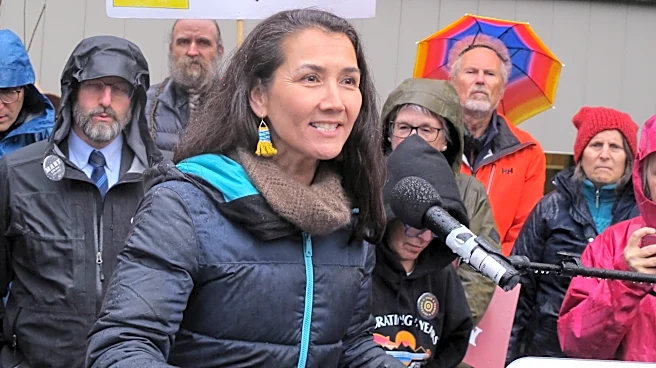
Voters in Alaska were taking part in an unusual nonpartisan U.S. Senate primary. In addition to Democratic challenger Mary Peltola, incumbent Republican Senator Dan S. Sullivan faced a Republican candidate with an almost identical name, Dan J. Sullivan, who remains on the ballot despite attempts to dislodge him.
Polls close in most of Alaska at 8 p.m. (0400 GMT).
Democrats, who are seeking to pick up at least four seats from Republicans to win control of the 100-seat Senate, see the Alaska race as one of their strongest opportunities.
The race has drawn the interest of Trump, who urged voters on social media to "be careful. VOTE FOR THE REAL DAN SULLIVAN TODAY," and called challenger Dan J. Sullivan an "imposter."
The U.S. Justice Department is investigating whether Dan J. Sullivan, a retired schoolteacher, entered the race to confuse voters and siphon votes from the incumbent, according to a source familiar with the probe. He has told other news outlets that it is not his aim.
Some opinion polls show Democratic candidate Peltola, a moderate who formerly held the state's sole House seat, leading Sullivan — an unusual result for a state that typically backs Republican candidates.
The top four candidates in the nonpartisan primary advance to the November election. Peltola also stands to benefit from Alaska's ranked-choice voting system, which could allow her to consolidate support among independents.
In the House of Representatives, incumbent Republican Representative Nick Begich III is facing a challenge from former school administrator Bill Hill, who is listed as an independent but has donated to Democratic candidates in the past. Thirteen other candidates are also on the ballot.
(Reporting by Richard Cowan in Washington, additional reporting by Andrew Goudsward; Editing by Andy Sullivan and Cynthia Osterman)