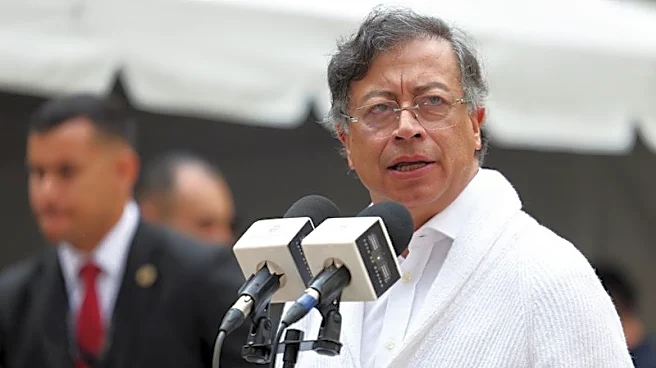








BOGOTA, April 7 (Reuters) - Colombian President Gustavo Petro said on Tuesday evening that his government would submit an economic emergency decree and a new tax reform bill to Congress to balance the 2026 budget.
The president said that if Congress did not approve his economic proposals, he would enact them by decree.
"If necessary, we will declare a new economic emergency in Colombia because what we must save is the standard of living, which is now much higher than at any time in history," Petro
said in a televised address.
The president also asked his interior minister to submit a tax reform bill to Congress in a bid to finance the unbalanced 2026 budget, but did not specify the amount expected to be collected.
Petro's announcement comes amid a standoff with the central bank. Finance Minister German Avila resigned from the central bank's board last week following disagreements over the bank's decision to raise the benchmark interest rate by 100 basis points to 11.25%.
However, analysts say it is unlikely that the current Congress, whose term ends in June, will approve Petro’s economic proposals.
Colombia elected a new Congress in March, which will be sworn in on July 20 and assume its duties once the winner of the upcoming presidential election is determined.
Colombians will go to the polls in late May to elect Petro’s successor. If no candidate secures more than half of the votes, a runoff election will be held in June.
Late last year, Petro declared an economic emergency after Congress rejected a tax reform bill aimed at raising 16.3 trillion pesos ($4.45 billion).
Congress approved a 2026 spending budget of 546.9 trillion pesos, not enough to cover the country's fiscal needs, which led the government to declare an economic emergency after the legislature refused to approve a reform to raise certain taxes.
However, in January, the constitutional court provisionally suspended the economic emergency under which the Petro administration sought to raise 11 trillion pesos ($3 billion) to finance part of its 2026 budget.
Latin America’s fourth-largest economy is experiencing a deterioration in its fiscal accounts, which forced the government in June to suspend a fiscal rule under which the Ministry of Finance raised the fiscal deficit target.
(Reporting by Luis Jaime Acosta, Editing by Christian Schmollinger, Himani Sarkar and Kate Mayberry)