
By Cynthia Kim
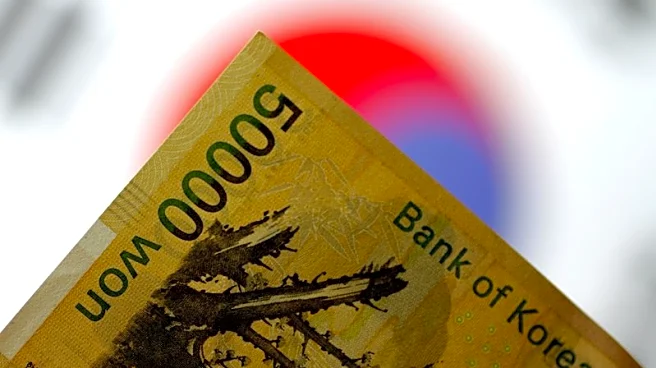
SEOUL, Jan 2 (Reuters) - South Korea's won weakened on the first trading day of the year on Friday even after authorities renewed their determination to stabilize foreign exchange markets
following a package of measures to bolster the local currency.
In his New Year speech, Bank of Korea Governor Rhee Chang-yong warned that the recent dollar-won levels in the high-1,400 range did not accurately reflect the local economy's fundamentals, insinuating that the currency has been too weak.
"While it's difficult to determine the appropriate exchange rate, the recent exchange rate in the upper 1,400-won range appears to be significantly misaligned with our economic fundamentals," Rhee said.
Rhee also said the central bank would not agree to any U.S.-bound investments that could hurt foreign exchange stability as it works with the government to implement a bilateral trade deal with Washington. He also urged the National Pension Service (NPS) to review its overseas investment strategy to minimize its impact on the spot dollar-won market.
On Friday, the won declined 0.26% against the dollar to 1,443.2 at 0408 GMT.
Over the past few weeks, the won has been inching toward 1,500 to the dollar as authorities work to reverse that trend with a package of new tax measures and by issuing warnings against making speculative investments.
In an effort to bring more capital into local equities, the government plans to roll out new tax incentives to bring more foreign investments back home.
And the NPS has been selling dollars to support the won, a move that was interpreted by market participants as an attempt to be in tandem with the government's push to bolster the won.
"We continue to believe that FX authorities would likely prefer the relatively lower dollar-won market average rate of December 30," said Kim Jin-wook, an economist at Citibank Korea, referring to when the won gained to 1,439.5 at the end of last year.
"Our team forecasts dollar-won to stabilize at 1,450 and 1,430 over the next three months and six to 12 months, respectively."
In October, Seoul and Washington finalized a trade deal that caps tariffs at 15%. South Korea is expected to fund its $350 billion U.S. investment pledge mainly through the return of foreign currency assets, though it capped maximum annual outflows at $20 billion to minimize the impact on the won.
Finance Minister Koo Yoon-cheol previously said the scheduled U.S.-bound investment would likely be below the annual $20 billion cap, especially in the early stages.
(Reporting by Cynthia Kim; Editing by Muralikumar Anantharaman, Tom Hogue and Thomas Derpinghaus)