






By Leila Miller
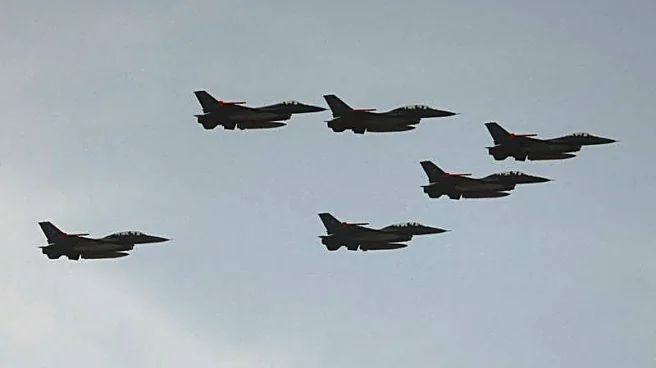
BUENOS AIRES, Nov 27 (Reuters) - In August, long-awaited F-16 fighter jets soared over Buenos Aires, part of Argentina's newly purchased fleet that President Javier Milei has proudly dubbed the country's "guardian angels."
The jets are a potent symbol of Milei's military modernization drive, even as his ambitions for better strategic positioning in the South Atlantic and stronger sovereignty claims over the British-controlled Falkland Islands encounter real-world obstacles.
Argentina’s
armed forces suffer from decades of neglect. In 2025, the government spent 0.56% of its GDP on defense, the lowest in South America, according to the Stockholm International Peace Research Institute.
Milei says he is rebuilding with help from allies. Argentina beat a handful of countries to buy the US-made airplanes from Denmark in April 2024. Washington threw its weight behind the deal, worried that Argentina would turn to China instead, a former defense official from then President Joe Biden's administration told Reuters.
The US has in recent years also approved the purchase of four P-3C Orion surveillance aircraft, sold Argentina eight Stryker armored vehicles and approved the potential purchase of Black Hawk helicopters. Argentina is also replacing its rifles with Israeli ones, while Germany and France have offered to sell the country submarines, according to local media.
Milei’s focus on defense intensified in September when he stepped up the country’s sovereignty claims to the Falklands, known in Argentina as the Malvinas, a bipartisan national cause. Days before, US President Donald Trump had suggested Washington could reconsider its traditionally neutral position on the dispute.
On Saturday, an international court will rule on Argentina's request for provisional measures to halt British-authorized oil drilling near the archipelago. While Milei has pledged to recover the islands that Argentina lost in a 1982 war to Britain through diplomacy rather than force, some experts argue that a more capable military could strengthen his hand in the South Atlantic.
“We don’t have the ability to project power towards the Malvinas,” said Jorge Duran, a former commander of Argentina's armed forces’ special operations. He later added: “We could barely patrol our waters.”
Argentina's Defense Ministry and Milei's office did not respond to requests for comment.
‘LITTLE MORE THAN A MUSEUM'
Argentina’s defense budget plunged after its military dictatorship ended in the 1980s and has remained low through subsequent economic crises, said Luciano Anzelini, an international relations professor at the Universidad Nacional de Quilmes in Buenos Aires province.
The country lost its last submarine in a 2017 naval disaster. Argentina's aging destroyers still rely on the vintage Commodore 64 computer, the military's top official, Marcelo Dalle Nogare, told Buenos Aires' Rotary Club in October.
"The military capacity is little more than a museum,” said Juan Battaleme, a former Argentine defense secretary for international affairs who helped negotiate the $301 million contract for the F-16 fleet.
Milei has pledged to return “respect" to the armed forces, naming a career military officer as defense minister for the first time since Argentina's return to democracy. He has earmarked 10% of government proceeds from the sale or lease of non-military public assets for defense spending.
Since launching his Falklands sovereignty push, Milei's administration has also begun a tender for a dock at a long-planned southern naval base aimed at improving access to Antarctica.
Critics dismiss Milei's talk of a military revival as political theater.
There's been this "sudden burst of patriotism from Milei regarding the Malvinas issue," said former defense minister and opposition congressman Agustin Rossi. "In reality, the policy has been one of military downsizing."
POWER BALANCE
Whether Argentina's recent acquisitions will alter the balance of power in the South Atlantic remains unclear.
Britain has long maintained restrictions on arms sales to Argentina and says its position in the Falklands is secure. Armed Forces Minister Louise Sandher-Jones told Parliament in October that she was "confident that our military presence is at the appropriate level for the defence of the Islands."
Battaleme said that the F-16s, which can intercept hostile aircraft, weren't bought with the aim of recovering the Falklands.
A written statement provided by the F-16 program, which is run by the defense ministry's air force, said that the jets are meant to improve Argentina's air control, as well as "protect its energy resources, critical infrastructure, and even its capacity as a global food producer," while "not losing sight of its interests in the South Atlantic."
Analysts said the acquisition marks a significant upgrade for Argentina's military. Daniela Portella Sampaio, senior Latin America security fellow at the London-based Royal United Services Institute, said the aircraft change Argentina's "capability picture."
Still, others argue that because the F-16s depend on US maintenance and long-term support, Washington is unlikely to allow them to be used against close ally Britain. That prospect remains remote, with Argentine pilots still in the process of training on the aircraft.
“The Argentines are not doing anything that would put the US in an awkward position,” said Evan Ellis, a professor at the US Army War College. "It's just Britain has to worry that they now have them.”
(Reporting by Leila Miller, Editing by Lucinda Elliott and Deepa Babington)