


By Guy Faulconbridge, Dmitry Antonov and Elena Fabrichnaya
MOSCOW, April 16 (Reuters) - Russia's top officials have outlined numerous proposals to President Vladimir Putin on how to kick-start the war economy after he scolded them for what amounts to Russia's sharpest economic contraction in more than three years.
Russia's economy, which contracted in 2022 but grew in 2023, 2024 and 2025, has outperformed most expectations and avoided a crash which Western powers had hoped to stoke by slapping on the
most onerous sanctions ever imposed on a major economy.
But the strain of the war in Ukraine - the deadliest conflict in Europe since World War Two - and double-digit interest rates, slowed growth to just 1% last year. Putin said on Wednesday that the economy had contracted 1.8% in the first two months of this year.
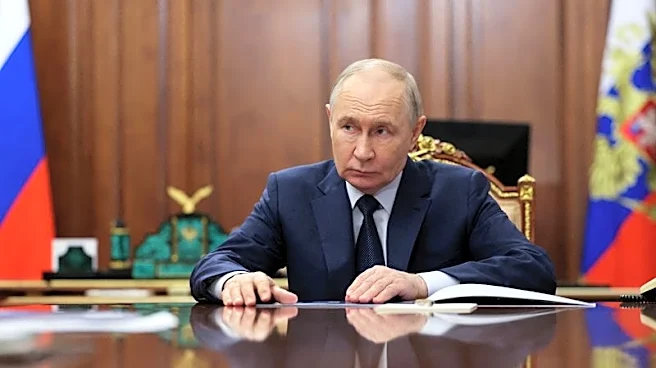
At the start of a Kremlin meeting with Russia's most powerful economic officials on Wednesday, Putin said manufacturing, industrial production and construction were negative in the first two months compared to the same period last year.
Putin said the trajectory of the economy was below expectations and asked officials to give him detailed options on what could be done to remedy the situation.
Kremlin spokesman Dmitry Peskov said on Thursday that the closed part of Wednesday's meeting went on for several hours behind closed doors and that there had been a free exchange of opinions.
"The members of the government's economic bloc have many proposals to activate the economy and give it greater momentum," Peskov told reporters. He declined to give details.
Attendees at the Kremlin meeting included Prime Minister Mikhail Mishustin, Kremlin Deputy Chief of Staff Maxim Oreshkin, First Deputy Prime Minister Denis Manturov, Deputy Prime Minister Alexander Novak, Central Bank Governor Elvira Nabiullina, and PSB bank CEO Piotr Fradkov.
Russia's $3.1 trillion economy contracted 1.4% in 2022, but grew 4.1% in 2023 and 4.9% in 2024. It grew only 1% last year and Moscow's official forecast for this year is 1.3%.
IRAN WAR BOOST
While there were serious concerns in Moscow about the economic slowdown ahead of the Iran war, the biggest energy supply crisis in modern history is likely to bolster the oil producing economy.
The International Monetary Fund on Tuesday raised its forecast for Russia's economic growth this year to 1.1%, from 0.8% previously, due to higher oil and other commodity prices as a result of the Middle East crisis.
Still, according to Russian state statistics, the last quarterly contraction of such intensity as the first quarter of this year was likely in the first three months of 2023, when GDP declined by 0.8%.
In a speech on Thursday, Nabiullina, who has served as Putin's central bank chief since 2013, said the Russian economy was grappling with an acute shortage of labour just as the Iran war was stoking inflation risk.
"The peculiarity of the current situation is that for the first time in modern history, our economy has faced shortages or limits on labour," she said, adding that the shortage had created a new reality for both the state and for business.
"Now we have the deterioration of external conditions, one could say, that is almost constant both in exports and
imports."
At the same Moscow conference, Finance Minister Anton Siluanov, who was also present at the Kremlin meeting, said that the government was considering an early return to the foreign currency market after the rouble strengthened this month.
A stronger rouble helps the central bank fight inflation but is negative for economic growth as it eats into exporting firms' profits, forcing them to cut investment, and makes Russian products less competitive.
(Additional reporting by Gleb Bryanski and Darya Korsunskaya; Writing by Guy Faulconbridge; Editing by Andrew Osborn and Susan Fenton)