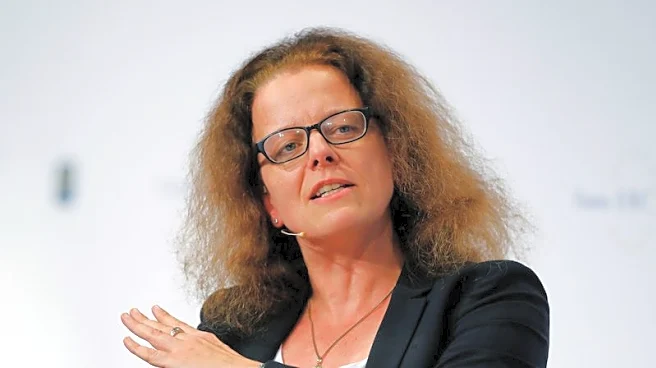


FRANKFURT, March 27 (Reuters) - The European Central Bank should not rush to raise interest rates to combat a surge in inflation and should instead take time to analyse whether the jump is becoming entrenched, board member Isabel Schnabel said on Friday.
The ECB lifted its inflation projections last week and policymakers are now debating whether to raise rates to prevent this rapid price growth from taking hold or whether to look through the shock.
"There is no need to rush into action," Schnabel,
considered a hawkish member of the ECB's Governing Council, told a university lecture in Zürich.
"We have the time to look at the data and to analyse what is actually happening, whether there is evidence of second-round effects, how strong the demand environment is, and how likely it is that this inflation shock is becoming entrenched in inflation expectations, and also in wage growth."
Financial markets now expect three interest rate hikes this year from the ECB, with the first coming in April or June, on the premise that policymakers will be keen to move early after being criticised for misjudging the 2021/22 inflation surge.
But Schnabel said the starting point was now different since interest rates are much higher, there is less support from fiscal policy, there is no pent-up demand as in the post-pandemic environment, and the imbalance between supply and demand is not similar.
"We are in a different starting position," Schnabel said. "And I would argue that this gives us the time to analyse carefully."
However, the energy shock does have the potential to lead to lasting inflation and the ECB will act if this proves to be the case, she added.
"If there is a more persistent impact on inflation, monetary policy will need to act, and it will act, and it will act decisively, just as we have done the last time," she said.
(Reporting by Balazs Koranyi;Editing by Andrew Cawthorne and Gareth Jones)