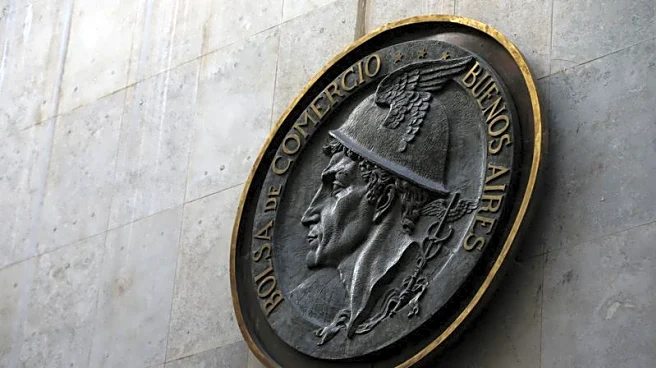

BUENOS AIRES, Feb 9 (Reuters) - Argentine financial markets traded cautiously on Monday as political developments increasingly weighed on short- and medium-term investment decisions.
Investors are closely
watching this week’s Senate debate over a labor reform bill promoted by libertarian President Javier Milei, as well as new regulations aimed at encouraging undeclared U.S. dollars held outside the financial system —commonly known as “mattress dollars” — to enter the formal economy.
The benchmark S&P Merval stock index dipped 2% after an initial gain, following a plunge of 6.95% last week amid a global environment unfavorable to risk assets.
“While sovereign bonds and regional equity markets got off to a strong start this year, the Merval is down about 3% in dollar terms so far in 2026,” said Roberto Geretto of brokerage firm Adcap.
Uneven economic recovery across sectors and delays in implementing reforms help explain the underperformance, he added.
Sovereign bonds traded in the local over-the-counter market were slightly higher in early dealings, according to traders.
On Monday, the government issued regulations establishing a new framework to bring undeclared "mattress dollars" into the financial system without reviewing past assets, in an effort to attract part of an estimated $170 billion that Argentines hold outside the banking system.
“The new framework is not a tax amnesty, but it establishes a scheme under which annual transactions below 100 million pesos can be carried out with greater freedom,” Max Capital said in a note.
“In principle, the government is focusing on facilitating the use of undeclared dollars, which could be incorporated into the formal economy up to certain thresholds—around $65,000—without requiring proof of origin,” the firm added.
In the foreign exchange market, the peso remained steady at 1,432 per dollar, while the central bank continued to buy dollars to bolster international reserves.
The central bank purchased $317 million in foreign currency last week, bringing total net purchases so far in 2026 to $1.476 billion.
(Reporting by Walter Bianchi; Editing by Alistair Bell)