


Aug 17 (Reuters) - U.S. President Donald Trump has told the Pentagon to "substantially reduce" joint military exercises with South Korea that began on Monday, citing the cost and Seoul's refusal to take part in actions against Iran.
Here are some details on the drills and Trump's previous stance.
WHAT IS PLANNED FOR THIS YEAR
South Korea's Joint Chiefs of Staff confirmed the annual Ulchi Freedom Shield drills, due to run to August 27, started on Monday.
Military officials said last week the drills will
incorporate exercises to counter drones, GPS disruption and cyberattacks to reflect North Korea's evolving capabilities.
The drills were focused on threats to the Korean Peninsula and the defence of South Korea, a U.S. official said, noting how North Korean soldiers deployed to fight against Ukraine had taken back lessons from the conflict.
The official highlighted the changing character of war, including the growing use of unmanned systems, electronic warfare and cyber operations.
About 18,000 South Korean troops will take part, a scale similar to previous years, said Captain Jang Doyoung of South Korea's Joint Chiefs of Staff.
HOW HAS NORTH KOREA REACTED?
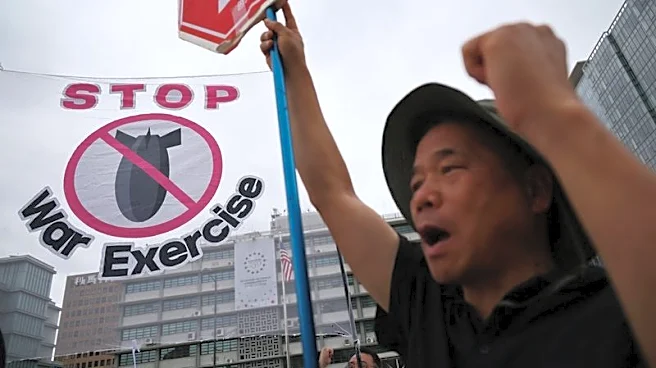
While the U.S. and South Korea say the drills are defensive in nature, Pyongyang routinely denounces them as rehearsals for invasion.
North Korea on Friday condemned the drills as more provocative than last year's exercises, state media reported.
U.S.-Japan-South Korea military cooperation is turning into a nuclear alliance and North Korea will respond to a new level of threat with a new level of deterrent, state media KCNA cited a spokesperson for North Korea's Foreign Ministry as saying.
North Korea also said on Friday it would further strengthen its nuclear deterrence, accusing the United States of pursuing a new nuclear strategy that lowers the threshold for using weapons and could push global security "to the brink of a nuclear war."
HISTORY OF THE DRILLS
The first combined exercises took place soon after the Korean War ended with an armistice in 1953. The exercises have since evolved to focus on interoperability and command relations between the militaries, shaped by perceived and actual threats from the North.
In 1976, the Ulchi and Focus Lens drills were combined into Ulchi Focus Lens, an expanded exercise, which eventually became the largest computer-assisted military simulation in the world, according to 38 North, a U.S.-based think tank.
They have undergone several name changes before their current label, as well as changes in scale and focus. There has also been a shift away from live-fire exercises to computer-simulated missile and cyberattacks.
TRUMP'S VIEWS TOWARD THE EXERCISES
It is not the first time Trump has criticised the drills.
After trading threats of nuclear annihilation during the first year of his initial term, Trump held three unprecedented meetings with North Korean leader Kim Jong Un in Singapore, Hanoi, and at the border between North and South Korea.
In 2018, he announced after his summit in Singapore that the U.S. was suspending the summer’s joint military drills with South Korea, then known as Ulchi Freedom Guardian.
Trump said at the time he would halt what he called “very provocative” and expensive regular military exercises that the United States holds with South Korea.
While the drills later resumed when the diplomatic efforts foundered over North Korea's nuclear programme, Trump has during his second term continued to tout his special relationship with Kim and his willingness to hold new talks.
SOURCES: Reuters, 38 North.
(Reporting by Ed Davies and Heejin KimEditing by Lincoln Feast.)