






By Janis Laizans and David Latona
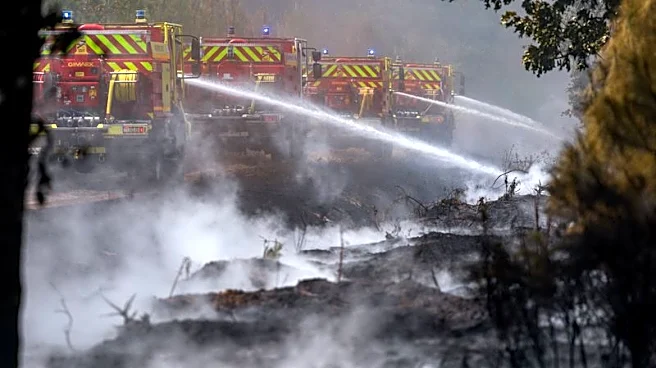
BORDEAUX/MADRID, July 27 (Reuters) - Firefighters battled massive wildfires threatening the French city and wine region of Bordeaux on Monday, while crews in Spain struggled to control a series of forest blazes raging since last week, the result of a blisteringly hot and dry summer in Western Europe.
About 220,000 people, including tourists and local residents, have been evacuated in France, while in neighbouring Spain nearly 100,000 have been told to leave their homes,
authorities said.
The French blazes, which broke out last week near the Atlantic coast, are now only 15 kilometres (9.3 miles) from entry points to the main metropolitan area of Bordeaux.
"This is a fire of a size never seen before," Jerome Steffe, mayor of Cestas, said on Monday. Cestas is one of the suburbs just outside the main Bordeaux city area.
The spread of the large fires converging in central Spain slowed overnight thanks to more favourable weather conditions, authorities said, but a separate blaze in the eastern Castellon province raged out of control as the weather agency warned of another potential heatwave this week.
"What we're experiencing isn't a succession of isolated events. It's the most painful expression of a climate emergency that is making sixth-generation wildfires more ferocious, heatwaves more frequent, and our territory more vulnerable," Prime Minister Pedro Sanchez said on Monday.
The so-called sixth-generation fires are the most extreme and uncontrollable category of forest blazes, capable of generating their own weather and destroying thousands of hectares per hour. Many scientists blame such fires and heatwaves on human-driven climate change.
Maria Angeles Serrano, an evacuee in Castellon, said she was afraid for all the nature being ravaged: "Material damage is one thing, but that can be repaired, so to speak. What really hurts is the emotional loss.”
ECONOMIC IMPACT BEING FELT
The wildfires around Bordeaux in southwestern France have delivered a shock to the regional economy, Finance Minister Roland Lescure said on Monday. The region is one of the centres of French wine production and a major centre for tourism.
"It's like a clap of thunder for an area which could have done without this," Lescure told reporters.
President Emmanuel Macron's government was due to discuss the wildfire situation at a cabinet meeting on Monday.
In central Spain, three separate fronts remained active in the mountains northwest of Madrid. Authorities estimate that a combined 77,000 hectares have burnt so far in the fires across the provinces of Madrid, Toledo and Avila. The one in Avila has been classified as the biggest wildfire in recent Spanish history.
WINDOW OF OPPORTUNITY
"Today and tomorrow are absolutely crucial days in tackling this wildfire. From Wednesday onwards, weather forecasts become significantly more unfavourable for firefighting operations, but we remain confident," said Spanish Interior Minister Fernando Grande-Marlaska.
France faced a similar situation, with more favourable conditions on Monday before temperatures rise again to as high as 37 C (98.6 F) later this week in the Bordeaux area, according to forecasts from France's weather office.
"It's a race against time before the heatwave returns," said Cestas mayor Steffe.
In both Bordeaux and Avila, July high temperatures have averaged 32 degrees Celsius (90 degrees Fahrenheit), almost 6 C above the month's normal high between 1961 and 1990, according to the Reuters Climate Monitor.
RESPONSE UNDER SCRUTINY
The scale of this summer's wildfires in Europe is putting pressure on firefighting resources and raising questions about how to respond.
Under the European Union's civil protection mechanism, Greece and Italy have each sent two Canadair water-bombing aircraft to Spain, while Portugal has deployed more than 100 military personnel and equipment.
Two more planes were due to arrive from Turkey, Spain's interior ministry said.
Switzerland is supporting France by sending two Super Puma helicopters and their crews after a request from Paris.
(Reporting by Sudip Kar-Gupta, Manuel Ausloos, Elizabeth Howcroft, Yves Hermann, David Latona, Emma Pinedo and Emma FargeWriting by Keith Weir, editing by Andrei Khalip)