



Dec 10 (Reuters) - Groups operating from Israeli-held areas of Gaza say they will continue to fight Hamas despite the killing of their most prominent commander, reporting more recruits since an October ceasefire as they eye a role in the enclave's future.
The emergence of the groups, though they remain small and localised, has added to pressures on Islamist Hamas and could complicate efforts to stabilise and unify a divided Gaza shattered by two years of war.
Prime Minister Benjamin Netanyahu acknowledged
Israeli backing for anti-Hamas groups in June, saying Israel had "activated" clans, though Israel has given little detail since then.
Last week, the man seen at the heart of efforts to establish anti-Hamas forces - Yasser Abu Shabab - was killed in southern Gaza's Rafah area. His group, the Popular Forces, said he died mediating a family feud, without saying who killed him. His deputy, Ghassan Duhine, has taken over and vowed to continue on the same path.
Hamas, which has controlled Gaza since 2007 and has so far refused to disarm under the ceasefire plan, has branded such groups collaborators - a view that Palestinian analysts say is broadly shared by the public. Itmoved swiftly against Palestinians who defied its control after the U.S.-backed ceasefire took hold, killing dozens, including some it accused of working with Israel.
Nearly all Gaza's 2 million people live in Hamas-held areas, where the group has been reestablishing its grip and where four Hamas sources said it continues to command thousands of men despite suffering heavy blows during the war.
But Israel still holds over half of Gaza - areas where Hamas' foes operate beyond its reach. With President Donald Trump's plan for Gaza moving slowly, there is no immediate prospect of further Israeli withdrawals.
Three Egyptian security and military sources said Israel-backed groups had increased their activities since the ceasefire, and estimated they now had 1,000 fighters, adding 400 since the truce.
Egypt, which borders Gaza, has been closely involved in negotiations over the conflict. The sources expected the groups to further step up their activities in the absence of a comprehensive deal on Gaza's future.
FOOTAGE SHOWS FIGHTERS ASSEMBLED
A diplomat who spoke on condition of anonymity said the anti-Hamas groups lacked any popular constituency, but added that their emergence raised concerns for the enclave's stability, heightening risks of conflict among Palestinians.
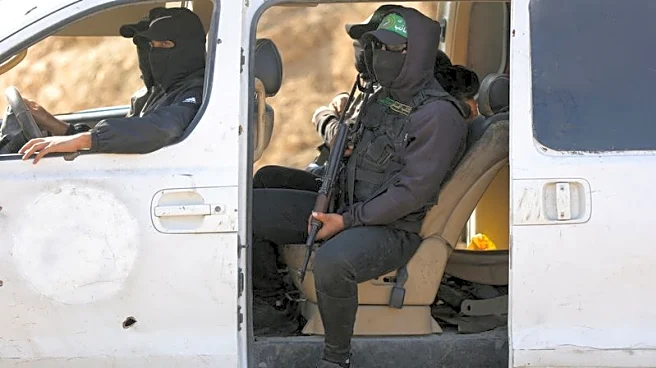
Since Abu Shabab's death, his group and two others have posted videos showing dozens of fighters assembled, as commanders are heard praising him as a martyr and vowing to continue.
One video released on December 5 shows Duhine telling fighters Abu Shabab's death was a "grave loss" and adding that they would "continue on this path and move with the same strength and even more strength".
Reuters verified the location as Rafah Governorate - an area of Gaza where Israeli forces are still deployed - by analysing the buildings, walls and trees in the footage which matched file and satellite imagery of the area.
On December 7, Duhine announced the execution in late November of two men he identified as Hamas militants, saying they had killed a member of his group. A security official in a Hamas-led coalition of militant groups in Gaza said such actions did not "alter the realities on the ground".
Hussam Alastal, who heads another anti-Hamas faction based in the Khan Younis area, said he and Duhine had "agreed the war on terror will continue" during a visit to Abu Shabab's grave in the Rafah area. "Our project, new Gaza ... will move ahead," Alastal told Reuters by phone.
Alastal, speaking to Reuters in a separate call in late November, said his group has received arms, money and other support from international “friends” whom he declined to identify. He denied receiving Israeli military backing but acknowledged contacts with Israel over "the coordination of the entry of food and all the resources we need to survive".
He said he was speaking from inside Gaza, in the Israeli-controlled sector near the "yellow line" behind which Israel has withdrawn. Alastal said his group had added recruits since the truce and now had several hundred members including fighters and civilians. The Popular Forces has also grown, a source close to it said, without giving a figure.
HAMAS: ABU SHABAB MET 'INEVITABLE FATE'
Israel says it aims to ensure that Hamas - which ignited the war with its October 7, 2023 attack on Israel - is disarmed and has no future role governing Gaza.
In response to a request for comment, an Israeli government official said: "There is no shortage of Palestinians wishing and actively fighting to free themselves of the Hamas repression and tyranny".
The Popular Forces didn't respond to requests for comment sent via their Facebook page. It has previously denied receiving Israeli support.
Hamas said Abu Shabab's death was the "inevitable fate of all those who betrayed their people and homeland", while claiming no role in his killing.
The security official in the Hamas-led coalition said threats by its foes were "psychological warfare" orchestrated by Israel to "undermine internal stability".
Hamas spokesperson Hazem Qassem said security forces would pursue collaborators "until this phenomenon is eradicated".
But they "are protected by the occupation army in the areas where these forces are present, which makes it difficult for the security apparatuses", he said, in comments to Reuters before Abu Shabab's death.
HOUSING COMPOUNDS PLANNED
As well as disarming Hamas, Trump's plan foresees the establishment of a transitional authority, the deployment of a multinational force, and reconstruction.
But with no clarity on next steps, there is a risk of de facto partition between an inland sector controlled by Israel where few people now remain, and a sector along the coast now crowded with displaced people, much of it wasteland.
Touring Gaza on Sunday, Israeli military chief Lieutenant General Eyal Zamir said Israel had "control over extensive parts of the Gaza Strip and we will remain on those defence lines".
"The Yellow Line is a new border line — serving as a forward defensive line for our communities and a line of operational activity," he said.
Goals cited by anti-Hamas groups include establishing secure areas for displaced Gazans.
In October, U.S. Vice President JD Vance and Trump's son-in-law Jared Kushner said reconstruction funds could flow to the Israel-controlled area without waiting for the next stage of the plan to begin, with the idea of creating model zones for Gazans to live in.
Rafah is one of the first sites U.S. officials have identified for such housing compounds, described as "Alternative Safe Communities," though no timeline has been set, according to two Israeli officials and three Western diplomats involved in post-war Gaza planning.
A U.S. State Department spokesperson said the U.S. was working with partners "to provide housing and other services to Gazans as quickly as possible".
The United States has not had any official contact with the anti-Hamas groups, "nor are we providing any funding or support", a U.S. official said. "We are not going to be picking winners or losers in Gaza," the official said, adding: "Beyond Hamas having no future role, who will govern Gaza will be up to Gazans."
DESTABILIZING HAMAS CONTROL
Some Palestinians celebrated news of Abu Shabab's death in the nearby city of Khan Younis by distributing sweets, witnesses said.
Ghassan al-Khatib, a lecturer in international studies at Birzeit University in the occupied West Bank, said that while Hamas' popularity had declined because of the costs of the Gaza war, the anti-Hamas groups had no future because they are viewed by Palestinians as collaborators.
"Israel is using them only for tactical reasons, particularly to try to destabilize Hamas control," he said.
A spokesperson for President Mahmoud Abbas' Fatah Movement, which was driven from Gaza by Hamas and runs the Palestinian Authority in the West Bank, said it rejected any armed groups backed by Israel, saying they had "nothing to do with our people and their cause".
(Editing by Aidan Lewis)