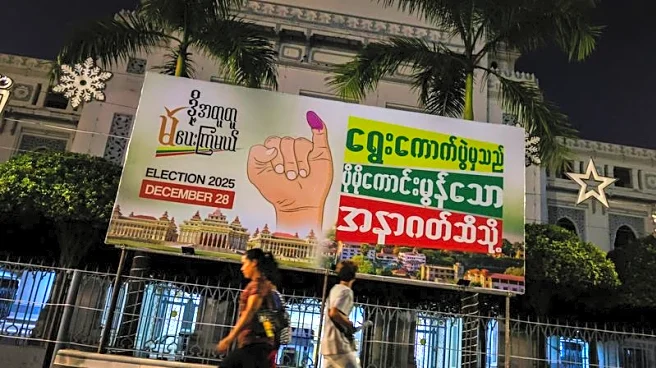

Jan 11 (Reuters) - Voters in war-torn Myanmar queued up on Sunday to cast their ballots in the second stage of a military-run election, following low turnout in the initial round of polls that have been
widely criticised as a tool to formalise junta rule.
Myanmar has been ravaged by conflict since the military ousted a civilian government in a 2021 coup and detained its leader, Nobel Peace Prize winner Aung San Suu Kyi, sparking a civil war that has engulfed large parts of the impoverished nation of 51 million people.
Suu Kyi's National League for Democracy party, which swept the last election in 2020, has been dissolved along with dozens of other anti-junta parties for failing to register for the latest polls, while rebel groups have refused to take part.
The United Nations, many Western countries and human rights groups say the election is a sham exercise that is neither free, fair nor credible in the absence of a meaningful opposition.
ARMY ALLIES MARCHING TOWARDS VICTORY
The military-backed Union Solidarity and Development Party is leading by a huge margin after winning 90 of the 102 lower house seats contested in the first phase on December 28, which saw only 52.13% voter turnout, much lower than elections in 2020 and 2015.
"The USDP is on track for a landslide victory, which is hardly a surprise given the extent to which the playing field was tilted in its favour. This included the removal of any serious rivals and a set of laws designed to stifle opposition to the polls," said Richard Horsey, Senior Myanmar Adviser for Crisis Group.
A final round will take place on January 25. In all, there will be voting in 265 of Myanmar's 330 townships, including areas where the junta does not have full control.
TRANSITION PROMISED
The junta has said the election will bring political stability and a better future for the country, which is facing one of the most serious humanitarian crises in Asia.
At least 16,600 civilians have died in the conflict since the coup, according to Armed Conflict Location & Event Data Project, and the U.N. estimates that 3.6 million people have been displaced.
However, analysts warn that the junta's attempt to form a stable administration amid raging conflict is fraught with risk and any military-controlled government is unlikely to gain broad international recognition.
Junta chief Min Aung Hlaing last month sidestepped a question from a reporter about his political ambitions.
He hailed the election as a success during a visit last week to central Myanmar township, where he urged authorities to work to further boost turnout.
"In phase one of the election, a large number of votes were cast, showing that the people have a strong desire to participate in the democratic process," state media quoted him as saying.
"Therefore, the election can be considered a successful one."
(Reporting by Reuters Staff, Editing by Devjyot Ghoshal, Martin Petty)