






By Lucy Craymer
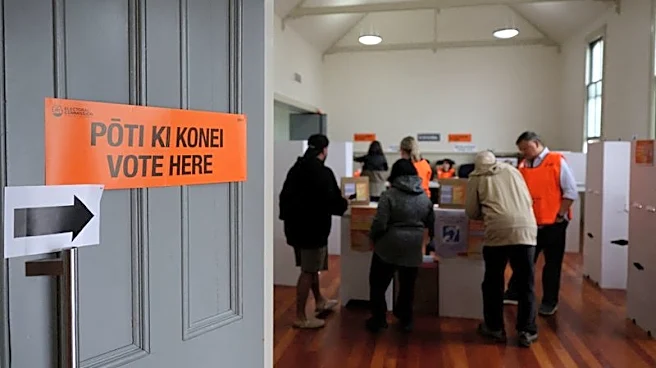
WELLINGTON, Nov 16 (Reuters) - For three years, lawyer Tania Waikato used social media to challenge what she saw as the government's assault on New Zealand's founding document and to encourage people to vote. Now, as a newly elected Green MP, she is taking the fight to parliament.
Waikato, 47, is among at least nine new Maori MPs expected to join the 55th parliament, according to preliminary results, building on the record Maori representation elected in 2023.
But the most visible emerging
force is a younger, largely left-leaning generation who see politics not simply as a contest over budgets and election cycles, but as a struggle over identity, rights and the direction of the country.
Their influence could be particularly significant after three years of a conservative government that has moved to reduce the role of the Treaty of Waitangi in public policy and to unwind programmes designed to address entrenched inequality.
Preliminary results show the incumbent National-led coalition holding a narrow majority, although nearly 400,000 votes — around 14% of the total — remain to be counted before final results are announced on November 27.
"My main focus is to work towards the entrenchment of Tiriti (the Treaty of Waitangi)," said Waikato, who added if it was from opposition it would be extremely difficult given the bills being progressed that undermine it.
'PROUD TO BE MAORI'
The Treaty of Waitangi, signed in 1840 by the British Crown and more than 500 Maori chiefs, sits at the heart of New Zealand's political and legal debate. Its English and Maori texts differ in important ways, and arguments over its meaning have shaped relations between Maori and the state for generations.
For many of the new MPs, political rights are not separate from material conditions: Maori communities continue to experience poorer economic and social outcomes, with unemployment at 10.9%, compared with 5.7% nationally.
Those pressures help explain why younger Maori candidates are gaining traction: they combine an unapologetic cultural confidence with more progressive answers to the pressures facing working families.
"There has been a generational shift," said Lara Greaves, an associate professor of politics at Victoria University of Wellington.
"They feel proud to be Maori, they feel like they stand up for Maori culture and Maori political rights," Greaves said. "That's kind of changing the landscape."
Maori make up roughly 17.5% of New Zealand's population and are expected to increase to 20% by 2038 with a third of New Zealand's children being Maori, according to government data.
'SOMETHING QUITE PHENOMENAL'
Nearly half of Maori MPs were under 50 before the election, according to parliamentary services data. Many came of age during a period of cultural and language revitalisation, including the growth of kohanga reo preschools, kura kaupapa Maori and other Maori-language immersion education.
That background has helped produce politicians who are comfortable moving between te ao Maori — the Maori world — and the institutions of the modern state. They are less likely to see their language, culture and political aspirations as subjects confined to ceremonial occasions and want them reflected in the way governments make decisions.
Hana-Rawhiti Maipi-Clarke became the clearest symbol of that change in 2023. At just 21, she defeated former foreign minister Nanaia Mahuta in a Maori electorate, signalling that voters in the seven dedicated Maori seats were willing to back younger and bolder voices.
She later broke parliamentary protocol to lead a haka during the first reading of a controversial bill that sought to reinterpret treaty principles.
Waikato says she is slightly too old to be classified among the generation and instead calls herself part of the "hybrid generation." However, she did attend one of the country's first bilingual schools in Te Teko, on the country's east coast.
"What it produces is something that is quite phenomenal," she said, pointing to her 13-year-old son's ability to stand confidently in adult spaces as evidence of what he has learnt at school.
A DIFFERENT WORLDVIEW
Green MP Tamatha Paul, 29, is more firmly part of the kohanga reo generation. Raised in a working-class Maori and Pacific community in central New Zealand, she argues that today's leaders must be as ambitious as the Maori activists who drove the renaissance of the 1970s and 1980s.
"I hope that this generation of Maori politicians are willing to do something equally as transformational," she said.
The political environment they are entering is fraught. In 2024, a nine-day march against proposed changes to treaty principles culminated in an estimated 42,000 people marching on parliament.
The bill ultimately failed, but critics say the government has continued to reduce the treaty's influence through other policy changes. National and its coalition partners argue that their reforms are intended to ensure consistent public services and equal treatment for all New Zealanders.
Labour, the Greens and Te Pati Maori have all promised, to varying degrees, to reverse parts of that programme. Labour MP Cushla Tangaere-Manuel, 47, said her party would reinstate the Treaty of Waitangi across legislation, but stressed that the treaty must also live "in all New Zealanders' hearts and minds."
For this rising generation, however, the debate is also about bringing a different worldview into the centre of politics.
A te ao Maori worldview stresses relationships between people, ancestors, land, water and future generations, as well as collective responsibilities of care and guardianship. Tangaere-Manuel said that outlook should shape environmental and social policy.
"We certainly do want to be able to fulfil our roles as guardians of our whenua (land)."
(Reporting by Lucy Craymer; Editing by Saad Sayeed)