
By Lili Bayer
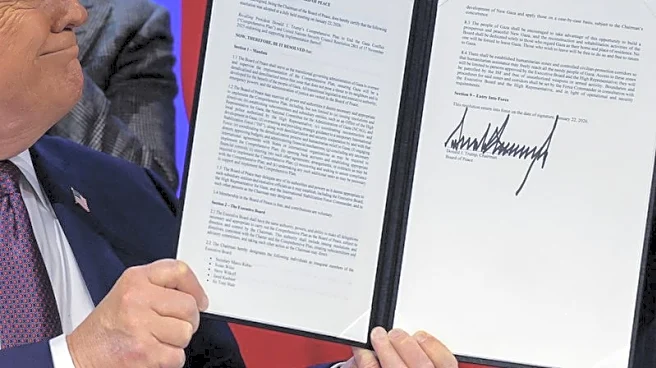
BRUSSELS, Jan 23 (Reuters) - The European Union’s foreign policy arm has raised questions about U.S. President Donald Trump’s broad powers over his new Board of Peace, according to an internal
document seen by Reuters.
Trump has urged world leaders to join his Board of Peace initiative aimed at resolving conflicts globally, but many Western heads of government have been reluctant to take part.
In a confidential analysis dated January 19 and shared with the EU’s member countries, the European External Action Service expressed worries about a concentration of power in Trump’s hands.
The Board of Peace's charter “raises a concern under the EU’s constitutional principles” and “the autonomy of the EU legal order also militates against a concentration of powers in the hands of the chairman,” the bloc’s diplomatic service wrote.
The document also says the new Board of Peace “departs significantly” from the mandate that was authorized by the United Nations Security Council in November and solely focused on the Gaza conflict.
EXPANDING REMIT
The new board, which the U.S. president launched on Thursday, is chaired for life by Trump and is set to start by addressing the Gaza conflict and then be expanded to deal with other conflicts. Member states are limited to three-year terms unless they pay $1 billion each to fund the board's activities and earn permanent membership.
"Once this board is completely formed, we can do pretty much whatever we want to do. And we'll do it in conjunction with the United Nations," Trump said, adding that the U.N. had great potential that had not been fully utilised.
After European leaders met to discuss the transatlantic relationship on Thursday evening, European Council President Antonio Costa told reporters: "We have serious doubts about a number of elements in the charter of the Board of Peace, related to its scope, its governance and its compatibility with the United Nations charter.”
Costa said that the EU was “ready to work together with the United States on the implementation of the comprehensive Peace Plan for Gaza, with a Board of Peace carrying out its mission as a transitional administration, in accordance with the United Nations Security Council Resolution 2803”.
Several EU countries, including France and Spain, have already said they would not be joining the board.
In its analysis, the EU’s diplomatic service said that “the provision that a Member State’s choice about the level of its participation needs the approval of the chairman constitutes an undue interference with the organisational autonomy of each member”.
(Reporting by Lili Bayer in Brussels and John Irish in Paris; Editing by Alex Richardson)