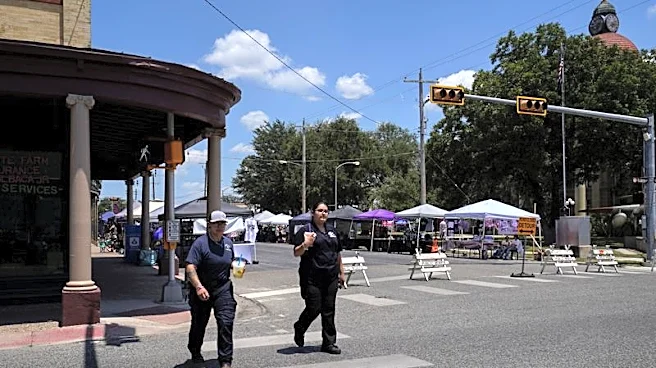






BEEVILLE, Texas, Sept 4 (Reuters) - The makeup and toys on Valencia Macias' table are items people buy on impulse at discount stores. But on a sweltering summer day in South Texas, she is trying to sell them to turn them into gas money, grocery money, student loan money: any kind of money.
With three young children, a job as a medical assistant and nursing classes at night, the 26-year-old has little time for politics. But when Texas officials withdrew funding for the only after-school program available
in her rural town of George West, politics became impossible to ignore.
Then, a TikTok video appeared: A Mexican American woman on the screen, Gina Hinojosa, talked about the high cost of living and badly needed investments in Texas public education. Macias stopped scrolling.
“With everything just getting so expensive and the gas and everything, it's really hard to just make do,” Macias said. Seeing a mother and a woman who looks like her, Macias made up her mind: “100%, she has my vote.”
Hinojosa, a Democratic state representative, is trying to end an electoral drought that has defined Texas politics for a generation: no Democrat has won statewide office in Texas since 1994.
Her strategy hinges on persuading Latino voters like Macias that rising costs and strained public schools matter more than the cultural and immigration issues that have pulled many Latino voters toward Republicans in recent years.
Hinojosa said that means resisting the tendency to treat Latino voters as a distinct political constituency with separate priorities. Instead, she argues they are motivated by the same concerns as other Texans, including housing costs, schools and day-to-day expenses. So, her campaign delivers that message in Spanish to Latino audiences.
"We are as Texan and American as anyone," she said in an interview in Austin. "Latinos are feeling the economic strain just like families all across this country and in Texas in a big way."
Her campaign tests whether Democrats can regain support among Latino voters by emphasizing pocketbook issues.
The test is whether it can overcome the political machine Republican Governor Greg Abbott has built over the last 12 years in office.
He has name recognition, President Donald Trump's endorsement and a vast support network that stretches beyond Texas. He has raised roughly $25.5 million between February and July, while Hinojosa raised about $6 million. Abbott holds more than a 22-to-1 cash-on-hand advantage, with $67.2 million to Hinojosa's $3 million, the latest campaign finance reports show.
Abbott spent years cultivating support in South Texas, regularly visiting heavily Latino border communities, building an extensive field operation in the Rio Grande Valley and making border security a centerpiece of his outreach.
Republican gains followed his sustained efforts to compete for Hispanic voters on issues including immigration, public safety and the economy.
Hinojosa’s betting that the sharp drop in support for Trump and the party he leads will lead her to victory. State polls have consistently shown she's within striking distance of Abbott all year.
FORMIDABLE INCUMBENT
Abbott is still favored to win in the Republican-leaning state. Hinojosa would have to break the three-decade Republican streak in the office. To stay in power, Abbott has turned to a Republican playbook portraying Hinojosa as out of step with his law-and-order agenda on the campaign trail.
“Governor Abbott is not taking the support of any voter — including Latino voters — for granted, which is why he is investing significant time and resources to earn votes in every community,” Abbott's campaign press secretary Eduardo Leal said in a statement to Reuters.
Recent polling suggests Latino voters favor Hinojosa over Abbott. An August 2026 Emerson College Polling/Nexstar survey found Hispanic voters favored Hinojosa over Abbott by 17 percentage points and that 57% disapproved of Abbott's job performance. That same statewide poll, which surveyed 1,000 likely voters, showed Abbott leading Hinojosa 49% to 45% overall, with a margin of error of 3 percentage points.
Abbott recently released an "affordability agenda" — including property tax cuts, housing reforms, lower electricity costs, expanded low-cost health insurance, a $25-a-month cap on certain prescription drugs, and more. His campaign says the measures will help Texans offset rising living expenses.
“Latino voters care about the same issues that are important to all Texans: overhauling the property tax system, securing the border, putting dangerous criminals behind bars, and keeping Texas affordable,” Leal said.
Samuel Aguero, 28, a Navy veteran, voted for Trump in 2024. But as a single father of two daughters, his top issue is education — he says Beeville's public schools need more state resources, and if Hinojosa offers specifics on improving them, he may back her instead.
"We have to have higher standards in school," he said. "Teachers should be paid a lot more, like, a heck of a lot more."
NUMBERS
Hinojosa may benefit from electoral tailwinds that eluded Beto O'Rourke and other statewide Democratic candidates before her.
Demographic trends have strengthened Democrats' long-held belief that Texas' growing Latino electorate could eventually reshape statewide politics. Texas now has about 6.5 million Latino eligible voters, roughly 1 million more than in the years leading up to Abbott's last reelection campaign.
But the key to Hinojosa’s campaign is how many people actually turn out to vote. Nearly 4.5 million Texans voted in the Democratic and Republican primary elections in March, a recent midterm record.
Record participation, fueled by the high-profile Senate primary battles involving Attorney General Ken Paxton and State Representative James Talarico, could offer Democrats a rare sign of momentum in a state where voter turnout has historically trailed the national average.
Still, voters like Dawn Barraza, 54, an eighth-grade schoolteacher in Victoria, Texas, want “change.” At a monthly outdoor market in Beeville, Barraza said her family fares okay financially, but there’s palpable frustration among Latinos in South Texas that Republicans are not addressing.
“They need to be standing up for our people here; it's high time everybody realizes that we're not going anywhere,” she said.
(Reporting by David Hood-Nuño; Editing by Kat Stafford and Alistair Bell)