
PHOENIX, Oct 1 (Reuters) - On Phoenix campaign signs, Arizona-wide TV ads and in debates for key US House races, one issue has bubbled to the top of politics in this drought-hit state: Water.
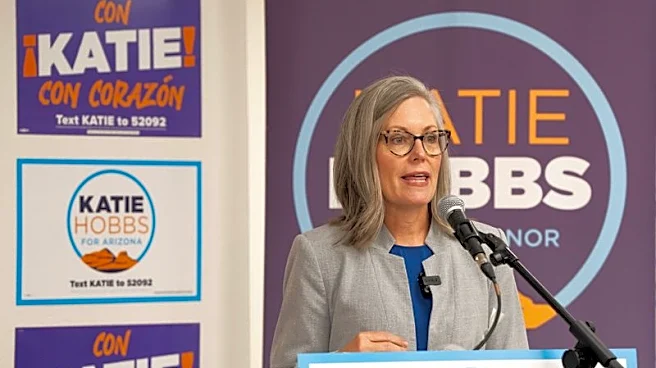
Governor Katie
Hobbs, a Democrat seeking reelection in the November 3 midterm polls, says, “Arizona’s water is for Arizonans” in a TV commercial claiming she fought the federal government this year for the state's fair share of the drought-stricken Colorado River.
Right-wing group Turning Point USA hit back with street placards across the state's largest city, Phoenix, claiming Hobbs "LOST AZ BILLIONS OF GALLONS OF WATER."
That water has surpassed issues such as affordability, immigration and the Iran war as the most important campaign concern underscores how deeply worried Arizona residents have become by the drought crisis.
A survey released in September by the Center for the Future of Arizona found long-term water supplies were, for the first time, the top concern of Arizona voters. Water had previously ranked second or third in the survey, now in its fifth year.
The change followed deep federal cuts in Colorado River supplies to Arizona in August. Now, water is a central campaign issue and the focus of election ads.
Politicians have long left water issues to water managers or framed them as shared policy challenges requiring long-term solutions, like the Central Arizona Project. The concrete canal, completed in the early 1990s, provides Colorado River water to millions of people in Phoenix and Tucson.
For some observers, the prominence of water in campaign messaging is unprecedented. "This is very new. I don't think I've seen candidates running for governor talking about water issues in the past," said Sybil Francis, head of the CFA, an independent research organization.
ONCE TABOO TOPIC
For decades, the state relied on an abundant supply of Colorado River water, its population nearly tripling since 1980 to 7.6 million.
Additionally, Phoenix and other cities banked billions of gallons of Colorado River water underground as an emergency backup. As a condition for federal funding for the CAP canal, Arizona agreed to take cuts in Colorado River water before California, should supplies ever fall.
That day of reckoning arrived with this year's 27% federal cut in Arizona's water supply from the Colorado River. Under a multistate compact, reductions might nearly double after 2028 if the drought worsens, an action that could drain the CAP dry, Arizona water managers warn.
That has pushed water to the forefront of Arizona politics with the issue discussed everywhere from kids' soccer practices in Phoenix to farms in neighboring Pinal County.
"We can't continue business as usual, and the state has to figure out, particularly ways to make investments in new water supplies," said Sarah Porter, director of the Kyl Center for Water Policy at Arizona State University. Consumers should expect water rate hikes and restrictions as communities invest in alternative water sources and ramp up conservation, she said.
The Center for the Future of Arizona study found around 71% of Arizonans do not believe the state's water systems can reliably support future growth and extreme heat. Such scarcity could hammer the state's economy and housing market.
"The outlook for the desert climate over the next 20 years, according to science, is not promising," said Matt Beidler, 41, a Phoenix resident who works in IT sales and is a registered Democrat. He plans to visit Chicago to check out moving there.
Others fear that one day their taps will run dry.
METRO PHOENIX CONCERNS
"We are slowly losing our water from the Colorado River," said healthcare worker Elizabeth Ramirez, 36, a Scottsdale resident who supports US Congressman Andy Biggs, the Republican gubernatorial candidate. She cited his $19 billion plan to build water infrastructure and complete a Yuma desalination plant.
Biggs said Hobbs has stoked fears that Arizona has run out of water, costing the state tens of thousands of jobs and hundreds of millions of dollars in investment.
"It is this panic narrative out there that this governor engenders," Biggs said in an interview. "We're not out of water. This is a matter of bringing it under control, managing it."
Hobbs, who did not respond to a Reuters request for an interview, said in a statement that she had stopped outsiders from stealing Arizona's groundwater, won a rightful share of the Colorado River and was converting agricultural water rights to lower-water-use urban development.
"After years of doing nothing, Biggs has suddenly decided in an election year that Arizona’s water is worth his attention," Hobbs' spokesperson Michael Beyer said in the statement.
Water security is also a big issue for US House candidates in northeast metropolitan Phoenix. The largely affluent suburban district is one of a handful that will decide who controls the US House of Representatives in November.
Republican candidate Jay Feely said Hobbs failed to negotiate a fair Colorado River deal for Arizona. The state took the majority of cuts, while states like Colorado, Utah, Wyoming and New Mexico took none.
"You have to create leverage, and you have to do a good job of advocating for your state," said the former NFL kicker and ally of President Donald Trump, pledging to be a water champion for Arizona in Colorado River talks that resume in a year.
Democratic opponent Amish Shah said the district needs to conserve water and find new sources like desalination plants in Mexico and California. He too vowed to battle for Arizona's rightful allotment of the Colorado. Unlike Feely, he opposes data centers in the arid area, which is dotted with golf courses.
"We live in a desert and we're running out of water, so obviously our voters are really scared and upset about this," said Shah, an emergency room doctor and former state legislator in his second run for the seat.
(Reporting by Andrew Hay and Erica Stapleton in Phoenix; Editing by Donna Bryson and Cynthia Osterman)