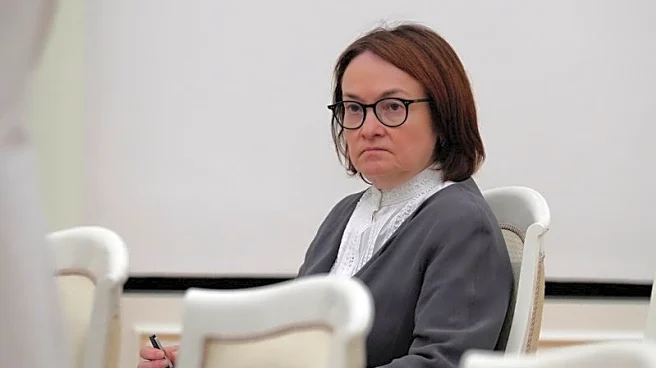

MOSCOW, Dec 19 (Reuters) - The governor of Russia's central bank, Elvira Nabiullina, and her deputy Alexei Zabotkin spoke on Friday after the bank cut its key interest rate by 50 basis points to 16%.
Here
are some of the most important things they said. They spoke in Russian, and their words were translated by Reuters.
NABIULLINA ON RATE DISCUSSIONS:
"We considered three options: keeping the rate unchanged, cutting it by 0.5 percentage points, and cutting it by 1 percentage point. Those who proposed maintaining the key rate emphasized the fact that it was still premature to judge the sustainability of the inflation slowdown."
"Because it has been volatile in recent months, it's quite difficult to judge sustainability based on just one month. Considering the inflationary factors that are expected to materialize in the near future, including increases in VAT and tariffs, they also noted a significant acceleration in lending and continued elevated inflation expectations."
"Those who proposed a larger step believed that the current inflation slowdown was already quite sustainable. However, under these circumstances, the majority still believed that a more balanced, more cautious decision was needed, about cutting the rate by 0.5 percentage points."
NABIULLINA ON VICTORY OVER INFLATION:
"I can definitely say that we've come a significant part of the way, but the second half, as we know, is always harder ... One month of low inflation is definitely not enough. And that's why, by the way, we're looking at and paying more attention not even to monthly inflation, but to three-month, seasonally adjusted, rolling inflation. It averaged 5.2% over the past three months. And that's above our target. Add to that inflation expectations, and you'll understand why we're so cautious about lowering the rate ... We see that we'll reach a neutral level in 2027."
NABIULLINA ON POSSIBLE INFLATION SURGE AND MONETARY POLICY IN 2026
"We are indeed taking a rather cautious approach to rate decisions, given the current prevalence of inflationary risks. Yes, as you can see from our forecast, the baseline scenario assumes a rate cut next year, but given the inflationary factors associated with high inflation expectations and other factors ... we will, of course, proceed cautiously."
"As for inflation dynamics over the next year, yes, some growth is possible, an increase in the current rate of price growth in January due to the VAT increase. However, we believe that sustained inflation will continue to decline after this surge, and that in the second half of the year, sustainable inflation components will fall to around 4%. A slight increase in the current rate of price growth is possible in October, when tariffs are indexed, but we also believe this will be temporary."
ON LAWSUIT AGAINST EUROCLEAR OVER ASSET FREEZE:
"We have no plans to withdraw our claims for now."
"As for how the court's decision will be enforced and how damages will be claimed, this will be determined after the court's decision is issued and enters into legal force. I would like to say that we are also considering the possibility of defending our interests in international courts and arbitration tribunals, with subsequent enforcement of such courts' decisions in other countries."
ABOUT FINANCIAL RISKS AND STABILITY OF THE BANKING SYSTEM
"Financial stability issues are always a priority for us; they are always important. But we don't currently see any risks to financial stability."
"As for the stability of the banking system, it remains quite stable. We see that, yes, there is some growth in problem loans, but the share of, for example, bad corporate loans has increased only slightly and remains at around 4%. That's not much. The banking system is well capitalized again, and in our view, there are no issues here either."
(Reporting by Reuters Moscow Bureau, Compiled by Felix Light, Editing by Mark Trevelyan)