




By Joseph Ax
April 21 (Reuters) - Virginians head to the polls on Tuesday to vote on a new Democratic-drawn congressional map for November's midterm elections that could flip four Republican seats in the U.S. House of Representatives, after both parties spent tens of millions of dollars in a campaign over the referendum.
Virginia is the latest battleground in an unprecedented national redistricting fight that began last summer, when U.S. President Donald Trump successfully urged Texas Republicans to
install a new congressional map that took aim at five Democratic incumbents.
Since then, states controlled by both parties have launched their own redistricting efforts, leading to a near-draw thus far. Even a few seats could prove decisive: Democrats need to flip only three Republican districts in the 435-seat U.S. House in November to capture a majority, which would allow the party to conduct investigations into Trump's administration and block his legislative agenda.
Democrats currently hold six of Virginia's 11 House seats, but the new map would give them the edge in all but one.
Redistricting typically occurs at the end of each decade to reflect population changes recorded in the U.S. Census. State lawmakers have historically used that process to draw districts that are more favorable to their party, a strategy known as partisan gerrymandering.
Reflecting the stakes, both parties have poured money into the Virginia race, with Democrats spending far more than Republicans. Most of the funds have come from so-called "dark money" political groups that are not required to disclose their donors.
The main organization backing the measure, Virginians for Fair Elections, raised $64.1 million through April 13, according to campaign finance reports. More than $38 million came from House Majority Forward, House Democrats' main political nonprofit arm.
The leading Republican-led opposition group, the similarly named Virginians for Fair Maps, had brought in nearly $20 million as of April 13.
Republicans have also filed lawsuits challenging the referendum's legality. The state Supreme Court allowed the vote to proceed while it weighs those challenges.
Most public polls show the Democrats' "yes" campaign narrowly ahead.
Virginia has swung toward Democrats in recent years, with the party's nominee winning the state in every presidential election since 2008. Tuesday's special election comes just five months after Democrat Abigail Spanberger won the governor's race by a 15-point margin.
"In a blue state, it's still going to be spun as an up-or-down vote on Trump," said J. Miles Coleman, an analyst at the University of Virginia's Center for Politics.
Democrats have argued the new map is necessary to counter Texas and other Republican states that have used redistricting to target Democratic seats. Republicans have accused Democrats of hypocrisy, pointing to their previous stances against partisan gerrymandering.
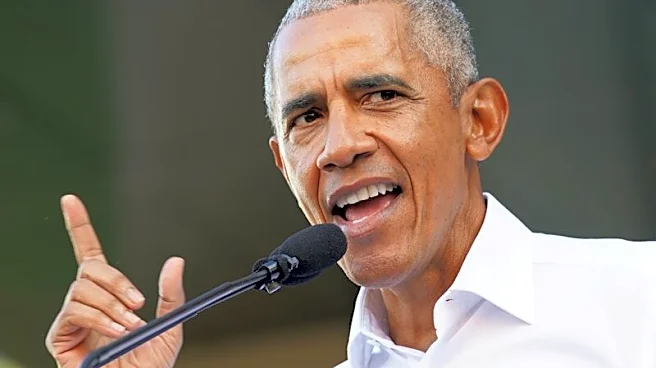
In a sign of how Democratic messaging has shifted in response to Trump's redistricting gambit, Republicans and Democrats are both using the words of former Democratic President Barack Obama to make their case.
Republicans have aired ads opposing the ballot measure that feature Obama's previous anti-gerrymandering statements, while Obama has recorded videos urging voters to approve the referendum to prevent a Republican "steal" of Congress.
Even after Virginia's vote, the national redistricting fight is not over; Republican Florida Governor Ron DeSantis has called for a special session next week to consider redrawing that state's map.
And the U.S. Supreme Court is scheduled to issue a decision in the coming months that could permit Republicans in Southern states to target additional Democratic seats.
(Reporting by Joseph Ax; Editing by David Gregorio)