





By Juliette Jabkhiro, Dominique Vidalon and Lucien Libert
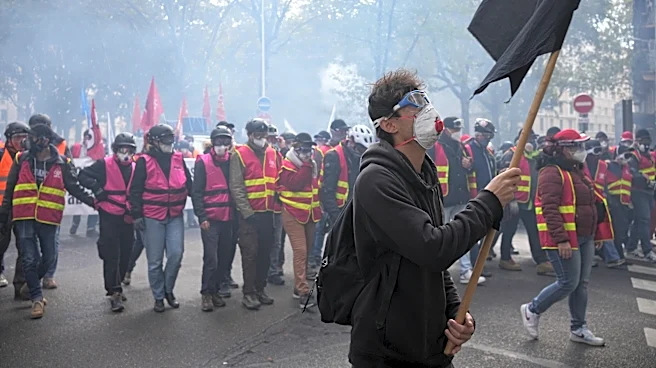
PARIS/LYON, Nov 5 (Reuters) - Some protesters clashed with police in Paris and Lyon on Thursday during largely peaceful nationwide demonstrations and a one-day strike by some public sector workers in a renewed challenge to President Emmanuel Macron.
The protests were attended by several high-profile politicians, including presidential candidates Jean-Luc Melenchon and Raphael Glucksmann. They follow demonstrations over living costs, public services
and education that have triggered the worst civil unrest France has seen in years.
The interior ministry said 270,000 people had participated in protests around the country so far, excluding Paris, where the main demonstration started in the afternoon.
"This country needs justice," Glucksmann told reporters at the start of the Paris march. "We are going to bring the French people back together. We are going to restore public services; we will do ... the opposite of what's taken place in the past 10 years."
In Paris, the mood was festive at the start, featuring a diverse group of participants singing "La Marseillaise" and some Carnival-like floats. The Eiffel Tower was shut by the one-day strike, which was joined by some energy workers and teachers, but there were no major disruptions to transport.
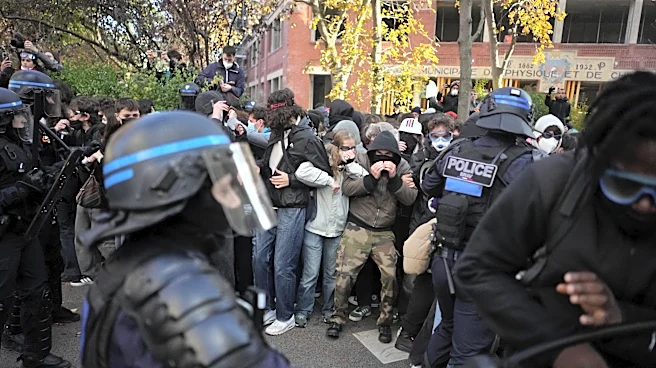
But about two hours in, some of the people at the front of the march clashed with police, who fired tear gas.
WORKERS AND STUDENTS JOIN FORCES TO PRESS FOR CHANGE
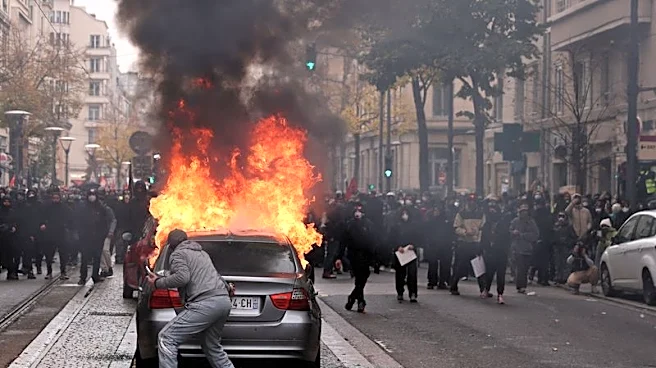
In Lyon, riot police fired tear gas and charged a group of protesters, some of whom were seen shouting anti-police slogans and dressed all in black, with face coverings. The Interior Ministry said the police there had been confronted by several hundred hardcore protesters and that the violence had been contained although tensions remained high.
The unrest comes only five months before a presidential election which could pit far-right candidate Marine Le Pen against hard-left rival Melenchon in a second-round run-off. Macron, who is serving his second term and is unpopular, cannot run again.
"There is a lot of concern about the future, notably the issues of salaries, public services," said Alice Martinovic, an 18-year-old student participating in the Paris demonstration.
"I hope in the upcoming elections the candidates will really think about this movement and include the opinions of young people, of students, who are now joined by a lot of other workers."
SCHOOL ABLAZE AFTER FIREWORKS ARE HURLED
The Interior Ministry said people throwing fireworks had caused a fire at a high school near the city of Toulouse in the southwest on Thursday morning, forcing pupils and staff to evacuate the building while firefighters doused the flames.
"This criminal behaviour is an absolute scandal," said Education Minister Edouard Geffray on X.
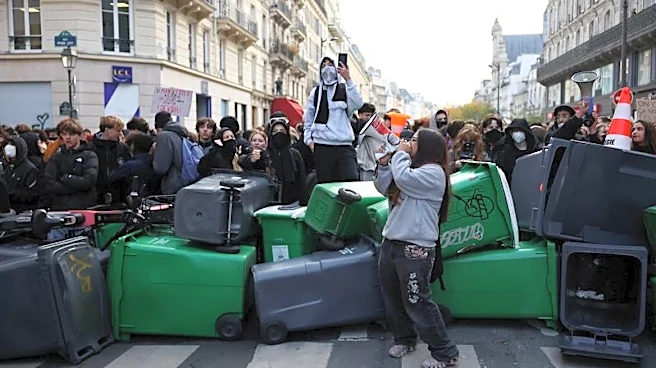
French high school students and other demonstrators had earlier faced off against riot police in Paris as they blocked a street with rubbish bins on Thursday morning.
While the demonstrations in Lyon and other cities including Marseille and Nantes began in the morning, the main protest march in Paris set off in the afternoon from Place de la Republique.
Since riots and looting on October 17 caught security forces off guard, leaving damaged shops and public buildings across the country and fuelling criticism of Macron's handling of the crisis, French authorities have issued curfews, bans on large gatherings and have required groups to take alternate routes for demonstrations that avoided main boulevards, which trade unions have decried.
"The government tried to block the demonstrations. The demonstrations are bigger than ever," Sophie Binet, head of the CGT trade union, told reporters. She estimated that some 250,000 people were demonstrating across France before the Paris march.
"High school students, pensioners, students, workers, all together. Unity wins," read one banner at the protest in Lyon.
POLICE DEPLOY IN LARGE NUMBERS
"Our pay has not kept up with inflation," said Mehdi Dumontroty, a 45-year-old firefighter who was joining the protest in Paris.
"What happened this summer proves that we were right when we said we needed more resources to deal with the crisis that we faced," he said, referring to wildfires exacerbated earlier this year by intense heat waves.
Around 70,000 police were on duty nationwide, a comparable figure to recent weekends. The French government has defended police tactics while saying any abuses would be investigated.
The strike contributed to a reduction in France's nuclear output early on Thursday and the Education Ministry said just over 15% of French teaching staff had joined the strike.
(Reporting by Juliette Jabkhiro, Clotaire Achi, Dominique Vidalon, Forrest Crellin and Makini Brice in Paris, Lucien Libert in Lyon and Sudip Kar-Gupta in Brussels; writing by Michel Rose and Keith Weir; editing by Gareth Jones and Philippa Fletcher)