







By Nelson Bocanegra, Julia Symmes Cobb and Luis Jaime Acosta
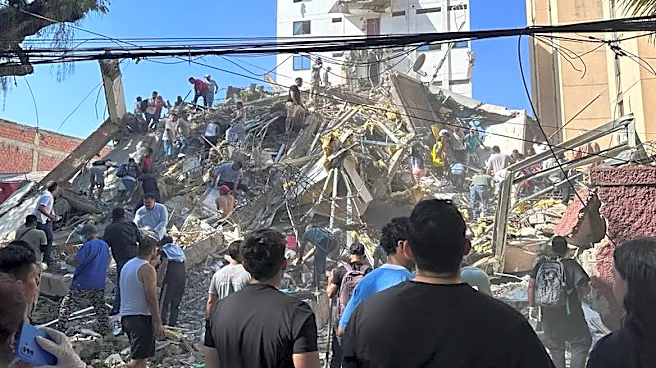
BOGOTA, Aug 10 (Reuters) - At least 82 people were killed after a powerful earthquake struck western Colombia early on Monday, knocking down buildings across several cities and leaving others trapped in the rubble.
The quake struck just days after Abelardo De La Espriella was sworn in as president, thrusting the new administration into its first major crisis, with memories still fresh of devastating twin earthquakes in neighboring Venezuela
in June.
The 7.4 magnitude quake, according to the U.S. Geological Survey, struck at a depth of 107 km (66 miles) near San Jose del Palmar, in Choco, a sparsely populated province on Colombia's Pacific Coast, but was felt in major cities nationwide.
"Significant casualties and damage are likely and the disaster is potentially widespread," the agency warned.
The highest reported death toll was in the western province of Risaralda in Colombia's coffee-growing region, where Governor Juan Diego Patino, speaking by phone to Caracol Television, reported 42 fatalities.
Cali, one of Colombia's biggest cities, was among the worst hit, though authorities have yet to confirm deaths there. Mayor Alejandro Eder told Caracol at least 30 buildings had collapsed and rescue crews were working at 10 of them. Caracol showed firefighters and Colombian Red Cross workers carrying a survivor on a stretcher from one collapsed building.
"The building completely collapsed. It sounded like a bomb. It was horrible," Juan Carlos Osorio told Caracol Television as he helped remove debris from a collapsed structure in Cali. "All of us neighbors are working together, forming human chains. We need heavy equipment. There are many people trapped."
In the province's capital of Pereira, social media images showed a building with a cracked facade crash to the ground, sending up a dark cloud of dust and debris as onlookers on the street darted away. The impact also toppled one of the towers atop a neo-Gothic cathedral in Manizales.
In Choco, the province closest to the epicenter, Governor Nubia Carolina Cordoba-Curi reported fatalities, dozens of injuries and heavy damage in the provincial capital, Quibdo, while warning residents about aftershocks.
LAND OF EARTHQUAKES AND LANDSLIDES
Smaller earthquakes are not uncommon in Colombia, which is crisscrossed by three ranges of the Andean mountains. However, it is landslides which have historically been the deadliest natural disasters in the country, with the Armero disaster in 1985 killing some 25,000 people.
Cities in the country's coffee region, including Armenia and Pereira, suffered a devastating 6.2 magnitude quake in 1999, which killed more than 1,000 people.
De La Espriella, a right-wing politician who has never before held elected office, said in a video filmed while flying to Bogota that he was suspending his planned activities to lead emergency coordination efforts out of the capital.
His government declared a state of emergency to coordinate rescue efforts, Caracol reported.
Colombia's civil aviation authority said flights were suspended at airports in Pereira, Manizales, Quibdo, Armenia, Cartago and Buenaventura while inspectors checked for structural damage.
The U.S. tsunami warning system said there was no tsunami threat after the quake, which occurred at 7:34 local time (1234 GMT) and was felt in nine departments and all 32 departmental capitals.
Reuters witnesses in the Venezuelan border state of Tachira and central-western city of Barquisimeto reported the quake had been felt there.
Venezuela was hit by twin earthquakes in June, which killed more than 6,000 people, mostly on the coast near the capital, Caracas.
(Reporting by Nelson Bocanegra, Luis Jaime Acosta, Julia Symmes Cobb and Fabiola Aramburo; Additional reporting by Yury Garcia in Quito, Writing by Kylie Madry and Daina Beth Solomon; Editing by David Holmes, Paul Simao and Daniel Wallis)