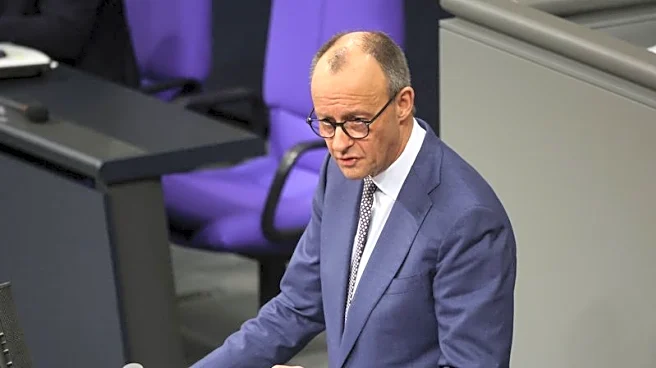


BERLIN, Jan 29 (Reuters) - European nations are starting to discuss ideas around a shared nuclear umbrella to complement existing security arrangements with the U.S., German Chancellor Friedrich Merz said, amid growing talk in Germany of developing its own nuclear defences.
Merz, speaking at a time of increased transatlantic tensions as U.S. President Donald Trump upends traditional alliances, said the talks were only at an initial stage and no decision was imminent.
"We know that we have to reach
a number of strategic and military policy decisions, but at the moment, the time is not ripe," he told reporters on Thursday.
Germany is currently banned from developing a nuclear weapon of its own under the so-called Four Plus Two agreement that opened the way for the country's reunification in 1990 as well as under a landmark nuclear non-proliferation treaty that Germany signed in 1969.
Merz said Germany's treaty obligations did not prevent it from discussing joint solutions with partners, including Britain and France, the only European powers which have a nuclear arsenal.
"These talks are taking place. They are also not in conflict with nuclear-sharing with the United States of America," he said.
European nations have long relied heavily on the United States, including its large nuclear arsenal, for their defence but have been increasing military spending, partly in response to sharp criticism from the Trump administration.
Trump has rattled Washington's European allies with his talk of acquiring Greenland from Denmark, a NATO ally, and his threat, later rescinded, to impose tariffs on countries that stood in his way.
He has also suggested in the past that the U.S. would not help protect countries that failed to spend enough on their own defence.
Merz's comments were echoed by the head of the parliamentary defence committee, Thomas Roewekamp, who said Germany had the technical capacity which could be used in developing a European nuclear weapon.
"We do not have missiles or warheads, but we do have a significant technological advantage that we could contribute to a joint European initiative," Roewekamp, from Merz's centre-right Christian Democratic Union party, told Germany's Welt TV.
(Reporting by Andreas Rinke, writing by James MackenzieEditing by Gareth Jones)