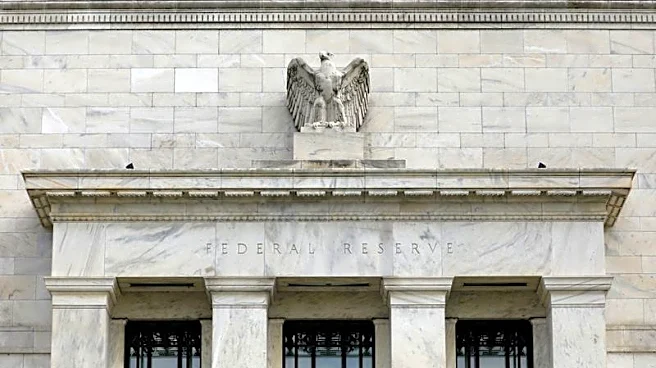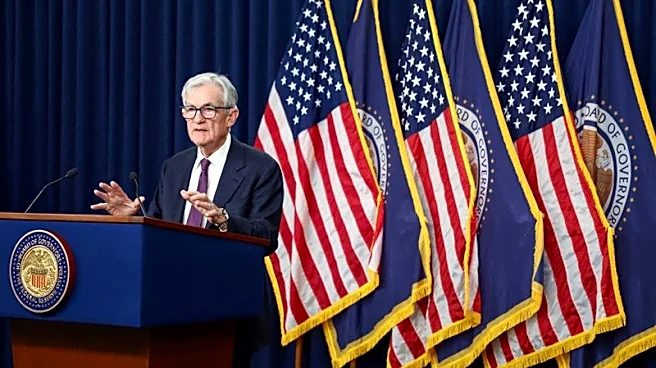





NEW YORK, April 29 (Reuters) - The Federal Reserve held its policy rate steady on Wednesday, as was widely expected, citing rising concerns about inflation in what is likely to be Jay Powell's last meeting as chair.
The decision was the most divided since 1992, with eight officials voting to hold the fed funds rate in the range of 3.5%-3.75% and four dissenting -- three who took issue with the Fed's bias toward easing rates and one who voted to cut rates. Traders were betting on Wednesday there would
be no rate cuts in 2026. Traders were seeing as much as a 25% chance of a rate hike in the next year in the minutes following the decision, reflecting in part concerns about the inflationary impact of oil prices that have risen above $100 a barrel again with the Iran war continuing.
Investors said the vote and the macroeconomic backdrop point to challenges ahead for Kevin Warsh when he replaces Powell as chair next month.
MARKET REACTION:
STOCKS: The S&P 500 declined after the policy statement, leaving it down on the day by 0.4%. The Dow industrials were down 0.8% and the Nasdaq Composite was off 0.4%.
BONDS: The yield on benchmark U.S. 10-year notes was up 6 basis points at 4.41%. Selling was stronger in shorter-dated debt, with the yield on 2-year U.S. notes rising 8 basis points to 3.92%, their highest since March 27 and a sign of waning rate-cut expectations.
FOREX: The dollar index was up 0.4% to 98.95.
COMMENTS:
BRAD CONGER, CHIEF INVESTMENT OFFICER, HIRTLE & CO., BRYN MAWR, PENNSYLVANIA:“A minor food fight broke out at the FOMC today. The dissenters’ preference for a tightening bias stakes out the battle lines for the incoming chair. Bonds have been pricing this scenario out for several weeks now. We think the hawks have the upper hand here based on stronger growth in both private consumption and booming business investment. The question is whether equities will hear the message over the siren song of strong corporate earnings.”
JAMIE COX, MANAGING PARTNER, HARRIS FINANCIAL GROUP, RICHMOND, VIRGINIA:
"This statement portends what awaits Kevin Warsh--a series of Fed bank presidents who worry he will advocate lower rates when the inflation outlook may suggest otherwise. This statement is way more about the future than the current Fed meeting."
ZACHARY GRIFFITHS, HEAD OF INVESTMENT-GRADE AND MACRO STRATEGY, CREDITSIGHTS, CHARLOTTE:
“I don't see what I would consider to be a clear easing bias in the statement, but that's what the three policymakers dissented against. And then, of course, we have Stephen Miran, who dissented in favor of a 25-basis point rate cut. So, for us, the key takeaway is if Kevin Warsh had hoped to inherit a committee that was willing to cut rates in the near term, that's not what he's getting.”
CHRISTOPHER HODGE, CHIEF US ECONOMIST, NATIXIS, NEW YORK:
"The Fed is likely to approach the coming quarters with a bias toward caution, balancing still-elevated inflation against a softening growth backdrop. While inflation remains above target, policymakers will be particularly focused on preventing the recent energy-driven price shock—stemming from the Iran conflict—from feeding into broader, more persistent core inflation dynamics.
"Our base case is that the energy shock dissipates over the coming months, limiting the risk of a renewed acceleration in inflation.
"Against this backdrop, the growth side of the mandate becomes increasingly relevant. If the economy slows as expected and labor market conditions soften—without a de-anchoring of longer-term inflation expectations—the Fed will have scope to ease policy. Indeed, this scenario is our expectation, and we believe cuts will be forthcoming in September and December. In any case, these dissents will likely be a common theme in the coming months."
KAY HAIGH, GLOBAL CO-HEAD FIXED INCOME & LIQUIDITY SOLUTIONS, GOLDMAN SACHS ASSET MANAGEMENT, NEW YORK:“The Fed’s updated guidance indicates that it’s in a stable place when it comes to policy direction, although some members pushed for more two-sided language. While upside risks to inflation have increased, the Fed is keeping one eye on potential weakness in growth and the labor market. This balance could see rates being brought back down to neutral later this year; however, the FOMC will be sensitive to a re-escalation in Iran and rising energy prices, and could keep policy restrictive in that scenario.”
TOM GRAFF, CHIEF INVESTMENT OFFICER, FACET, PHOENIX, MARYLAND:
“As was widely assumed, the Fed did not change interest rates at this meeting. The most interesting element of the press release is that the Fed kept the easing bias by referring to ‘the extent and timing of additional adjustments.’ This implies that most of the Fed thinks the next move is most likely to be a cut.
“Equally notable, though, is that three FOMC members disagreed with keeping this easing bias strongly enough to actually dissent on the statement. It is not unheard of for Committee members to dissent just on language, but it is rare. I think this really highlights how divided the Fed is, as well as how uncertain the impacts of the recent oil spike are.”
BRIAN JACOBSEN, CHIEF ECONOMIST, ANNEX WEALTH MANAGEMENT, MENOMONEE FALLS, WISCONSIN:
"It’s not too surprising to see that there are divisions on the Fed, but it is surprising that it’s so visible. If this is how it is with Powell’s last meeting, imagine how much louder the dissenters will get under Warsh.
"The language around elevated inflation has the fingerprints of the hawks all over it. Inflation isn’t elevated solely because of high energy prices, meaning some Fed officials think a rate hike might cure what ails inflation, even if it means making the labor market sick."
MICHAEL BROWN, SENIOR RESEARCH STRATEGIST, PEPPERSTONE, LONDON:
"No major surprises from the FOMC this evening, with the target range for the fed funds rate maintained at 3.50% - 3.75%, in line with expectations, and with money market pricing."
"The policy statement, meanwhile, was little changed from last time out. As such, unemployment was again described as being ‘little changed’, while overall economic activity continues to expand at a ‘solid pace’. Inflation, meanwhile, is now simply described as ‘elevated’, ditching the ‘somewhat’ prefix that was previously present, though the statement clearly tied this uptick in inflation to the recent surge in global energy prices."
"Of course, that surge stems from geopolitical events in the Middle East, the impacts of which are ‘contributing to a high level of uncertainty’ regarding the outlook, mirroring similar language used last time out."
TONY WELCH, CHIEF INVESTMENT OFFICER, SIGNATUREFD, ATLANTA:
"The market isn't really responding much to the Fed decision. It was pretty well telegraphed.
"It looks like they changed the wording of the statement. Where they were saying inflation was somewhat elevated they changed it to say inflation is elevated. They pulled out that reference to somewhat.
"That's a stronger statement. There were signs of inflation pressure even ahead of the energy dislocation here. Part of that is because the economy is continuing to surprise to the upside. That's not an environment that's begging for rate cuts."
"The bond markets have been picking up on this for weeks now, as interest rates have kind of trended higher as the probability for a cut is slowly dwindling away. I still think it's a high hurdle to get any sort of hike ... this looks like it's going to be a neutral Fed unless you get some sort of economic deterioration."
CHRIS GRISANTI, CHIEF MARKET STRATEGIST, MAI CAPITAL MANAGEMENT, NEW YORK, NY
“The big news were the dissents of three members of the FOMC. They dissented not to the rate decision, but to easing bias in the statement. This serves two purposes: On its face, it’s more hawkish, and it says we may not be leaning towards easing anymore, so that’s new news.
"But even more importantly, I think this is a shot across the bow to incoming Fed Chair Kevin Warsh, who has been a proponent of easing. The dissenters are saying ‘you cannot take for granted that we will support your easing intentions.’ I suspect there will be a lot of drama ahead.”
MATTHIAS SCHEIBER, HEAD OF THE MULTI-ASSET TEAM, ALLSPRING GLOBAL INVESTMENTS, LONDON:
"The Federal Reserve once again held rates steady against a mixed backdrop of elevated inflation, a stabilizing labor market and stable growth, for now. Amid rising geopolitical risk, time will tell how U.S. fundamentals are affected.
"The FOMC continues to focus on a data-dependent approach. For now, it is looking through geopolitical risks and treating the energy price shock as “transitory” rather than a rolling series of pressures on consumers. Market consensus has priced nothing into the U.S. yield curve for the bulk of this year. Risks remain symmetric, with both future hikes and cuts possible depending on the balance of the Fed’s dual mandate and the policy philosophy of the future Fed leadership."
JP POWERS, CHIEF INVESTMENT OFFICER, RWA WEALTH PARTNERS, BOSTON: "Over 30 years since we have had that many dissenters, pretty crazy time. Stephen Miran, he's a little bit of an outlier, wanted another cut here. Really hard for the committee, I'm sure, to get any consensus on that with oil back well over $100. And then just the transition from Powell, too, would have been pretty tough to get something done along those lines. Interesting that the three others, though, didn't even want to keep that easing bias in the statement, that's probably the story here."
(Reporting by Chuck Mikolajczak, Suzanne McGee, Laura Matthews, Sinead Carew, Saqib Ahmed, Saeed Azhar, Karen Brettell; editing by Colin Barr)