



By Ahmed Elimam, Jana Choukeir and Maha El Dahan
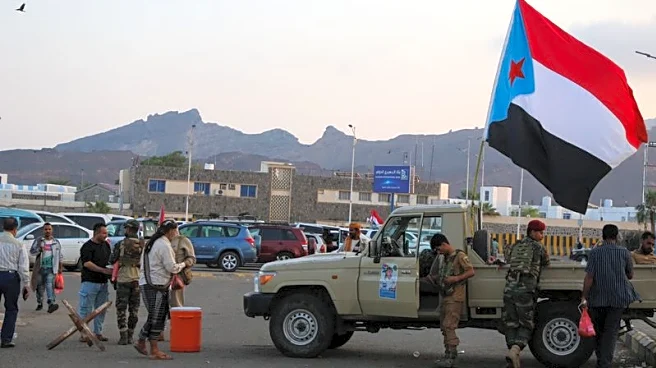
DUBAI, Jan 2 (Reuters) - Yemen's Saudi-backed government launched what it called a peaceful operation to take back military positions from the UAE-backed southern separatists on Friday, who in turn said seven Saudi airstrikes had taken place since the declaration.
The Saudi-backed governor of Yemen's Hadramout province announced the move, which marks the latest escalation in Yemen, where a rift between Gulf powers Saudi Arabia and the United Arab Emirates,
who back opposing sides, has been playing out since December.
A senior official of the UAE-backed Southern Transitional Council told Reuters the Saudi Arabian operation had not been peaceful.
"Saudi Arabia knowingly misled the international community by announcing a peaceful operation that they never had any intention to keep peaceful," Amr Al Bidh said in a statement.
"This was evidenced by the fact that they launched seven airstrikes minutes later," he said.
Saudi Arabia did not immediately respond to a request for comment on the airstrikes.
Once the twin pillars of regional security, the two Gulf heavyweights have seen their interests diverge on everything from oil quotas to geopolitical influence.
OPERATION TARGETS MILITARY SITES
Yemen’s Saudi-backed government said in a statement on Friday it had appointed Hadramout Governor Salem Ahmed Saeed al-Khunbashi to take overall command of the "Homeland Shield" forces in the eastern province, granting him full military, security and administrative authority in what it said was a move to restore security and order.
“This is not a declaration of war,” the governor said in a speech on Yemen TV, adding that the move aims to prevent the use of camps to threaten security and to protect Hadramout from sliding into chaos.
A spokesperson for the STC, Mohammed al-Naqeeb, said later on Friday that forces were on full alert across the region and warned that it was ready to respond forcefully in a post on X.
The STC's Bidh told Reuters that three of the airstrikes targeted the Al Khash'a military camp, one of the largest in the province.
Three Yemeni sources told Reuters armored vehicles belonging to the Saudi-backed government have been moving towards the Khash'a camp in Hadramout, which has the capacity to house thousands of troops and was taken over by the STC in December.
The UAE backs the STC, which seized large swathes of southern Yemen last month from the internationally recognised government, backed by Saudi Arabia, which in turn saw the move as a threat.
The UAE last week said it was pulling its remaining forces out of Yemen after Saudi Arabia backed a call for its forces to leave within 24 hours in one of the severest disagreements between the two Gulf oil powers to ever play out in public.
The move briefly eased tensions but disagreements between the various groups on the ground in Yemen have persisted since then.
Saudi Arabia and the UAE are both major players in the OPEC oil exporters' group, and any disagreements between them could hamper consensus on oil output.
They and six other OPEC+ members meet online on Sunday, and OPEC+ delegates have said they will extend a policy of maintaining first-quarter production unchanged.
ADEN AIRPORT SHUT
Saudi Arabia's ambassador to Yemen also on Friday blamed STC leader Aidarus Al-Zubaidi for refusing to grant landing permission the previous day for a plane carrying a Saudi delegation to Aden.
A halt in flights at Aden international airport on Thursday continued into Friday as both sides traded blame as to who was responsible for the air traffic shutdown.
"For several weeks and until yesterday, the Kingdom sought to make all efforts with the Southern Transitional Council to end the escalation ... but it faced continuous rejection and stubbornness from Aidarus Al-Zubaidi," the Saudi ambassador, Mohammed Al-Jaber, said on X.
Zubaidi issued directives to close air traffic at Aden's airport on Thursday, the ambassador added, saying that a plane carrying a Saudi delegation to Aden aiming to find solutions to the crisis was denied permission to land.
In a statement on Thursday, the STC-controlled Transport Ministry in turn accused Saudi Arabia of imposing an air blockade, saying Riyadh required all flights to go via Saudi Arabia for extra checks.
Aden's international airport is the main gateway for regions of the country outside Houthi control.
(Reporting by Ahmed Elimam, Jana Choukeir and Maha El Dahan; Editing by Clarence Fernandez and Sharon Singleton)