








By Andrea Shalal
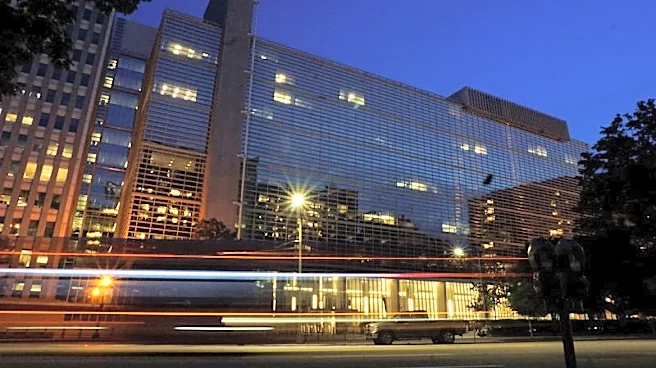
WASHINGTON, Sept 21 (Reuters) - The World Bank and International Monetary Fund said on Monday that both their executive boards had approved proposed reforms of their joint framework for evaluating the debt of low-income countries to reflect a more complex and riskier environment.
A joint review, the first since 2017, recommended changes in several areas, including beefing up the analysis of domestic debt held by poor countries, and broadening consideration of long-term development
challenges, including climate change. It stopped short of calling for a wholesale redesign.
The reforms are intended to refine how the IMF and World Bank measure a country's debt-carrying capacity and provide new tools to better differentiate between countries facing some risk of debt stress and those whose debt is deemed unsustainable.
The World Bank and IMF said they would also work to enhance the tools and stress tests used to ensure the consistency and accuracy of forecasts, while encouraging countries to improve reporting and transparency of their debt data. They left the discount rate used in making assessments unchanged at 5%.
"Overall, our goal is a very practical one. It is to help countries identify vulnerabilities earlier and also more precisely, so that they can make better-informed financing choices and better-informed policy choices," said Allison Holland, who worked on the new debt sustainability framework and now serves as deputy director in the IMF's African Department.
Holland said recent shocks had reversed improvements in the debt landscape seen since 2021, taking the number of countries at high risk or already in debt distress back to pre-pandemic levels.
"Around 14% of low-income countries are in debt distress, and another 33% are at high risk. About 23% of emerging market countries are at high risk of overall sovereign stress," she said.
The revised framework could help inform a debt restructuring requested earlier this month by Senegal in exchange for a $2.2 billion IMF bailout two years after a hidden debt scandal that pushed it into crisis. The IMF has said it will assess Senegal's debt sustainability using the current framework, "while taking into account the implications of the transition" to the new one.
The IMF has not provided details on how the revised framework — with consideration of domestic debt — could affect Senegal's debt restructuring.
TAKING EFFECT IN SECOND HALF OF 2027
The changes, which will become operational in the second half of 2027, should help countries better assess how much they can invest in needed development and climate adaptation measures while containing debt vulnerabilities over the long term, the IMF and World Bank said.
A review completed in July confirmed that the debt sustainability framework, first introduced in 2005, had worked well to identify debt distress episodes ahead of time and help countries make informed borrowing and lending decisions.
But it recommended changes to account for higher debt levels in many low-income countries and a shift in financing sources to include more domestic and external borrowing on commercial terms. The IMF and World Bank have a separate framework for assessing the debt sustainability of advanced and emerging market economies that will be reviewed in coming years.
The IMF said near- and medium-term economic projections that feed into the analyses had generally been reliable, but longer-term forecasts of exports and revenues had shown some "optimism bias" and left data gaps, including for state-owned enterprises.
The new framework introduces a long-term module to add granularity to risk assessments, as well as specific thresholds for overall public debt stress.
But IMF board members agreed to temporarily hold off publishing the models used to assess unsustainable debt to give time to adjust to the new methodologies. Stand-alone staff notes would be used to share data with the board for now, it said.
(Reporting by Andrea Shalal; Editing by Nick Zieminski, Alexander Smith and Paul Simao)