




By Leah Douglas
Sept 29 (Reuters) - Pacing a stage at the Iowa State Fair, flanked by his wife and four of their six children, Republican US Congressman Zach Nunn spoke passionately about an issue that has emerged as a key concern in his competitive midterms race: cancer.
"Look, my mom is a survivor. I know that it has touched all of us, our family, our friends," he said at the August event, touting his efforts to bring more money for cancer screening to Iowa's third congressional district.
Two days
before, his Democratic challenger in November's election, state Senator Sarah Trone Garriott, had discussed cancer on the same stage.
"We know Iowa has a cancer problem. All of us have friends, neighbors, maybe we've even experienced it ourselves," she said.
They were not the only hopefuls to talk about it: five of the six House, Senate and gubernatorial candidates who appeared at the fair discussed Iowa's high cancer rates, reflecting the extent to which the disease has become a bipartisan campaign issue this year.
Candidates, advocacy groups and strategists say the state's rising cancer rate - the second highest in the country behind Kentucky - has for the first time emerged as a major issue alongside kitchen-table concerns such as the cost of living.
While the causes of cancer are often complex and not well understood, Iowa voters' concerns are driven in part by worries that the state's worsening water pollution from nitrates and other chemicals may be to blame for a spike in cases.
Every major candidate in Iowa's competitive races for Congress and the state governorship has talked about their plans to tackle cancer in recent speeches, social media posts or on their websites, according to a Reuters review of campaign materials.
The candidates have pledged a range of actions from increasing cancer screening to improving water quality monitoring. Democrats have used the issue to push for expanded healthcare access, while Republicans have promoted greater treatment options and research funding.
After more than a decade of decline, Iowa's cancer rate began to rise in 2014, and it has had the second-highest cancer rate in the nation since 2023, according to reports by the Iowa Cancer Registry, which tracks and studies cancer cases among Iowans.
It is one of just three states where cancer is rising, driven by higher rates of lung, prostate and breast cancers, among others, according to the National Cancer Institute at the National Institutes of Health.
Tim Hagle, a political scientist at the University of Iowa, said he can't remember cancer ever being such a significant concern in past elections. The issue has taken hold in part this year because it ties into voter concern about other health issues, like Republican-backed cuts to Medicaid, the federal health program for lower-income Americans, he said.
THE POLITICS OF CANCER
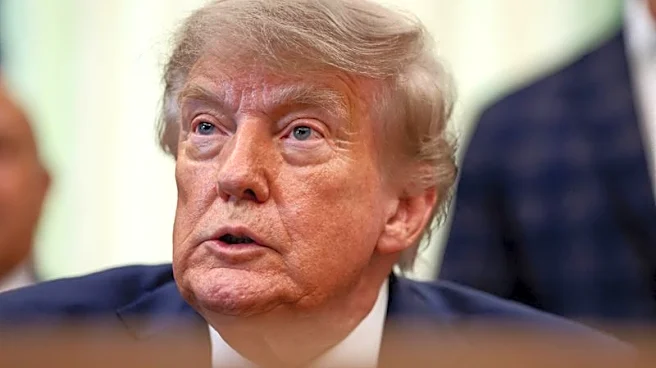
Some Democrats are using the focus on cancer to attack incumbent Republicans for supporting President Donald Trump's 2025 tax and spending law, which made cuts to Medicaid by expanding work requirements for beneficiaries, among other changes.
Josh Turek, a Democrat running for Senate, in his remarks at the Iowa State Fair criticized his Republican opponent Ashley Hinson, who represents Iowa's second congressional district, for "(voting) for 110,000 Iowans to lose their healthcare in a state with a cancer and a healthcare crisis."
Independent health policy research group KFF estimates that around 100,000 Iowans could lose health insurance by 2034 due to changes under Trump's tax and spending law.
Hinson pointed to her support for legislation that would improve access to mobile cancer screening and mammogram machines in rural areas, and for conservation efforts to improve water quality.
"I have lost two aunts and my grandmother to cancer. It’s personal to me," she said in an email to Reuters.
Turek and other Democrats, like Christina Bohannan, who is running in Iowa's first district, have said they would push to reverse those cuts and campaign for further federal investment in cancer research.
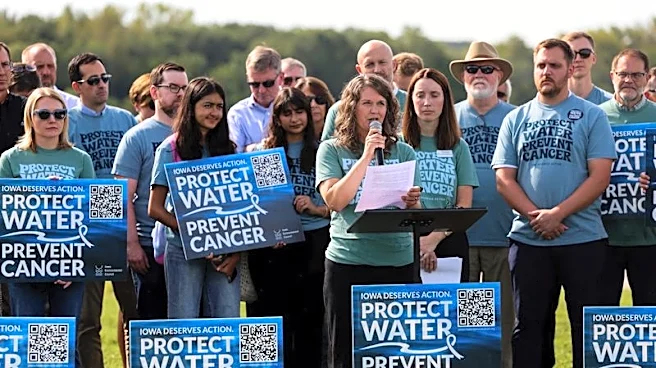
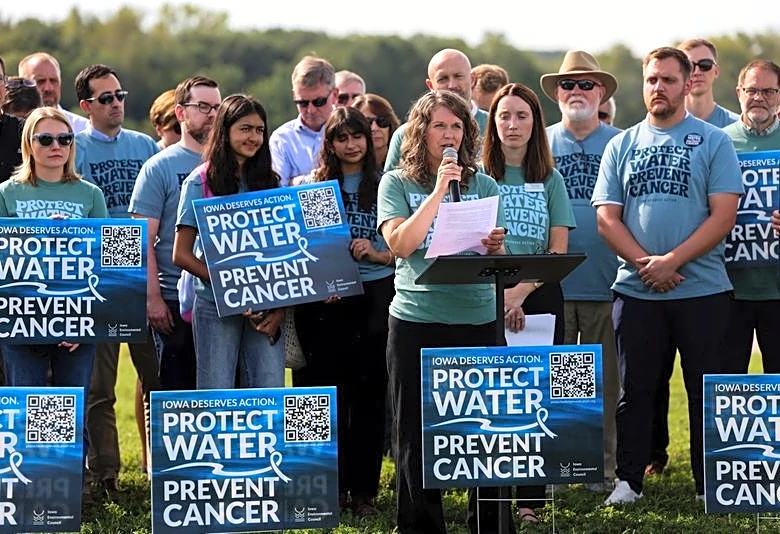
Iowa's chapter of the American Cancer Society Cancer Action Network, which advocates for policies to end cancer, says voters are more engaged on the issue and that all are raising the question of whether water quality is linked to cancer rates.
"(It) is top of mind for everybody," government relations director Jackie Cale said, adding that the causes of cancer are complex and not limited to just one thing.
A July poll conducted by GQR, a polling firm that works with Democrats, on behalf of the Johns Hopkins Center for a Livable Future, a public health center focused on agriculture, found that 60% of 800 likely Iowa voters ranked water quality among their top five issues in the November elections.
THE SCIENCE
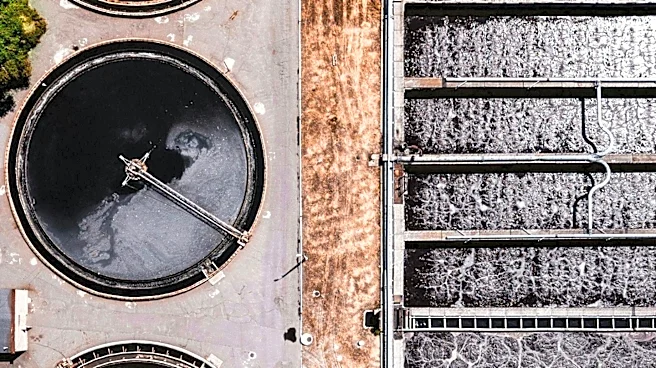
Many Iowans tie their cancer concerns to high nitrate levels in the state's water, which can occur when fertilizer washes into rivers and groundwater. About 85% of Iowa is farmland, much of it dedicated to fertilizer-heavy crops like corn, according to the US Department of Agriculture.
The concentration of nitrates in Iowa's main waterways doubled over the past 50 years and regularly exceeds levels set by the Environmental Protection Agency, according to a 2025 statewide report commissioned by Iowa's Polk County Board of Supervisors.
The Fertilizer Institute, an industry trade group, declined to comment for this story.
Scientists have not reached a consensus on the cancer risk posed by nitrate-contaminated drinking water. Some studies, including by the University of Iowa and the National Cancer Institute, have found associations with higher cancer rates or mortality, while others have not.
Outgoing Republican Governor Kim Reynolds in 2025 commissioned a two-year study by the state's Department of Health and Human Services and the University of Iowa to examine why the state has seen such a rise in cancer.
An interim report released in February found that Iowa has similar demographic and behavioral risk factors as neighboring states, though it is among the highest-ranked states in cancer risk factors like binge drinking and obesity. The report did not provide firm conclusions about the rise.
The Iowa Farmers Union said concerns about possible links between cancer, contaminated water and pesticide use are a recurring theme in discussions with rural Iowans.
The group's president, Aaron Lehman, told Reuters that the focus should be on expanding farmers' options to reduce runoff and improve water quality, while holding all parts of the agricultural system accountable and placing producers at the center of any long-term solution.
Iowa has attempted to reduce runoff through its 2013 Nutrient Reduction Strategy, which aimed to curb pollution into the Mississippi River, but environmental groups and the Iowa Farmers Union have said the voluntary plan hasn't done enough.
The uncertainty over the cause of the increase in the cancer rate has not diminished voter concerns. During a five-county tour this August, Bohannan, the Democratic candidate, said voters worried about the rise of cancer cases told her water quality was among their top issues.
"I talked to water treatment plant operators, people involved in conservation, I talked to everyday people, parents who are worried about the water with their kids," she said. "It is definitely becoming a major issue."
(Reporting by Leah Douglas in Washington, editing by Ross Colvin and Alistair Bell)