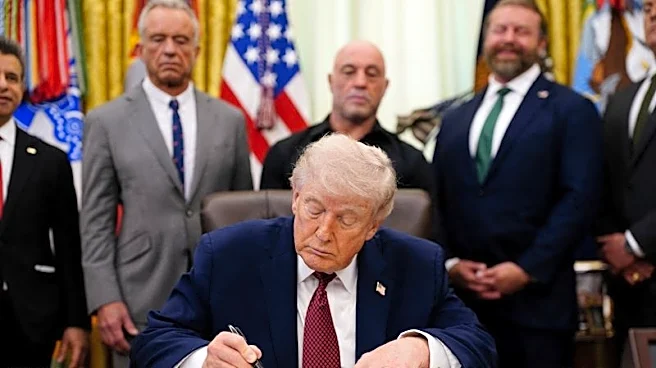






WASHINGTON, April 18 (Reuters) - U.S. President Donald Trump signed an executive order on Saturday intended to speed up access to medical research and treatment based on psychedelic drugs.
The order instructs the U.S. Food and Drug Administration to expedite the review of drugs such as ibogaine, which U.S. military veteran groups have said can help treat post-traumatic stress disorder.
Health Secretary Robert F. Kennedy Jr. has championed the idea of using drugs such as ibogaine as an alternative treatment
for mental health conditions such as depression.
At an event in the Oval Office, U.S. federal officials said the reforms would pave the way for the drugs, which can cause hallucinations and are largely illegal, to be reclassified after successful clinical trials. Trump also said the U.S. would dedicate $50 million to federal research into ibogaine.
U.S. Food and Drug Administration Commissioner Marty Makary said decisions on the drugs could come as soon as this summer.
MEXICO HAS IBOGAINE TREATMENT CENTERS
Ibogaine, derived from a shrub native to Africa, is a Schedule I substance in the United States, meaning it is deemed to have "no currently accepted medical use and a high potential for abuse," according to the Drug Enforcement Administration.
Globally, ibogaine is sometimes used to treat mental health conditions in nations where it is legal or faces fewer restrictions. Mexico has ibogaine treatment centers that often attract U.S. veterans.
Flanked by U.S. military veterans such as Marcus Luttrell and Representative Morgan Luttrell, a Texas Republican, and with podcaster Joe Rogan standing directly behind him, Trump said ibogaine had come to his attention partly through the efforts of Rogan, who devoted an episode of his show to advocates for the drug's use in treating veterans.
Officials on Saturday said there is now enough scientific evidence to justify the potential use of ibogaine as a mental health treatment.
"I've been hearing about it a little bit over the last year," Trump said. "I never heard anything about it in the past. It was almost like, taboo. It's not taboo anymore."
Trump has often signed executive orders where legislation with a more durable legal impact has failed. In December, Trump signed an executive order backing research into marijuana and cannabidiol, also substances classified as illegal.
The December order instructed the U.S. attorney general to move ahead with reclassifying marijuana, a decision that would represent one of the most significant federal changes to marijuana policy in decades. The Justice Department's Drug Enforcement Administration has not yet reclassified the drug.
During Saturday’s signing ceremony, Morgan Luttrell said he and others had unsuccessfully tried to pass legislation in Congress. In a statement after the signing, Luttrell and Representative Michael McCaul, a Texas Republican who formerly chaired the House Foreign Affairs Committee, said they would also push for legislation on ibogaine.
"We will continue working in Congress to build on the president's leadership and expand access to this life-saving treatment," the two said. "Our veterans answered the call for us. Now we must deliver for them."
Legalizing certain substances has been an area of agreement between some Trump supporters, such as Rogan, and some Democratic opponents of the president. U.S. Representative Lou Correa, a Democrat from Southern California, applauded Saturday's action.
"Is it the magic cure? That’s what it looks like," Correa wrote on social media platform X. "Let’s find out. First, we need to declassify from schedule one so that more medical studies are performed," Correa wrote, referring to the DEA's roster of controlled substances.
(Reporting by Stephen Nellis and Trevor Hunnicutt, Editing by Louise Heavens, Sergio Non, Chizu Nomiyama, Rod Nickel)